
Friday, November 13, 2026
EDGE is live. Chicago fans can now access and explore the beta.
Home Blog Page 136

Ben Johnson Wanted Coleman Bennett And We Finally Figured Out Why

coleman bennett
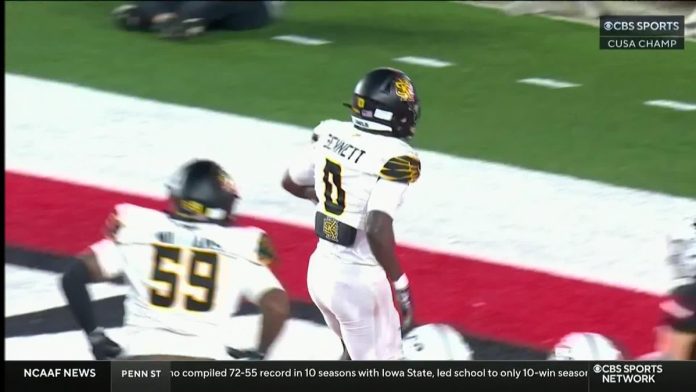
Kennesaw State running back Coleman Bennett scores a touchdown during a game.

Running back was largely a quiet position for the Chicago Bears this offseason. That isn’t a surprise after how well D’Andre Swift and Kyle Monangai played last season. Both are coming back this year. Both are still relatively young. There doesn’t seem to be much of a reason to mess with a good thing. That said, head coach Ben Johnson does have a considerable depth issue to address. Travis Homer departed in free agency, leaving the #3 spot uncertain. Roschon Johnson remains an option, but he struggles to stay healthy. Brittain Brown flashed in the preseason last year. Deion Hankins did as well, but he’s coming off a knee injury. That is where the arrival of Coleman Bennett becomes interesting.

At first glance, there wasn’t much to react to. He was an undrafted free agent out of Kennessaw State. After standing out as a versatile running back and return man at Bucknell, he vanished for a season at Rice before finally getting a real opportunity last season. He responded by leading the team in total yards from scrimmage with 1,074, including 764 rushing and 314 receiving. However, those weren’t the numbers that likely drew head coach Ben Johnson’s attention. It was his remarkable ability to stay on his feet.

Coleman Bennett has a crucial trait Johnson loves.

Contact balance is something not always mentioned as a key trait for running backs. Most people focus on speed, agility, vision, and power. Footwork and balance are a bit lower on the list. Not for Johnson. He’s shown for years that he wants running backs who never go down on the first tackle attempt. The more they can squeeze out of every carry, the better. That is why he pushed the Detroit Lions to sign David Montgomery in 2023 and drafted Monangai last year. Both share the same trait.

It doesn’t take long to see that Bennett is the same way. There are examples littered across his tape. He constantly keeps his legs churning, fighting through tackles. He also uses his arms to keep defenders off him at every opportunity. Without the benefit of truly breakaway speed, this is a mentality Bennett knew he’d have to embrace if he wanted to excel at the position. We already know Johnson loves speed, but is willing to make exceptions at running back if the player runs hard and doesn’t go down easily.

Bennett has a clear lane to the main roster.

Don’t be fooled. Right now, the only real obstacle is Johnson. The primary reason for that is his special teams ability. That is why Travis Homer held the third spot last season. So if Coleman Bennett wants to fulfill Johnson’s expectations, he must put his versatility to good use and find a way to stand out on special teams. His return ability could be a huge factor in that. While Zavion Thomas is the obvious favorite for that role, the Bears will be looking for backup options as well. The more useful you can make yourself out to be, the better your odds of earning a spot.

There is no doubt Bennett will be one of the most interesting names to follow in training camp. Running backs typically don’t stand out until the pads go on. Until then, the best thing for him to do is absorb the playbook as much as possible and do everything asked of him. There is no room for sitting in his comfort zone. Try everything. The young man doesn’t lack resilience. That will come in handy as the summer unfolds.
The Real Reasons Behind The Chicago Bears Latest Barrage Of Roster Additions

chicago bears
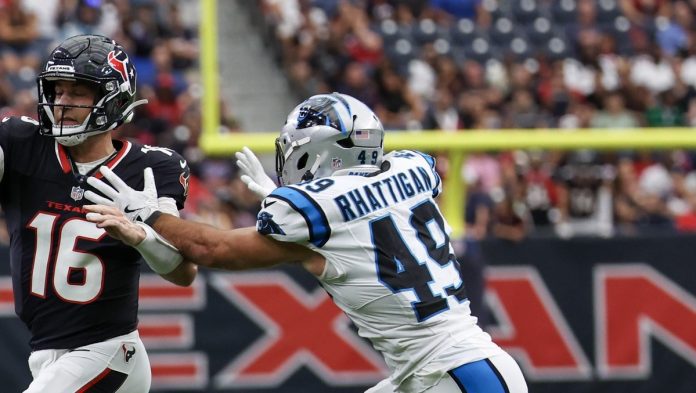
Aug 16, 2025; Houston, Texas, USA; Houston Texans quarterback Kedon Slovis (16) passes against Carolina Panthers linebacker Jon Rhattigan (49) in the second half at NRG Stadium. Mandatory Credit: Thomas Shea-Imagn Images

Coming out of the rookie minicamps last week, it seemed like the Chicago Bears were content with adding only one player to the roster as they prepare for the next phase of spring practices next month. That was veteran wide receiver Scotty Miller, who looked sharp across two days of work. It made sense. Chicago’s receiving corps got a lot younger this offseason with the departures of D.J. Moore and Olamide Zaccheaus, while rookie Zavion Thomas arrived via the draft. Miller, along with Kalif Raymond, would give them some much-needed experience.

So you can imagine the surprise when news came down the pipeline that the Bears had not only signed three other players in addition to Miller, but also saw one of their undrafted free agents abruptly retire. The three names included undrafted wide receiver Kyron Hudson, undrafted linebacker Wayne Matthews III, and veteran linebacker Jon Rhattigan. Conversely, Florida State wide receiver Squirrel White chose to retire after minicamps concluded. The only information available on that is that he left the field with a trainer at one point, indicating he must’ve suffered an injury.

Either it was serious enough to be career-ending, or it was enough to convince him that football was no longer worth it. Regardless, it helps explain why the Bears looked to add some extra bodies at wide receiver.

The purpose of these Chicago Bears moves is easy to see.

Hudson wasn’t brought in because the team felt he was overlooked. In truth, he had a rather unremarkable college career, serving as a third- or fourth-option for most of it. The primary reasoning for his addition is his relationship with Caleb Williams. The two were teammates for two years in 2022 and 2023. Hudson caught five touchdowns during that period. It feels like the Bears wanted to bring in someone Williams is familiar with, helping make the long training camp grind more comfortable later this year.

As for Matthews III and Rhattigan, the intent is more straightforward. They are special teams additions. Rhattigan has carved out a nice career as a special teams player, collecting 28 tackles in the last five seasons. The Bears are always looking for contributors on that front. Matthews III always showed potential in those areas, posting seven tackles in just ten games in 2022 alone. No doubt special teams coordinator Richard Hightower saw enough to add them to the mix for July.

This is where Ryan Poles deserves some credit.

While the Bears’ general manager has his faults, one thing you can’t say is that he ignores the special teams. He has been great about consistently feeding that unit with dependable players since he took over in 2022. Josh Blackwell, Daniel Hardy, Elijah Hicks, Jonathan Owens, Jaylon Jones, and Carl Jones Jr. were all additions he made with that in mind. It is nice to see he hasn’t shirked that responsibility. After all, the Bears don’t make the playoffs last year without some huge plays on special teams.

At first glance, Rhattigan is probably the name to watch out for in that group. He has the most experience and plays a position at which the Chicago Bears could use some depth. Miller has a good chance to win a roster spot on offense, though he may have to show some special teams value as well. All of this is a reminder that roster-building isn’t exclusive to just the draft and free agency. Good teams constantly churn the bottom of the depth chart, looking for help everywhere.

The White Sox Have Unexpectedly Struck Gold With Recent Move

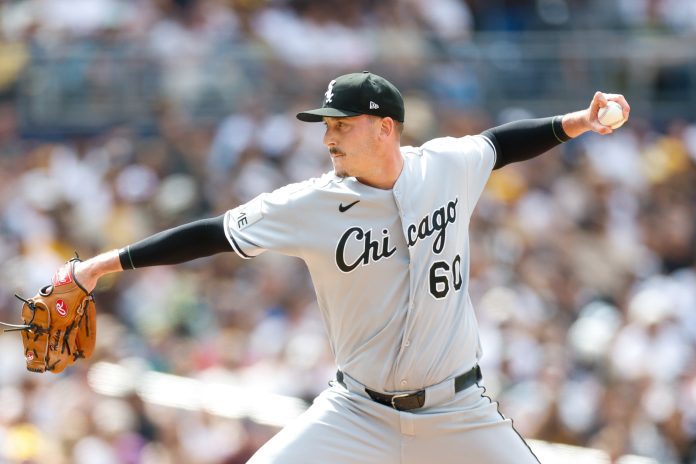
May 3, 2026; San Diego, California, USA; Chicago White Sox relief pitcher Bryan Hudson (60) throws a pitch during the eighth inning against the San Diego Padres at Petco Park. Mandatory Credit: David Frerker-Imagn Images

When the White Sox claimed left-handed pitcher Bryan Hudson off waivers from the Mets in late March, it didn’t generate much of a reaction from fans. It was a minor move that felt more like added depth than anything else. A little more than a month later, that perception has changed dramatically. He has paid massive dividends in the early going and looks to be one of the better moves Chris Getz made this offseason.

Rollercoaster Career Arc

What makes Hudson’s success interesting is that this is not the first time he has been good at the MLB level, nor is it even his first stint with the White Sox. In 43 appearances with the Brewers in 2024, he put up a 1.73 ERA, 0.72 WHIP, and 9.0 K/9, allowing 28 hits in 62.1 innings and becoming one of the more dominant lefty relievers in the game. He looked to be a key bullpen piece for Milwaukee until he fell on hard times the following season. His walk rate spiked at the start of 2025 and he quickly fell out of favor. The Brewers ultimately designated him for assignment last July, with the White Sox claiming him off waivers shortly after. He made just four appearances with the Sox last season before getting DFAed again as the corresponding move for the Austin Hays signing.

Recent Resurgence With White Sox

Hudson’s second stint with the White Sox has gone much differently. After allowing a run in each of his first two appearances to start the season, he has since made 18 consecutive scoreless appearances. His ERA is now below 1.00 for the season and he ranks among MLB’s best in advanced metrics like barrel%, hard-hit%, ground ball%, and extension. He is also tied for fourth in MLB in appearances with 20, pitching in exactly half the White Sox games so far this season. He has quickly become the most trusted left-hander for Will Venable out of the bullpen, even more so than free agent signing Sean Newcomb.

Unique Traits

Hudson is an fascinating player for multiple reasons. The most obvious is his size. At 6-8, he is one of the tallest pitchers in the league. Yet despite his towering frame, he is not a hard thrower. He averages just 91.7 MPH on his four-seam fastball, nearly two MPH slower than the average lefty. Even without overpowering stuff, he has experienced a lot of success this year while throwing his four-seamer 59% of the time.

His success comes from deception and pitch mix rather than pure velocity. Hudson pairs his fastball with a sweeper that consistently keeps hitters off balance. His arm angle is reminiscent of Chris Sale and makes him very deceptive. He is also one of the best in baseball in terms of extension, meaning his fastball appears faster than it actually is. It’s tough for hitters to pick up the ball out of his hand.

Hudson credits his resurgence to improved mechanics and confidence. It’s also not a coincidence that current White Sox bench coach Walker McKinven was in Milwaukee when Hudson had his best stretch with the Brewers.

Potential Gem

Relievers are volatile. Hudson’s career path is proof of that. He seems to have recaptured the magic he had in 2024 though and has quality become an integral part of the White Sox turnaround in the early going. If he can keep this going, he could be on the South Side for a while.

Chicago Cubs Pitching Reinforcements Suffer Setbacks

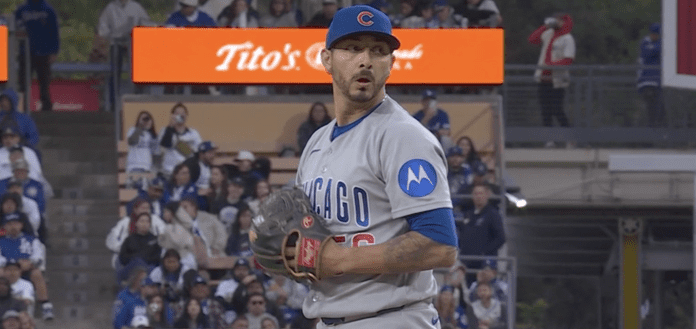
Man, oh man, this is getting ridiculous. Now the backups to the backups are even getting hurt for the Chicago Cubs. Cade Horton has already been ruled out for the rest of the year after undergoing Tommy John surgery, and then last week, Matthew Boyd needed surgery on his left meniscus. Fortunately, Boyd will miss only about six weeks of action, as the Cubs hope to get the veteran back before July. The depth has already been tested, and the situation isn’t getting any better because two more pitching reinforcements suffered injury setbacks.

First, Kyle Wright was ramping up in Arizona, as the former 21-game winner for the Atlanta Braves continued his rehab with the Cubs after signing a minor league deal in the offseason. According to The Athletic’s Sahadev Sharma, Wright was about to head up to Triple-A Iowa after pitching four innings and hitting 96mph with his fastball. However, the right-handed pitcher didn’t recover well, and felt pain in his shoulder last weekend.

So, if you were excited about or were just wondering what happened to Wright, it’s more shoulder issues for the 30-year-old. He had surgery on his pitching shoulder in Oct. 2023, which forced Wright to miss the entire 2024 season. Wright threw 23 innings in the Kansas City Royals’ minor league system last year, but he suffered from shoulder fatigue and an oblique strain that further set him back.

Then, Vince Velasquez made his return to the Iowa Cubs last Friday after he was designated for assignment at the end of April. He re-signed with the organization last week and in his first game back since pitching in mop-up duty against the Los Angeles Dodgers, Velasquez went down with an undisclosed injury on Friday night.

Just an unreal run of bad luck for the Cubs this year with pitching injuries. Luckily, Ben Brown got another opportunity to step back into a starter’s role, and his first start in 2026 was outstanding for the 26-year-old.

The discovery of his new sinker has truly changed the type of pitcher that Brown is on the mound. He is generating a ton more ground balls while decreasing the hard contact against him, a major issue for Brown in 2025.

Brown will continue to increase his pitch count in the coming weeks, and hopefully, he continues to succeed while filling in for Boyd. It was already tough enough for the Cubs without Horton, but losing two of your starting pitchers can really derail a pitching staff, like we saw last year when Justin Steele and Shōta Imanaga were both on the injured list from early May through the end of June, before Imanaga was able to come back.

The Cubs are using Javier Assad in the bullpen after his handful of spot starts in April. So far, Brown and Assad have been extremely valuable as the organization’s main depth options in 2026, alongside Colin Rea.

Pressure is on as the reinforcements for the Cubs are seemingly nonexistent if there are any more injury concerns in the starting rotation.

Dennis Allen Said The Quiet Part Out Loud About The Bears’ Shift In Draft Strategy

dennis allen
May 8, 2026; Lake Forest, IL, USA; Chicago Bears defensive coordinator Dennis Allen walks on the field during Rookie Minicamp at Halas Hall. Mandatory Credit: Kamil Krzaczynski-Imagn Images

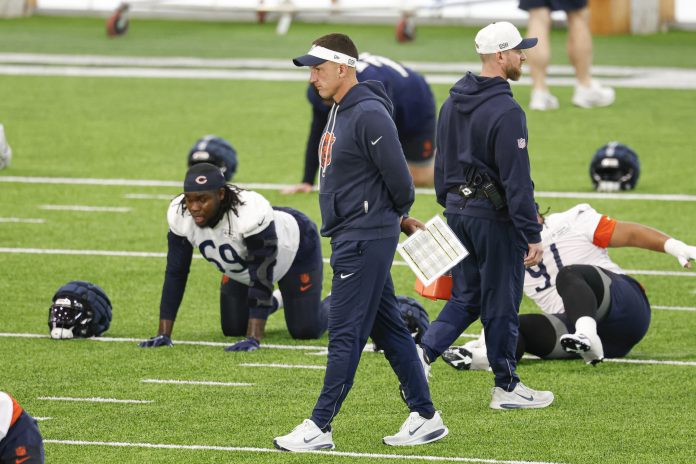
Something changed last year with the Chicago Bears. Most believed it was simply the arrival of head coach Ben Johnson on his staff, breathing some much-needed urgency into a deflated building. That was partly true. There is no question that the laser-focused coach set the tone from the moment he walked through the doors. However, another shift wasn’t noticed until a few months later. It took place during the NFL draft. Chicago, much to the surprise of onlookers, took players at positions that weren’t deemed glaring needs. A tight end? A wide receiver? It didn’t make sense, but it was all part of the plan. Dennis Allen just confirmed it.

When he arrived alongside Johnson last year, there was a consensus among everybody in the building that the scouting process had to change. For too long, the Bears were focused on how physically gifted players were and whether they filled a key roster need. Allen revealed in his recent presser that such an approach was no viable. Moving forward, there would be less of a focus on player measurables and more on on-field performance. Tape and football character will drive the draft process.

“We’re looking for smart players, we’re looking for tough players, we’re looking for highly competitive players,” Allen said. “There was a decrease in ‘what’s the 40 time, what’s the height, what’s the weight, what’s the athletic movement skills?’ And it was, ‘Are they above the line athletically?’ Alright, and then let’s watch the tape and let’s let their football character bleed off the tape. Every one of our players that you look at, they have great football character, and it bled off of the tape at us.”

Dennis Allen finally admitted what had been speculated for a while.

This pretty much confirms that Johnson is now guiding the talent-acquisition process. Between 2022 and 2024, when it was clearly general manager Ryan Poles who ran the show, the focus was on physical upside. That isn’t shocking. NFL scouts, by nature, focus on such things. They become enamored with what a player can become. Coaches, by contrast, are more interested in who a player is. Upside is important, sure, but they don’t like taking gambles on guys who haven’t shown much of anything on tape.

It was much the same this year. Dillon Thieneman checked the athletic boxes to be sure, but it was his excellent film from his final season at Oregon that swayed the Bears to leave their comfort zone. Remember, they hadn’t drafted a safety in the 1st round in 36 years. Logan Jones, a 25-year-old center, went in the 2nd round because he started 51 games at a top program and oozed the type of football passion the team craved. Dennis Allen made sure this approach stayed the course with Malik Muhammad and Keyshaun Elliott in the 4th and 5th rounds as well.

It is possible Allen wasn’t on board with this at first.

If you look back at the 2025 draft, it felt like the Bears leaned a bit more into the physical upside approach. That was certainly the case with linebacker Ruben Hyppolite and cornerback Zah Frazier. Now one is a little more than a special teams backup, and the other was just cut. Such setbacks may have pushed the veteran coordinator to shift more towards Johnson’s way of thinking. Already, there is serious buzz building around Thieneman and Muhammad in rookie minicamps.

The harsh truth is that the upside strategy only works if you have two things: an excellent coaching staff and a roster full of established veterans who could show the young guys how to be professionals. The Bears had neither through those first three years of Poles’ tenure. Rather than double down on it after Johnson arrived, the team chose to focus more on strong tape and productivity. The result was one of their best draft classes in years in 2025. If they find similar success in 2026, this team is poised for big things.

Wild Stat Shows Duality Of Chicago White Sox Pitching Staff

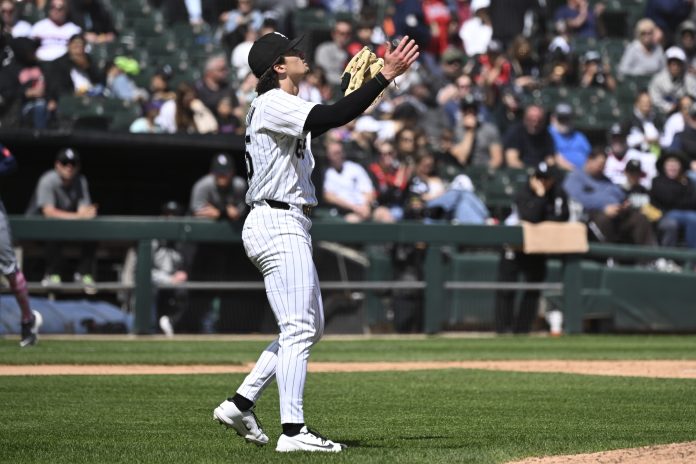
May 10, 2026; Chicago, Illinois, USA; Chicago White Sox pitcher Davis Martin (65) after closing out the sixth inning against the Seattle Mariners at Rate Field. Mandatory Credit: Matt Marton-Imagn Images

Forty games into the MLB season, the Chicago White Sox are giving fans hope. 

The American League is wide open, with just four teams owning winning records. Despite sitting two games under .500, the White Sox 19-21 record has them just one game out of first place in the American League Central and holding the final American League Wild Card spot.

This comes as the AL Central favorite, the Detroit Tigers, are going to be without their ace, Tarik Skubal, for several weeks, leaving the door ajar for the White Sox. While playoff aspirations remain a long shot, the White Sox pitching staff has kept them in the mix. 

The White Sox starting rotation has been the backbone of their early-season success, posting a 3.97 ERA that ranks 10th in the MLB. The rotation has been led by Davis Martin, whose 1.62 ERA is the second-best mark in the majors.

The bullpen has also delivered consistent production behind him. Bryan Hudson (0.95 ERA), Grant Taylor (2.29), Sean Newcomb (3.18), and Seranthony Domínguez (3.45) have all kept their ERAs under 4.00, with Domínguez tied for seventh in the MLB in saves.

How long that is going to be sustainable is yet to be seen, but the early results, paired with a top-ten scoring offense, have given the White Sox multiple ways to win games. 

But oddly enough, the White Sox pitching staff seems to perform better without run support. 

In the 14 games, the offense has scored between 3 and 5 runs the pitching staff owns a 2.92 ERA. In the 14 games, the offense put up six-plus runs the team ERA increased to 4.13.

Despite posting a 5.21 ERA in the 12 games when the offense has scored two runs or fewer, the pitching staff is still averaging its highest strikeouts per nine innings and is allowing its fewest home runs. That 5.21 mark is also skewed by Shane Smith’s early-season struggles before his move to Triple-A Charlotte, when the right-hander allowed 10 earned runs across his first two starts and forced the bullpen to cover 11.1 innings.

That statistical anomaly was on full display over the weekend against a Seattle Mariners team that many had as a World Series contender entering the season. The White Sox scored eight runs on Friday, tied for their third-highest output in a game this season. But despite racking up ten hits, the White Sox found themselves on the wrong end of an 11-8 loss to the Mariners. 

The eight-run outburst matched the team’s combined total from the final two games of the series, which included one of Chicago’s signature wins so far this season, a 2-1, come-from-behind victory Sunday. It was the kind of game the White Sox would have likely lost a year ago. The offense managed just five hits and went scoreless through seven innings, but the pitching kept them alive.

Davis Martin delivered again, tossing six innings of one-run ball, while Sean Newcomb and Bryan Hudson held the Mariners in check to give Chicago a chance entering the bottom of the eighth. 

The offense finally broke through with a mix of power and small-ball. Newly acquired Randal Grichuk delivered a game-tying home run, and Drew Romo followed with a double to put the go-ahead run in scoring position.

Sam Antonacci then dropped down a key sacrifice bunt to move Romo 90 feet away, setting up a Miguel Vargas sacrifice fly. Despite the ball traveling less than 250 feet into shallow left field, third base coach Justin Jirchele opted to test the arm of Mariners left fielder Randy Arozarena. Arozarena rewarded the White Sox aggressive baserunning by air-mailing the throw home, allowing the go-ahead run to score. Seranthony Domínguez wiggled out of a ninth-inning jam to secure his ninth save and a 2-1 White Sox victory.

What Would It Take For The Chicago White Sox To Extend Murakami? 

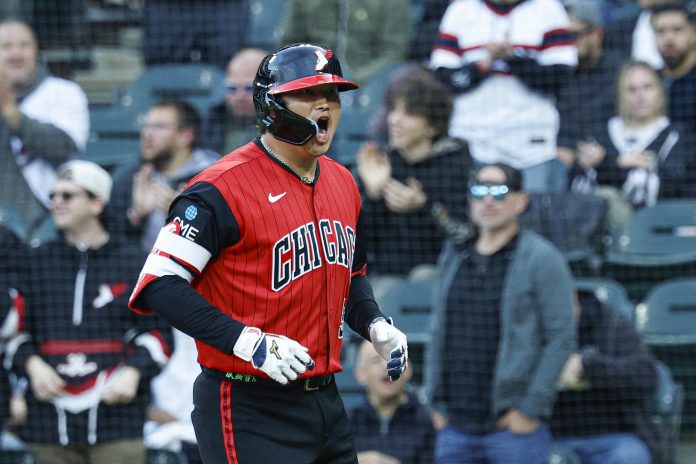
May 8, 2026; Chicago, Illinois, USA; Chicago White Sox first baseman Munetaka Murakami (5) reacts after hitting a solo home run against the Seattle Mariners during the first inning at Rate Field. Mandatory Credit: Kamil Krzaczynski-Imagn Images

After taking MLB by storm, Munetaka Murakami has quickly positioned himself for a massive payday. 

Just seven weeks into the season, the White Sox rookie has already posted a .920 OPS, 1.2 WAR, and launched 15 home runs, the second-most in MLB. As a result, the White Sox have seen a spike in national attention, along with increased viewership from fans in Japan following the former NPB single-season home run king.

The increased exposure is good for business, something that is sure to pique the interest of White Sox owner Jerry Reinsdorf, who reportedly needed persuasion from the team’s marketing department before approving Murakami’s two-year, $34 million deal this offseason.

At this point, Murakami has exceeded many industry expectations. Despite a high strikeout rate, he’s drawing walks at a 17.3% clip and ranks near the top of the league in barrel rate, expected slugging, average exit velocity, and hard-hit percentage, production that’s helped drive strong demand for his jerseys. With the MLB’s top two jersey sale leaders, both coming from Japan, Murakami could soon see his name climb up that list. 

However, some fans in Japan have said they’re hesitant to make the trip to Chicago this season out of concern that the White Sox could move him. While reports suggest a trade is highly unlikely, the White Sox may be wise to explore locking up a potential star who more or less fell into their lap this offseason.

Last week, ESPN 1000’s Carmen DeFalco reported that league sources believe conversations are already underway regarding a possible extension for Murakami. DeFalco also noted the White Sox would be willing to move into the range of a four-year, $100 million deal, which would make him the highest-paid player in franchise history.

However, DeFalco added that he was told Murakami would not accept that type of offer. That leaves a major question hanging over the situation: what would it actually take for the White Sox to lock up Munetaka Murakami long term?

Murakami draws frequent comparisons to Kyle Schwarber, another three-outcome power hitter who lives off walks, strikeouts, and home runs. 

Schwarber signed a five-year, $150 million deal with the Phillies, but has a much longer track record. The White Sox have realized what they have stumbled into with Murakami, who has received rave reviews about his work ethic and dedication to the game. That work ethic is one of the reasons that the White Sox believe the early returns have been no fluke. 

But there are still some red flags, which is why extending a similar offer to Murakami is unlikely at this point. The 26-year-old has done the bulk of his damage this season in the first game of a series, which suggests teams are adjusting to him. He is also striking out at a 34% rate, which profiles similarly to Joey Gallo, another three-outcome hitter, who owned a career 38% strikeout rate. 

Following an All-Star season in which he hit 38 home runs, the highest contract Gallo ever received was a one-year $10 million deal with the New York Yankees. Unlike Gallo, Murakami’s underlying metrics suggest a higher offensive floor, as he is on pace for a higher batting average and more homers. But unlike Gallo, he also does not provide value as an above-average defender. 

When looking at player contracts, the AAV is more important to most players than the actual total value of the contract. With the White Sox reportedly willing to offer him an AAV of $25 million over four years, it’s hard to believe that a Reinsdorf-owned team will go above the $30 million AAV Schwarber has. 

Currently, the top five highest-paid first basemen in MLB carry an average annual value of about $27 million. If the White Sox were to structure a five-year deal at that rate, it would make Murakami the seventh-highest-paid first baseman in the game, just below Pete Alonso’s five-year, $155 million contract with the Baltimore Orioles. It would also line up Murakami to reach free agency at age 33, positioning him for one more payday.

On paper, that framework looks reasonable for both sides, especially for the White Sox, who would only need to go roughly $3 million per year above what they were initially rumored to be considering. But if Murakami is unwilling to sign at that level, it becomes difficult to justify pushing much further this early in his MLB tenure.

Murakami does appear to be settling in well on the South Side, and a longer-term deal could ultimately be in play. Matt Olson’s eight-year, $168 million contract, with a $21 million AAV, could serve as a realistic blueprint. Olson is the more complete player at this stage of his career, but even if Murakami never quite reaches that level of production, his offensive upside and marketing appeal could still help bridge the gap in value over the life of a deal.

Justin Ishbia, who is waiting in the wings to take over as owner, is also part of the equation. Ishbia has shown a willingness to spend aggressively in free agency as a co-owner of the Phoenix Suns, and securing Murakami long-term would only increase the value and appeal of his White Sox investment.

It’s a unique and unenviable position for the White Sox, who are watching Murakami’s value climb by the day as he continues to mash baseballs. But after being burned by early extensions with players like Luis Robert Jr., Yoán Moncada, and Eloy Jiménez, it’s understandable why the organization would approach another long-term commitment with caution.

White Sox ABS Struggles Putting Edgar Quero Under Microscope

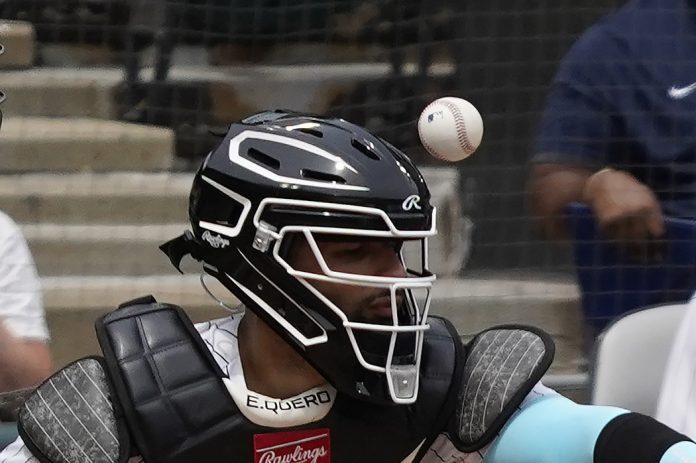
Jul 13, 2025; Chicago, Illinois, USA; Chicago White Sox catcher Edgar Quero (7) takes a foul ball off his mask during the fourth inning against the Cleveland Guardians at Rate Field. Mandatory Credit: David Banks-Imagn Images

On May 2 in San Diego, Edgar Quero faced a pivotal decision behind the plate. With the Chicago White Sox protecting a four-run lead in the bottom of the ninth, the Padres loaded the bases with former White Sox outfielder Gavin Sheets representing the tying run with nobody out.

Facing a 2-2 count, White Sox reliever Grant Taylor snapped off an 84 mph belt-high curveball that clipped the edge of the strike zone, which was called a ball. Quero immediately tapped his helmet to initiate an ABS challenge, and replay confirmed the pitch had indeed caught the zone, turning a dangerous full-count situation into a critical strikeout looking.

The successful high-leverage challenge not only secured the first out of the inning but also cut the Padres’ win probability by 12 percent in a game the White Sox ultimately won 4-0.

Unfortunately for the White Sox and Quero, these types of moments have been few and far between. The White Sox rank first in the MLB in defensive ABS challenges lost this season, and Quero has been a major reason why.

Much has been made about Quero’s struggles in the batter’s box, but the 23-year-old is having an equally tough time behind the plate. His four errors are the most of any American League catcher, while his pitch framing and -4 blocks above average, each ranking in the bottom 20 percent of the league.

While pitch framing has taken on a smaller role this season with the emergence of the ABS challenge system, it remains a critical part of the game. The more borderline strikes a catcher can steal,  especially early in games, the more pressure it puts on opposing hitters, who are often hesitant to burn a challenge in lower-leverage situations.

But Quero hasn’t just struggled to steal strikes; he’s also had trouble identifying them. In 42 ABS challenge opportunities, Quero has successfully overturned just 18 calls, good for a 43% success rate that ranks among the worst in baseball. In fact, his 24 unsuccessful challenges are the most among the 79 catchers who have appeared in an MLB game this season.

It’s one of the reasons the White Sox have lost the most defensive challenges in the MLB so far this season, at 36. But Quero isn’t the only issue. The White Sox as a whole have struggled to adjust to the ABS challenge system. On the offensive side, White Sox hitters have only won 15 challenges, once again the fewest in the MLB.  

The White Sox have managed to hover around .500 despite their struggles with the ABS, but it is becoming clear that Quero is becoming a detriment. Despite spending the offseason working to improve his launch angle and bat speed at the Driveline facility in Arizona, the White Sox catcher has stumbled out of the gate.

Nearly 100 plate appearances into the 2026 season, he is failing to hit the ball hard, has yet to hit a home run, and is posting a pedestrian .642 OPS.

Quero still possesses one of the most valuable skill sets in baseball as a switch-hitting catcher. So while the White Sox would be unwise to give up on the 23-year-old, it may be time for a reset in Triple-A, especially with Drew Romo emerging and Kyle Teel nearing a return.

It would be one thing if the struggles were confined to the batter’s box, but the defensive metrics have become increasingly difficult to overlook. With the American League wide open and the White Sox suddenly in the thick of the playoff race in a weak AL Central, Chris Getz has already shown the organization is prioritizing production over potential. That was evident when the team designated hard-throwing right-hander Jordan Leasure for assignment. Like Quero, Leasure possesses plenty of upside, but inconsistent performances ultimately began costing the White Sox games.

How much longer of a rope Quero will have is yet to be seen, but once Teel, who has already begun a rehab assignment, is ready to return, the White Sox could be forced to make a decision on the former top-100 prospect.

Should the Blackhawks Target a Veteran Goaltender This Offseason

Possible Chicago Blackhawks starting goalie Sergei Bobrovsky
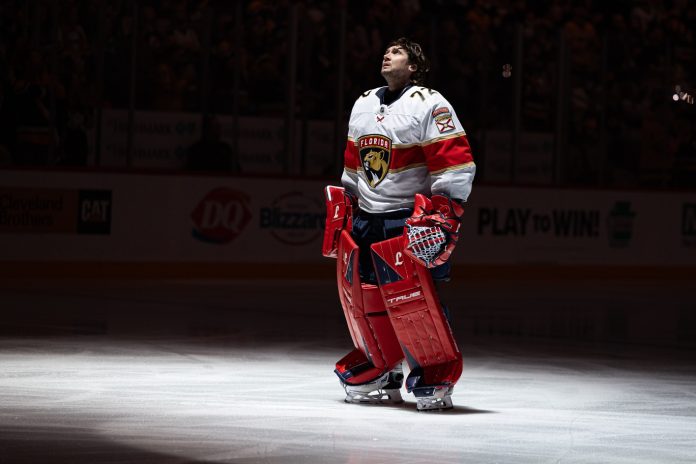
Apr 4, 2026; Pittsburgh, Pennsylvania, USA; Florida Panthers goalie Sergei Bobrovsky (72) looks on against the Pittsburgh Penguins before the first period at PPG Paints Arena. Mandatory Credit: Mark Alberti-Imagn Images

The Chicago Blackhawks have made enormous strides in their rebuild over the last two seasons. The forward group is loaded. The blue line is young and improving. The culture under Jeff Blashill is moving in the right direction. But there is one position that has quietly remained unresolved throughout the entire process, and it is the one position that can single-handedly derail a contending team faster than any other.

Goaltending.

Chicago enters the 2026 offseason with Spencer Knight as the established frontrunner in net after a solid first full season with the team, while Arvid Soderblom and Drew Commesso battle for the backup role. and neither has fully seized the crease in the way the organization needs them to. Soderblom has shown flashes of competence and brings a calm, technically sound game that fits Blashill’s structured system, but he has not demonstrated the consistency required to be a true number one on a team trending toward playoff contention. Knight, acquired from the Florida Panthers, carries undeniable talent and genuine upside, but his development has been slower and more uneven than anyone anticipated when he was taken 13th overall in 2019.

Heading into the 2026 offseason, the numbers from Chicago’s young goaltenders in 2025-26 tell a story of uneven progress and ongoing uncertainty. Spencer Knight, in his first full season with the Blackhawks, appeared in 55 games and posted a respectable .902 save percentage with a 2.82 GAA. He finished with a 19-25-11 record and added three shutouts. While Knight showed flashes of the high-end talent that made him a top prospect, his win-loss record reflected the team’s defensive and offensive inconsistencies more than individual shortcomings.

Arvid Soderblom, meanwhile, struggled to build on previous promise. In 26 games (24 starts), he managed just an .880 save percentage and a bloated 3.80 GAA, going 8-13-3 with one shutout. His regression opened the door for Knight to take the majority of the workload and allowed Drew Commesso to make a brief but strong impression in limited action.

These results underscore the central dilemma facing the organization: Knight has taken a meaningful step forward and looks like the frontrunner for the No. 1 job, but neither young netminder has yet delivered the consistent, high-level performance required to reliably support a team pushing toward playoff contention.

The question facing Kyle Davidson this offseason is whether he trusts that one of those two players takes a significant step forward in 2026-27, or whether the rebuild is far enough along that adding a proven veteran presence in net is the responsible move.

The Free Agent Market

The timing of this conversation is relevant because the goaltending market this offseason is unusually interesting. Three names worth examining are Stuart Skinner, Sergei Bobrovsky, and Vitek Vanecek, each of whom represents a different kind of solution depending on what Chicago is actually looking for.

Skinner is an intriguing option. Still just 27 years old, he has starting experience on a legitimate contender in Edmonton and knows what playoff hockey demands from a goaltender. After the Oilers moved on, he landed in Pittsburgh, where he has continued to log starts and build on his experience behind an organization that has been navigating its own transitional period. His numbers have been inconsistent across both stops, but the underlying talent is real and the resume of a goaltender who has faced genuine playoff pressure at a young age carries value. Skinner on a reasonable term deal gives the organization a capable starter who is young enough to grow alongside the core if they decide to move off of Soderblom.

Bobrovsky is the most established name on the market, but also the most complicated. At 37, he is coming off a very disappointing season with a Florida Panthers team that collapsed badly after back-to-back Stanley Cup wins, finishing with a mediocre 40-38-4 record and missing the playoffs entirely. Despite his reputation as a technically gifted goaltender with a strong resume, Bobrovsky himself posted a career-worst .877 save percentage and 3.07 GAA. He is not a long-term solution, but a one- or two-year bridge deal that stabilizes the crease while Knight continue to develop, could be exactly what Blashill needs to buy time without sacrificing the future. There is also a personal connection worth noting: Spencer Knight spent around three seasons as Bobrovsky’s backup in Florida, and the two developed a genuine rapport during that time. Having a familiar, respected veteran presence in the locker room could accelerate Knight’s development in ways that are difficult to quantify but genuinely meaningful.

“He has all the ingredients to be one of the best goalies in the game, and I think he’s going to do that,” Bobrovsky said. “He’s going to achieve that.”

-Sergei Bobrovsky on spencer knight

Vanecek is the most team-friendly option. He is not a star, and he will not be mistaken for one, but he is a reliable, experienced NHL goaltender who can handle a starting role on a rebuilding team without demanding a long or high-priced contract. If Davidson wants to address the position without making a major financial commitment, Vanecek fills the gap at a reasonable cost.

The Case for Staying Internal

There is an argument to be made that Chicago should resist the temptation to spend on a veteran goaltender and simply let the competition between Soderblom and Knight play out. Both players are still young enough to develop into legitimate starters, and adding a big contract in net risks blocking the very player who might have emerged given consistent opportunity.

Knight in particular deserves consideration here. He was a high-end prospect for a reason, and the Florida system, one of the best goaltender development environments in the league, clearly saw something in him worth investing in. Blashill has shown throughout his coaching career that he is capable of developing young players in difficult situations, and there is a version of 2026-27 where Knight gets the net, the workload, and the coaching attention he needs to finally become the goaltender his draft position always suggested he could be.

Soderblom is a competitor who battles hard every night and fits the structure Blashill demands, but the numbers are difficult to ignore. He has not cracked a .900 save percentage, and in a system built around defensive responsibility and limiting high-danger chances, that is a problem. Work ethic and compete level matter, but they do not show up on the scoreboard, and at some point a goaltender has to deliver the numbers that justify the roster spot. Soderblom has not done that consistently enough to be considered a reliable option on a team that is ready to take the next step.

The Verdict

The honest answer is that even though the Blackhawks finished 2nd last in the league this season, they have reached the stage in their rebuild where real progress must begin. To take the next step, the team needs to get meaningfully better, and improving the goaltending position is usually the best place to start.

A one- or two-year deal for Bobrovsky makes the most sense. The Florida connection with Knight gives the signing a development dimension that goes beyond the on-ice production, and Bobrovsky’s Stanley Cup pedigree brings exactly the kind of winning culture Blashill is trying to establish in that locker room. He is not a permanent answer, but he does not need to be.

Why Dillon Thieneman Already Seizing Control Of The Bears Defense Is A Big Deal

dillon thieneman
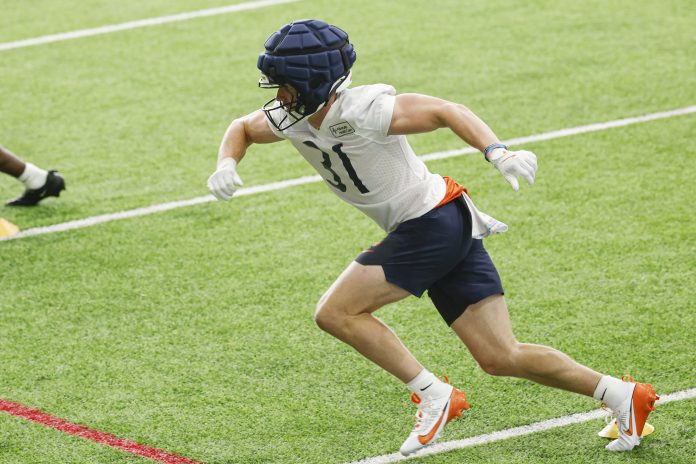
May 8, 2026; Lake Forest, IL, USA; Chicago Bears defensive back Dillon Thieneman (31) runs during Rookie Minicamp at Halas Hall. Mandatory Credit: Kamil Krzaczynski-Imagn Images

The Chicago Bears didn’t get cute with their 25th overall pick in the 2026 NFL draft. Head coach Ben Johnson and general manager Ryan Poles had agreed since they started working together that they would always take the best player on the board. Position didn’t matter. Get the best talent possible and worry about the rest later. When the Bears went on the clock, Oregon safety Dillon Thieneman stuck out. Many had expected he’d be gone somewhere between picks 12 and 18. His still being available was a surprise. The Bears didn’t need to think about it long, turning the card in.

It marked the first time the team had taken a safety in the 1st round since 1990. Their justification for it was fairly straightforward. Thieneman had good size for his position and is an elite athlete. His 4.35 speed shows up on tape constantly. He demonstrated a great mix of intelligence, instincts, and physicality. However, one thing that sometimes went overlooked about him was his leadership. It is rare for a safety to be the semi-quarterback of a defense, but Thieneman played that role for Oregon. Based on what Herb Howard of The Bigs saw at rookie minicamps, he’s already doing the same for the Bears.

Dillon Thieneman thrives as an adjuster.

His college coaches compared him to Brian Urlacher. Though not a linebacker, he was that guy who could read what an offense was doing pre-snap and get everybody lined up in the right spot. It was a big reason why Oregon had the 12th-ranked defense in the country in 2025, including 4th against the pass. The Bears have had some good safeties over the past several years. Recently departed Kevin Byard was one. Eddie Jackson and Adrian Amos were the other two. However, none of them ever established themselves as that vocal leader everybody listened to.

The last player who fit that role for the Bears was probably Mike Brown. While Urlacher may have been the pillar around which the team was built, he repeatedly insisted that Brown was the real brains behind the defense. You saw it all the time during his peak years from 2001 to 2005, as he constantly communicated to teammates where the ball was going. When he was healthy, the defense was elite. It is why the injuries that shortened his career were so difficult to accept. Thieneman appears built for that same role.

Thieneman wants that leadership role.

People must understand that this is not normal. Rookies almost never move to take over command of a unit so quickly. They’re in a new environment and trying to process tons of new information. Most are content to hover in the background, stay quiet, and do their jobs. The leadership thing can come later. Not for Dillon Thieneman. Like any self-respecting control freak, he can’t feel at home unless he’s conducting the orchestra. The pressure of that responsibility doesn’t even register with him. It is as natural as breathing.

We can talk about the speed, athleticism, and ball skills all day. What will likely make Thieneman a great player in Chicago is the thirst to be that voice. He commands attention and is willing to accept blame when things go wrong. You don’t always find that in safeties, let alone rookies. It is another reminder that the Bears made the right decision by taking him despite grumblings about positional value.