Aug 9, 2025; Baltimore, Maryland, USA; Baltimore Orioles pitcher Corbin Martin (48) throws during the fifth inning against the Athletics at Oriole Park at Camden Yards. Mandatory Credit: Daniel Kucin Jr.-Imagn Images
As much as I’ve lauded the Cubs for the work they’ve done by bringing in pitchers on minor league deals or cheap free agent contracts that have actually produced good results out of the bullpen it doesn’t mean this method will always work. It’s been a little different this offseason as the team has addressed the bullpen with several veterans on free agent deals, but as any smart team would, the Cubs have continued to make under the radar signings hoping to find another hidden gem.
Brad Keller is probably the biggest success story in this department as the veteran pitcher hit rock bottom in 2024, but he worked on adjustments during his time with the Boston Red Sox and then signed a minor league deal with the Cubs. Keller won a job in the bullpen thanks to an outstanding performance in spring training and after beginning the year as a middle reliever he ended the season closing out playoff wins for the Cubs.
The Philadelphia Phillies signed Keller to a two-year, $22 million contract this offseason, adding him as their set-up man. Although the Cubs didn’t re-sign Keller, they can point to him as a blueprint for future projects. According to one insider, the Cubs believe they might have their next Brad Keller after signing Corbin Martin to a minor league deal.
Heavy cut four-seam sits 95 mph.
Orioles nixed his sweeper for a “death-ball” curve early last season (which became his best Stuff+ pitch). Good bet to add a sinker.
Poor results overall, but Cubs have had a lot of success with these heavy cut-fastball types.
Martin, 30, pitched for the Baltimore Orioles in 2025, and similar to Keller, the overall results were poor. Martin made 17 appearances with the Orioles and recorded a 6.00 ERA in 18 innings of work. He broke into the majors with the Houston Astros in 2019, when he made five starts in his first MLB stint.
The right-handed pitcher underwent Tommy John surgery, but as a top-100 prospect heading into 2019, Martin still had plenty of value that allowed the Astros to include him in a trade for Zack Greinke. Martin only pitched in 12 total games with the Arizona Diamondbacks from 2021-22, and missed all of 2023 after having shoulder surgery.
It’s been a long road back for Martin, but the Cubs seem to love what he’s capable of doing and despite the limited innings and bad numbers last year, Ari Alexander is hearing that the Cubs think Martin can also follow in Keller’s footsteps.
Alexander, who was previously a news anchor and sports reporter in Houston, hinted at the Martin signing a day before it was reported and added an exciting wrinkle to the upcoming move.
Including Colin Rea and Caleb Thielbar, who are returning from last year’s bullpen, the Cubs have signed six free agent relievers this offseason. Of course, injuries can occur from now until Opening Day and it’s unrealistic to believe that every pitcher will stay healthy, so Martin should get a shot at winning a roster spot out of spring training despite all the relievers the team signed to guaranteed deals.
Hoping for a lot of this from Corbin Martin in 2026. He came to an organization that loves to optimize pitchers with his similar cutty-fastball/supinator profilepic.twitter.com/uimCeYgkdF
Can Martin finally reach his potential? If there’s one team that has shown they can revive a career it’s the Cubs, so his chances are probably higher with this organization than most.
May 7, 2025; Boston, Massachusetts, USA; Boston Red Sox third baseman Alex Bregman (2) runs the bases after hitting a solo home run against the Texas Rangers during the fourth inning at Fenway Park. Mandatory Credit: Brian Fluharty-Imagn Images
You have to go back to last offseason, when Boston did go all out for Bregman and gave him $40 million guaranteed for one year, in a three-year, $120 million contract that also gave him the opportunity to opt out. By signing Bregman, the Red Sox had to give up their second round pick in the 2025 MLB Draft and lost $500,000 in international free agent bonus pool money after Bregman rejected the qualifying offer from the Houston Astros.
Bregman’s addition created a bit of an awkward situation in Boston’s infield. Heading into the 2023 season, the Red Sox signed Rafael Devers to an 11-year extension worth $331 million, making him their primary franchise player. Devers was resistant to changing positions after the arrival of Bregman, but he did. Then, on June 15, 2025, Boston traded Devers to the San Francisco Giants.
In that deal, the Red Sox received Jordan Hicks, Kyle Harrison and two prospects, James Tibbs III and Jose Bello, as Boston essentially traded Devers as a salary dump. By the way, the Red Sox ended up trading Tibbs a month later in a package to the Los Angeles Dodgers for right-handed pitcher Dustin May. The starter only made six appearances for the Red Sox in the final two months of the regular season, posted a 5.40 ERA in 28.1 innings and missed almost all of September because of an elbow injury. May did not return to Boston this offseason and instead signed a one-year deal with the St. Louis Cardinals.
So, the Red Sox signed Devers to a long extension, a new front office led by Craig Breslow was established. Bregman was signed, you got dinged because he was attached to a qualifying and then Devers was shipped out along with his salary. Bregman then opts out after year one of his deal, but surely the Red Sox would do everything possible in order to re-sign the third baseman, right?
Uhhhh, apparently not.
Earlier this week we recapped how the Cubs did step up to the plate and went out of their comfort zone to eventually agree to a deal with Bregman. However, it certainly appears as though they got a nice assist by the Red Sox, the other team negotiating with the third baseman and the team that really botched this.
A.J. Pierzynski shared a gut-wrenching story for any Red Sox fan who was hoping Bregman would return to Boston. Pierzynski paints a terrible story for the Red Sox front office that essentially boiled down to Boston thinking Bregman and his agent Scott Boras were bluffing when approaching the Red Sox with a better deal.
As we know now, that deal was real and it was from the Cubs.
Alex Bregman became frustrated with the Red Sox because they were unwilling to meet his market after their initial offer, says @AJPierzynski12.
The Red Sox then refused to believe Bregman's camp when they told them they had a better offer on the table. pic.twitter.com/cm8SlliYd1
Previous reports have indicated that not only did the Cubs offer more money, the deferral timeline made the contract more valuable from Chicago compared to Boston and the Cubs actually gave Bregman security, offering him a no-trade clause.
Cubs Offer
Red Sox Offer
5 years, $175 million
5 years, $165 million
Shorter deferrals
Longer deferrals
Full no-trade clause
Refused to give full no-trade clause
I mean, the deals weren’t that far off. We’re talking about a $10 million difference and when spread out over five years it’s a $2 million difference. The key here was that Boston really wanted to stretch out the timeline to pay out the deferred money and Chicago was flexible when negotiating that aspect of the contract with Bregman. Plus, with young children, Bregman wanted stability and the Cubs had no issues with the full no-trade clause, something the Red Sox refused to offer.
According to @PeteAbe Alex Bregman “was prepared to accept five years and $165 million until the team balked at the no-trade clause and insisted on deferred payments that reduced the present-day value of the contract.
Bregman has been praised not only for his production on the field, but for his value in the clubhouse as well.
Here’s one example of how well respected Bregman was and how pivotal the third baseman was for the Red Sox in 2025, from Section 10 podcast host Jared Carrabis.
It’s clear to me how much the #Cubs value his character and leadership, advocating to push their budget 2 years in a row to acquire him, and changing principles with deferrals/lux tax to do so.
Jed Hoyer’s biggest criticism since taking over for Theo Epstein with the Cubs has been he will only do a deal on his terms. He wants to squeeze out as much value as he thinks he can and if that means not going outside of the team’s comfort zone, then so be it. That’s led to top free agent signing elsewhere and the Cubs missing out.
Well, this time around, it was the Red Sox screwing up, not making an extra effort to sign a beloved player because they wanted the deal on their terms. Hmmm, maybe not apples to apples, but this kind of reminds me of something that has happened before.
anyone remember what happened the last time the Cubs beat out the Red Sox for a top free agent 🤔 pic.twitter.com/zEEiyzeSvt
A proven leader and winner who did want to return to the Red Sox, but wasn’t offered a contract that met his market and ultimately signed with the Cubs? Just saying…
Sep 7, 2025; Phoenix, Arizona, USA; Detailed view of the jersey of Boston Red Sox third baseman Alex Bregman (2) against the Arizona Diamondbacks at Chase Field. Mandatory Credit: Mark J. Rebilas-Imagn Images
The Chicago Cubs officially announced the free agent signing of Alex Bregman on Wednesday and fans also received a few exciting updates about the team’s new third baseman.
Bregman, who will now be playing for the third different team in his MLB career, is changing his jersey number. The second overall pick in the 2015 MLB Draft originally chose the No. 2 in the majors in part of his favorite player Derek Jeter, but also as a reminder that he was the second pick behind Dansby Swanson. One of those chip on the shoulder type of things that Bregman also did while playing as a freshman at LSU, where he wore the No. 30, symbolizing the 30 teams that passed on him in the first round. He also wore No. 8, which is given to LSU players as an honor to recognize not only one of the best players on the team, but a leader for everyone else to look up to.
Now, Bregman will have a new number with the Cubs. Again, we could be reading too much into it, but Nico Hoerner has been No. 2 during his entire MLB career and he’s keeping it. Bregman will be No. 3 with the Cubs.
The Cubs will officially introduce Bregman in a press conference on Thursday morning and he will stick around in Chicago for this weekend’s Cubs Con.
Cubs make Alex Bregman’s signing official.
He will wear #3. His introductory press conference is scheduled for Thursday at 10:30 a.m., and he’s expected to attend Cubs Convention this weekend. https://t.co/GPn87XWRzO
Bregman’s deal with the Cubs was announced during Saturday night’s Wild Card round game between the Bears and Packers. Cubs star center fielder Pete Crow-Armstrong was attendance at Soldier Field and said he’s going back for Sunday’s game against the Rams.
The Chicago Bears stunning Wild Card comeback over the Green Bay Packers didn’t just shake up the NFC playoff picture, it also prompted a public reversal from one of Green Bay’s most famous fans.
After the Bears rallied from a 21–3 halftime deficit to win 31–27 at Soldier Field, longtime Packers supporter Lil Wayne initially reacted with an emotional and profane post on X, venting his frustration after another painful postseason loss to Chicago. His message included a personal jab at Bears quarterback Caleb Williams, drawing attention to Williams painted nails, a stylistic choice that has become part of the quarterback’s public image.
As the dust settled, Wayne took a different tone. On Tuesday, the rapper walked back his comments, posting a follow-up message acknowledging Williams talent and giving him respect despite the rivalry. Wayne admitted his emotions got the best of him in the moment, praised Williams game, and made it clear his frustration was rooted in fandom rather than personal animosity.
Williams responded by taking the high road. Rather than escalating the exchange, the Bears quarterback replied calmly, saying “Weez it’s all love” before signing off with “#BearDown.” The calm response quickly went viral.
On the field, Williams performance backed it all up. The quarterback led Chicago’s second-half surge and capped the comeback with a 25-yard touchdown pass to DJ Moore with 1:43 remaining. The Bears exploded for 25 points in the fourth quarter alone, delivering one of the most improbable postseason comebacks in franchise history.
For Bears fans, it was a statement win. For Caleb Williams, it was another reminder that letting your play, and composure, do the talking goes a long way.
Caleb Williams Leads INSANE Bears Comeback vs Packers
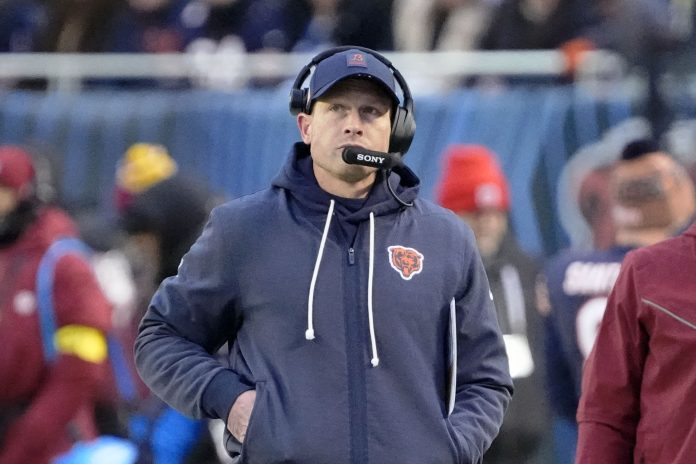
Jan 4, 2026; Chicago, Illinois, USA; Chicago Bears head coach Ben Johnson looks on from the sideline against the Detroit Lions during the first half at Soldier Field. Mandatory Credit: David Banks-Imagn Images
Let’s not sugarcoat. For ten weeks, the Chicago Bears were bullying people. We were physically imposing our will on defenses, running the rock down their throats, and making Ben Johnson look like the smartest guy in the room. We had an identity. We were tough. We were the team nobody wanted to tackle in the fourth quarter.
And then? The wheels didn’t just fall off; the damn axle snapped, the engine exploded, and the car careened off a cliff into a ravine.
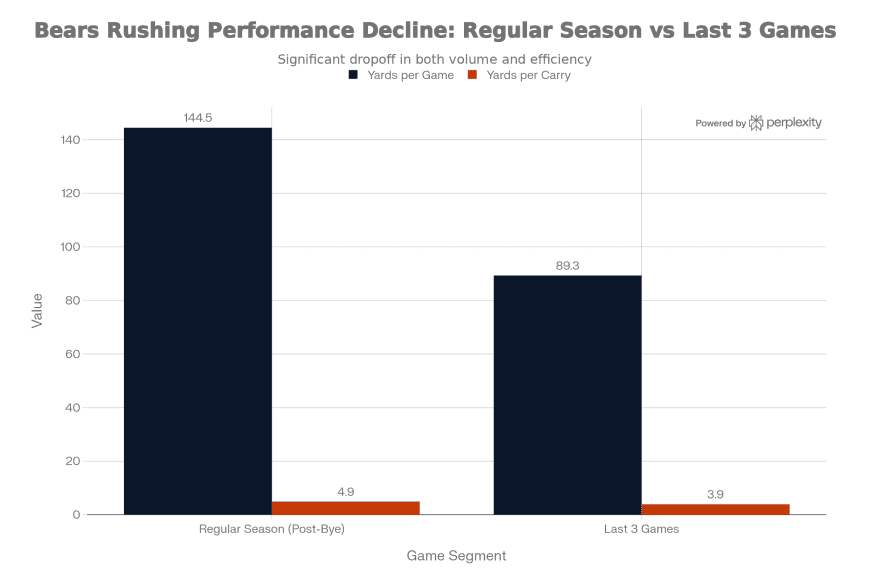
In the span of four weeks — including that heart-attack Wild Card game — the Bears’ rushing attack went from “elite powerhouse” to “anemic joke.” We’re talking about a unit that was churning out 144.5 yards per game suddenly struggling to crack 90. We went from averaging nearly 5 yards a pop to looking like we were running in quicksand at 3.9.
If you’re sitting there thinking, “Well, maybe defenses just adjusted,” stop making excuses. That’s lazy analysis. The reality is much uglier. Through some deep-dive film study and enough analytics to make your head spin, I’ve pinpointed exactly why our ground game died on the vine. It wasn’t one thing. It was a perfect storm of panic, regression, and straight-up failure to execute against teams we should have dominated.
Grab a drink. We need to have an uncomfortable conversation about what the hell just happened.
The Cliff Dive: By The Numbers
Before we get into the why, let’s look at the what. Because the numbers are frankly disgusting.
From Week 6 to Week 15, the Bears were a machine. We were 3rd in the NFL in rushing yards, 1st in yards before contact (meaning the O-line was parting the Red Sea), and 1st in rushing success rate. D’Andre Swift was eating. Kyle Monangai was the steal of the draft. Life was good.
Then came the final three regular-season games and the Wild Card round.
Rushing Yards Per Game: Dropped from 144.5 to 89.3. That’s a 38% collapse.
Yards Per Carry: Plummeted from 4.9 to 3.9.
First Down Percentage: Went from top-5 elite to bottom-third trash.
We didn’t just regress to the mean; we fell below it. And it happened against the Packers (twice), the 49ers, and the Lions. Three of those four performances were offensive malpractice. So, what broke?
The Bears’ rushing attack has dramatically declined in recent games, dropping from 144.5 yards per game and 4.9 yards per carry during their dominant stretch to just 89.3 yards per game and 3.9 yards per carry in their last three contests
Factor #1: The Panic Button (Game Script Dominance)
Here is the single biggest reason the run game vanished: We stopped trusting it the second we got punched in the mouth.
Ben Johnson’s offense is beautiful when it’s balanced. It’s built on 12-personnel, under-center play-action, and the outside zone. But it requires patience. The moment the Bears fell behind by two scores — which happened in three of the last four games — the coaching staff panicked. They abandoned the identity that got them there.
Look at the splits. When trailing by double digits in the fourth quarter, the Bears went 3-0 this season. Great, right? We love a comeback. But that success is fool’s gold because it conditioned the staff to abandon the run immediately.
Rushing Play % in last 3 games: Dropped to 35%.
Passing Play %: Skyrocketed to 65%.
We stopped running to set up the pass and started passing to save our lives. When you become one-dimensional, defenses don’t have to respect the play-action. They pin their ears back. The outside zone runs — which rely on horizontal stretch — don’t work when defensive ends are sprinting upfield to sack Caleb.
In the Wild Card game against Green Bay, we trailed 21-3. We literally didn’t run a single offensive play with a lead until the final two minutes. You can’t establish a ground game when you’re playing catch-up for three hours.
Factor #2: The Interior Softness (Dalman & Jackson)
I love our O-line. They’ve been top-tier all year. But let’s be real: down the stretch, the interior of the line got soft.
Pro Football Focus had our boys ranked highly, but that was mostly for pass blocking. In the run game, specifically the last month, Drew Dalman and Jonah Jackson regressed hard. Ben Johnson’s outside zone scheme relies on the center and guards executing “combo blocks” — double-teaming a defensive tackle and then climbing to the linebacker.
If you watched the tape against the Packers, you saw the issue. Dalman and Jackson weren’t getting that vertical push. They were getting stoned at the line of scrimmage (at least in the first half).
Worse, there were reports of “problematic snap exchanges” between Dalman and Caleb. In an outside zone scheme, timing is everything. If the snap is a split-second late or off-target, the running back misses his landmarks, the linebackers flow over the top, and the play is dead.
We paid these guys to be maulers. In December and January, they played like they were on roller skates.
Factor #3: We Failed to Exploit the Weak
This is the one that pisses me off the most. We didn’t struggle against the ’85 Bears or the 2000 Ravens. We struggled against defensive fronts that were decimated by injuries.
Packers (Wild Card): No Devonte Wyatt. No Kenny Clark (traded). They were playing practice squad guys on the interior. We averaged 3.3 yards per carry. That is embarrassing.
49ers (Week 17): No Nick Bosa. Their D-line was a hospital ward. We managed 110 yards, but on only 22 carries. We should have run it 40 times and broken their will. Instead, we got cute.
Lions (Week 18): A defense that had regressed all year and allowed 4.5 yards per carry. We put up 3.6.
We had golden opportunities to bully depleted fronts, and we failed. Why? Because we didn’t adjust. Defenses played two-high safeties, daring us to run into light boxes. A competent run game destroys light boxes. We ran straight into brick walls.
That tells me our “schematic advantage” evaporated. Defenses figured out our count system. They started slanting away from our combo blocks, disrupting the plays before they began. And Ben Johnson didn’t have a counter-punch until it was too late.
Game-by-game breakdown of the Bears’ rushing struggles shows a clear correlation between negative game script and diminished run game effectiveness, with the team averaging just 3.3 yards per carry when trailing by double digits in the Wild Card game
The Internet on Swift & Monangai
I see the tweets. “Swift is washed.” “Monangai hit the rookie wall.”
Stop it.
This wasn’t on the backs. D’Andre Swift averaged 6.0 yards per carry against the 49ers and 4.5 against the Packers in Week 16. The talent is still there. The burst is still there. But you cannot run through a brick wall if there isn’t a hole.
The metric to look at is Yards Before Contact (YBC). We were #1 in the league for most of the year. In the last month, that number cratered. Swift didn’t suddenly forget how to read a defense. He was getting hit the second he took the handoff.
As for Monangai, yes, 2.3 yards per carry against the Lions is ugly. But again, watch the tape. He was fighting for his life just to get back to the line of scrimmage.
Final Verdict
Here’s the wild part: Despite the run game tripping over its own feet for a month, we’re still here. We survived the Packers. Ben Johnson and Caleb Williams pulled a rabbit out of the hat, and this team showed the kind of grit that defines Chicago football. They refused to die.
Now we’ve got the Rams on Sunday Night in the Divisional Round. This isn’t just another game; it’s a war for a spot in the NFC Championship. We know the Rams have a defensive line that can wreck game plans, so we can’t afford to play from behind again. If we want to dominate — not just survive — we have to rediscover that ground-and-pound identity right now. The Ferrari is still running, we just need to shift it back into gear. Let’s get it done.
Jan 17, 2023; Chicago, Illinois, US; New Chicago Bears president and CEO Kevin Warren (left) shakes hands with chairman George H. McCaskey (R) during the press conference at Halas Hall. Mandatory Credit: Kamil Krzaczynski-USA TODAY Sports
Kevin Warren was hired in 2022 to replace Ted Phillips as the Chicago Bears’ team president. It felt like a reasonable move at the time. Warren had extensive experience as an NFL executive with the Rams, Lions, and Vikings before becoming Big Ten commissioner. If anybody had the credibility to guide the Bears in their efforts to get a new stadium built, it was him. Three years later and nothing has happened. The only discernible progress was closing the final details on the Arlington Park property. Other than that, Warren has managed nothing.
Illinois politicians haven’t budged on any sort of public assistance, despite assurances from the Bears that they would cover all the costs of construction for the building. Warren has pivoted back and forth between possible new sites, with his latest being a flirtation with Northwest Indiana. That would take the Bears out of the state they’ve resided in their entire existence. I expressed recently on Twitter (X) whether George McCaskey might be regretting the decision to hire Warren.
It didn’t take long to receive an answer. My Sports Mockery colleague Jeff Hughes, who’s proven to have excellent connections inside Halas Hall, provided it.
McCaskey is known for being patient, but there are a few things to keep in mind. He turns 70 next year. He isn’t getting any younger. There is no doubt he’d like the get the stadium built before he runs out of time. That would be part of his legacy. Yet Warren’s inability to gain any traction in negotiations can’t be ignored forever. The longer this goes on, the more apparent it becomes that the Bears’ president is out of his depth. He clearly wasn’t prepared for the challenges that the Illinois government would present.
Firing Kevin Warren may look bad, but the bottom line is that keeping him has done nothing. Better to take the brief PR hit and find somebody more competent than drag this out. It feels like the Northwest Indiana move is his Hail Mary. He likely hopes it will serve as a new home or convince the Illinois government to return to the negotiating table. If neither materializes in the next few months, McCaskey may reach the end of his patience. Something has to break, one way or another.
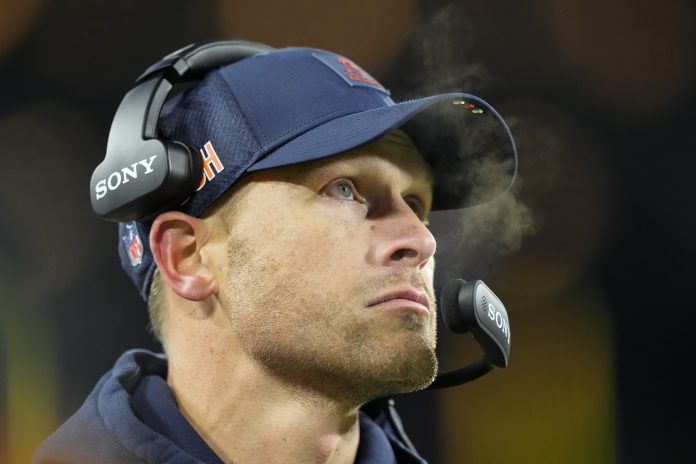
Dec 7, 2025; Green Bay, Wisconsin, USA; Chicago Bears head coach Ben Johnson during the game against the Green Bay Packers at Lambeau Field. Mandatory Credit: Jeff Hanisch-Imagn Images
Beating good teams is never easy. That means coaches like Ben Johnson must do everything in their power to find an advantage, no matter how small. The Chicago Bears had already faced the Green Bay Packers twice. Both times went to the wire, requiring big comebacks from the Bears. Johnson knew Green Bay would come out looking to make a statement. He had to find a way to give his team an edge. The solution he came up with was one nobody expected. It involved a high degree of risk.
Johnson basically benched punter Tory Taylor, opting to go for it on 4th down all game. In total, the Bears went for it six times, including in their own territory. Nobody could figure it out. Johnson finally explained his reason to Kalyn Kahler of ESPN.
“The aggressive fourth down mentality had something to do with time of possession and making sure we are maximizing our possessions. It’s a strategy we talk about as a team and the whole team was highly aware of it and had a lot of confidence. Where it gets misconstrued is there’s a lack of confidence in your defense. I think the opposite. I think because I have confidence in our defense and their ability to stop teams in the red zone that it makes you more willing to pull out a strategy like that…I’m never going to apologize for being aggressive or doing things that might be a little unorthodox if it’s what we deem is best for us to win a ballgame.”
The logic starts making sense.
Chicago lost each of their last two games of the regular season to San Francisco and Detroit. In both instances, they lost the time-of-possession battle. In his mind, Johnson felt the Bears’ best chance to win was to somehow steal a possession. You either do that by forcing turnovers or going for it on 4th down.
Ben Johnson made the strategy work.
The Bears only converted on two of the six attempts on Saturday night. However, both instances proved crucial. First came in the 2nd quarter, where a throw to D.J. Moore created a 1st down. That helped the Bears take another three minutes off the clock. That wouldn’t be felt immediately, but it would later. The other was Caleb Williams‘ fateful 4th and 8 scramble and heave to Rome Odunze. That not only helped them keep the ball for another minute, but also scored a touchdown to narrow the gap 27-24.
When Green Bay’s subsequent drive only lasted two minutes, everything Ben Johnson had planned came to fruition. The Packers defense went back onto the field, still tired from the previous drive. Chicago went 66 yards in just six plays, scoring the go-ahead touchdown with 1:48 left. Green Bay failed to answer. The Bears ultimately won the time of possession battle by six minutes, achieving the goal Johnson had set out for. It was daring and maybe a bit reckless, but the method to the madness was clear.
Aug 29, 2021; Santa Clara, California, USA; Las Vegas Raiders head coach Jon Gruden walks onto the field before the start of the game against the San Francisco 49ers at Levi's Stadium. Mandatory Credit: Cary Edmondson-USA TODAY Sports
Saturday’s Wild Card playoff win over the Green Bay Packers didn’t just push the Chicago Bears forward in the postseason, it reignited the oldest and most intense rivalry in football.
Caleb Williams before throwing the game winning TD to DJ Moore:
“Here we go.. exactly where we want to be. Here we go.”
Speaking after the game, Jon Gruden drew a clear connection between the present-day tension and the rivalry’s origins. He pointed to the infamous hatred between George Halas and Curly Lambeau, noting that Bears–Packers has always thrived on genuine animosity. According to Gruden, that same energy feels very real again. Especially with Bears head coach Ben Johnson and Packers head coach Matt LaFleur at the center of it.
“Yeah, I don’t know where this is coming from. But George Halas and Curly Lambeau hated eachother. And this is how this rivalry started. I feel the same hatred with Ben Johnson and Matt Lafleur. That could come back to haunt him. You gotta be careful going that far.”
Gruden suggested Johnson’s postgame “F*** the Packers” comment is where things may be pushing the line. While passion is part of what makes the rivalry special, Gruden cautioned that going that far can sometimes come back to haunt a coach or a team. Rivalries have long memories, especially ones built on decades of bad blood.
That said, Gruden admitted he loved seeing the rivalry return to this level of intensity. He had no issue with the postgame handshake and dismissed any controversy surrounding it, viewing the moment as raw playoff emotion rather than disrespect.
Gruden believes Chicago is back in control. With momentum, confidence, and a statement playoff win at home, the Bears have reclaimed the driver’s seat and the rivalry suddenly feels very familiar again.
New Chicago Cubs third baseman Alex Bregman was in town after agreeing to a five-year, $175 million contract and I’m taking the optimistic view here that he may have shut down any Nico Hoerner trade rumors by going to Monday night’s Blackhawks game.
Bregman’s deal was announced Saturday night and he immediately embraced Chicago’s fan base by celebrating the Bears’ 31-27 comeback win over the Packers at Soldier Field. Then, on Monday Bregman was in attendance at the United Center, where the Blackhawks hosted the Edmonton Oilers, as the two-time World Series champion is quickly winning over fans in Chicago.
But what does any of this have to do with Cubs trade rumors? Well, it’s all in the numbers.
Bregman was selected with the second overall pick in the 2015 MLB Draft by the Houston Astros and he later admitted that one of the reasons he decided to wear the No. 2, is because the Arizona Diamondbacks did not draft him with the No. 1 pick.
Third baseman Alex Bregman still isn’t over the fact that the Arizona Diamondbacks passed over him in the 2015 MLB draft.
“I was super-happy to come to a good organization like the Astros, an organization that was up-and-coming,” Bregman told The Arizona Republic on Saturday. “But, yeah, I was pissed. I wanted to be the No. 1 overall pick. Part of the reason I wear No. 2 is because of that.”
By the way, current Cubs shortstop Dansby Swanson went to the Diamondbacks with the No. 1 pick ahead of Bregman.
Anyway, Bregman has worn the No. 2 with the Astros and he did it last season with the Boston Red Sox. There’s a problem now though because Nico Hoerner wears the No. 2 with the Cubs and has ever since he made his MLB debut in 2019.
Of course, Hoerner has been the subject of trade rumors since last offseason and they’re not going away any time soon, especially now that Bregman has joined a crowded infield. The San Francisco Giants and New York Yankees are reportedly trying to work out a trade for Hoerner, but local reports indicate it’ll take a massive overpay for the Cubs to ever consider Hoerner.
If you paid close attention to Bregman’s appearance at the Blackhawks game, then you might have noticed that he’s wearing a No. 3 jersey.
Alex Bregman makes his first appearance as a member of the Cubs at the Chicago Blackhawks game.
Maybe I’m reaching here, but it’s possible that at the minimum we know Bregman’s new jersey number with the Cubs, but if we want to get into the weeds, he’s picking No. 3 because he knows Nico Hoerner is staying and will keep wearing the No. 2.
At least that’s what I’m hoping for. Trading Hoerner would be an awful idea.