Theo Epstein was back in Chicago as the Cubs welcomed back legends from the 2016 World Series-winning team, and the timing could not have been any better. Maybe you don’t have Twitter, but by now you’ve probably seen the deleted tweet from veteran reporter Bruce Levine, who essentially called Jed Hoyer and Carter Hawkins “Twinkle Dee and Twinkle Dum.” It was supposed to be either a private DM or text message, but Levine instead shared that on his public Twitter account.
It was a reference to Tweedledum and Tweedledee, characters from the book Through the Looking-Glass, and What Alice Found There. But of course, Bruce messed that up. Anyway, Theo showed up to the reunion this weekend with a shirt that references the tweet.
Now, while some of Jed’s haters are going to point to this and say that even Theo knows he’s an idiot, you know these guys are close friends. It’s a big joke, and something tells me that Hoyer might be wearing that same shirt later on in the season, maybe when the Cubs clinch a playoff spot.
Theo’s the best, though, because of course he wasn’t going to let the chance go by to troll his buddy, Jed.
Everyone is having a good laugh over this.
LMAO! Bruce Levine on The Score, ending a postgame interview with Nico Hoerner
There might have been some people mad that Bruce Levine apologized to Jed Hoyer and Carter Hawkins, as reported in a Chicago Sun-Times article, but you can tell everyone involved is pretty much getting a big laugh out of this entire thing. The controversy began on Monday night, when the longtime baseball reporter shared what was supposed to be a private message to someone on the Cubs’ coaching staff publicly on Twitter.
“Twinkle Dee and Twinkle Dum” became the best inside joke in Chicago during the All-Star break, as Levine outed his own critique of the Cubs’ front office that, in his eyes and the eyes of many fans, didn’t do enough to give the team support at the trade deadline in 2025.
Levine has not tweeted since Monday night’s Home Run Derby, but it’s not like he’s completely ignored the story either. Following the Cubs’ 6-2 win at Wrigley Field on Saturday over the Minnesota Twins, Levine was on the field doing a postgame radio interview with Nico Hoerner for The Score.
The final moments of the interview were gold, as Levine referenced his tough week as the one at the center of a story. Props to Bruce, who is able to make fun of himself, in what’s turned out to be a funny thing for everyone involved.
LMAO! Bruce Levine on The Score, ending a postgame interview with Nico Hoerner
All right, now we need Bruce to reveal who he was sending that message to. And you know Nico was holding in some laughter too after he played along at the end. Guys in the clubhouse had to be cracking up, looking at the story this past week.
May 15, 2026; West Sacramento, California, USA; Athletics pitcher Aaron Civale (45) throws a pitch against the San Francisco Giants during the first inning at Sutter Health Park. Mandatory Credit: Ed Szczepanski-Imagn Images
This might have been the most telegraphed move of the season, as Chicago Cubs fans were pretty much waiting on veteran starting pitcher Aaron Civale to return after he was let go by the Athletics. The right-handed pitcher was designated for assignment during the All-Star break, and on Saturday, he was traded to the Cubs, along with some cash, in exchange for a minor league pitcher.
Civale, 31, did not put up good numbers with the Athletics in 16 total games, including 15 starts this year. He posted a 5.42 ERA and 1.62 WHIP in 74.2 innings, but when you consider his home/road splits, the Cubs are getting a decent pitcher to fill in at the back end of the starting rotation.
In seven starts at home this year with the Athletics, who have either played their home games at minor league stadiums in Sacramento or Las Vegas, Civale yielded a 6.96 ERA in 32.1 innings. Meanwhile, in 42.1 innings pitched on the road this year, Civale has a 4.25 ERA with a strikeout-to-walk ratio of 3 to 1.
Meanwhile, ESPN’s Jesse Rogers reported that 22-year-old minor leaguer Aiden Moffett is going to the Athletics to complete the trade. Moffett signed with the Cubs last summer after he was not drafted out of Texas. The right-handed pitching prospect has struggled to throw strikes in his first year in pro ball, walking 42 batters in 22.1 innings between his time in the Arizona Complex League and Low-A with the Myrtle Beach Pelicans.
Righty Aiden Moffett going back. Cubs had Civale for a bit last year. https://t.co/9smylL7344
Civale was scooped up by the Cubs last year, joining the club after the Chicago White Sox put him on waivers. As with this year, the Cubs needed pitching depth, and they claimed the right-handed pitcher who did well in September. Civale gave up three total runs in 14 innings of work with the Cubs, all coming on solo home runs, while striking out 14 and walking none in five games.
That performance earned Civale a spot on the team’s postseason roster, and he once again did a stellar job in his one outing, throwing 4.1 scoreless innings in Game 1 of the NLDS against the Milwaukee Brewers, who were up big after Civale came in to pitch out of the bullpen.
One note on his health: Civale did miss some time earlier in 2026, as he went on the injured list with right-shoulder tendinitis on May 26. He missed about three weeks, needing one rehab start before returning to the Athletics on June 17.
He made his MLB debut back in 2019 with the Cleveland Guardians, and after spending five seasons there, Civale has bounced around the league since, pitching for five different organizations between 2023-26. Civale has had a solid career, making 150 starts and six relief outings, and recording a 4.26 ERA in 813 MLB innings.
Mar 20, 2025; Chicago, Illinois, USA; Chicago Blackhawks center Connor Bedard (98) skates during the second period against the Los Angeles Kings at United Center. Mandatory Credit: Talia Sprague-Imagn Images
Everybody knew it was coming. The Chicago Blackhawks have always viewed Connor Bedard as the centerpiece of their rebuild. His talent is unquestionable. He’s amassed 75 goals and 128 assists through his first three seasons with the franchise. Those numbers are right in line with what Patrick Kane produced in his first three seasons, and he was surrounded by a better team. It is hard to blame the Blackhawks for doing what they just did, handing Bedard a massive five-year extension worth $75 million.
This now makes him the third-highest paid player in the National Hockey League, trailing only Leo Carlsson and Kirill Kaprisov. Chicago never wavered in their intent to make this deal happen. Understandably so. They had no prayer of finding someone as gifted anytime soon. Still, that doesn’t change one uncomfortable reality. While the deal had to happen, it is still a massive risk the Blackhawks are taking. For all of his skill, Bedard is starting to look more and more like an injury risk.
Connor Bedard signs a five-year deal with a $15-million cap hit.
Connor Bedard can’t hide from those shoulder issues.
Last December, he missed 12 games with an injury to his shoulder. There had always been concerns that his smaller frame (5’10” and 190 lbs) might not handle the physicality of the NHL too well. Sure enough, during a scrimmage in practice earlier this month, Bedard hit the ice hard and injured his other shoulder. This was much more severe, costing him the first month of the upcoming season. Anybody who understands medical history will know that once you suffer an injury to the shoulder, it becomes much easier to do so again.
You can bet opposing teams will look to play him more physically in the coming years, putting pressure on those shoulders. Will they hold up? Connor Bedard better hope so. His career and the Blackhawks’ future are riding on it. They’re all in now. The escape hatch is shut. If there was any second-guessing, the organization decided the risk of repeated injuries was easier to stomach than the risk of having him go somewhere else and becoming the star everybody believes he’s becoming.
The Blackhawks’ roster construction is about to be tested.
They feel they’ve pieced together a lineup that is finally capable of making a run at the playoffs. Granted, many believe they still haven’t found a proper winger to pair with Bedard. Hence, the ongoing Kane reunion rumors. That said, the roster is young and skilled. The trick will be whether they can keep the ship afloat for the month Bedard will be out. If they do, it will be a sign that the Blackhawks are ready to compete. It has been too long waiting for the NHL to see the former #1 pick playing important hockey games.
This season will certainly tell a lot about where the organization is heading. They feel like they’re close. Bedard is a core part of that optimism. Now they don’t have to worry about losing him. Whether he earns that money will be the uncomfortable topic until he makes the All-Star team or wins a Stanley Cup.
Nov 28, 2024; Detroit, Michigan, USA; Chicago Bears quarterback Caleb Williams (18) gets helped off the turf by offensive tackle Larry Borom (75) and guard Teven Jenkins (76) in the fourth quarter against the Detroit Lions at Ford Field. Mandatory Credit: Lon Horwedel-Imagn Images
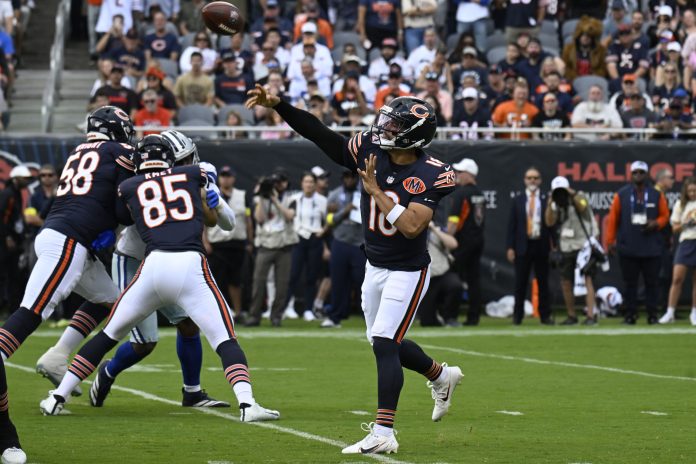
They say some leaders aren’t born, they’re made. It isn’t yet clear what the true origin story for Caleb Williams is, but one thing is clear. The Chicago Bears‘ quarterback has evolved as a leader over the past calendar year. He entered 2025 on uncertain ground. He had people questioning his maturity after a rookie season that saw him not always handle the losing and frequent hits too well. Many said it was a body language issue. Would the same problems persist under new head coach Ben Johnson?
Nope.
Williams not only improved his body language, but he also displayed more frequent moments of vocal leadership. He’d encourage teammates when they were down. He’d yell at them to do their job when they made mistakes. Most importantly, he would stay calm in high-pressure situations. All of it culminated in an 11-6 season, a division title, and a playoff victory.
People are wondering what Williams will do for an encore this year. It would appear the young quarterback might be thinking bigger than just the Bears. Could he be taking up the fight for every player in the NFL? His latest tweet suggests as much.
Caleb Williams has been vocal about the NFL’s ongoing turf war.
For those who don’t know, there is no set standard for what turf teams play on. Each franchise is allowed to install whatever type they wish in its stadium. Some use natural grass. Others use artificial field turf. This has created a serious point of contention between the league and the players, who feel the artificial surfaces aren’t safe enough and lead to way too many career-threatening injuries like torn Achilles and torn ACLs. Matters came to a head over the past month when FIFA brought the World Cup to U.S. shores. One of the requirements of hosting the event was removing artificial turf from every host stadium and replacing it with natural grass.
This has caused a wave of outrage among NFL players. They feel their franchises have no problem catering to international athletes who almost never play in the U.S., but play it cheap for the men who actually put their bodies on the line to fill their pockets. Caleb Williams and several others have begun taking up the cry for a league-wide ban on artificial surfaces and going to natural grass everywhere. The projected cost is said to be around $17 million for the initial conversion. The needed infrastructure would be another $5 million. Then, at most, around $3 million annually to maintain it.
For anybody who knows anything about the NFL’s finances, that is chump change. Teams blow $3 million per year on below-average players all the time.
It sounds like Williams and others are preparing for war.
This is not a topic that is going away. Players have grumbled about it for years, always bubbling beneath the surface. The World Cup controversy merely brought it back to the surface. The calls are getting louder. It feels like this will be a point of contention between players and owners, leading to some ugly legal fights in the next Collective Bargaining Agreement. The current CBA runs through 2030. It’s already apparent that the stage is set for a battle over owners wanting an 18-game schedule. Now, this playing surface issue could complicate matters even further.
Williams hasn’t been shy about sharing his opinion on the matter. He is a major advocate of playing on grass. There is something on the line with it, too. There is a strong possibility he will play on turf in a few years once the Bears build their new stadium. It isn’t something he is probably looking forward to. That would explain why he is taking up the call to push owners to adopt grass as the league-wide playing surface. Player unity has been a constant issue in recent years on important issues like this.
Somebody needs to take up a leadership position. The Bears’ quarterbacks seems ready and willing.
Jul 17, 2026; Toronto, Ontario, CAN; Chicago White Sox left fielder Sam Antonacci (17) reacts and runs the bases after hitting a two run home run against the Toronto Blue Jays during the second inning at Rogers Centre. Mandatory Credit: Nick Turchiaro-Imagn Images
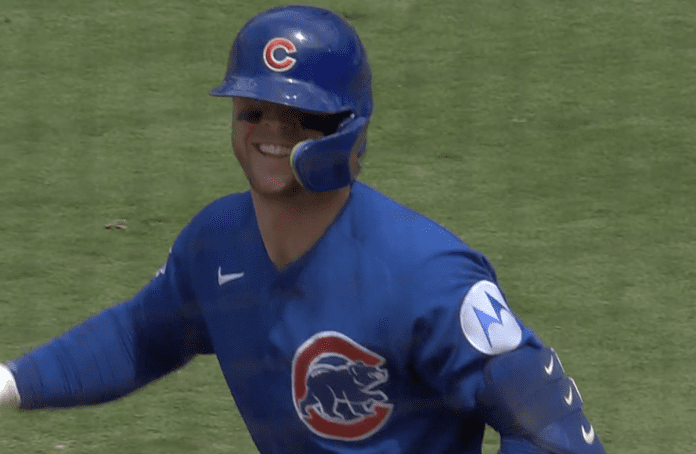
Sam Antonacci had just 14 games in Triple-A under his belt before getting called up to the show. Since then, few rookies have been asked to do as much as the 23-year-old. He’s adjusting to major league pitching while simultaneously learning a new position and setting the table as the Chicago White Sox everyday leadoff hitter.
That’s a tall order for any rookie, but Antonacci hasn’t just met expectations; he’s quickly emerged as a legitimate American League Rookie of the Year contender, posting a 132 wRC+ through his first 76 games, one of the best marks among AL rookies.
On Friday, Antonacci continued his impressive rookie campaign by launching a two-run homer off Blue Jays right-hander Spencer Miles for his seventh home run of the season. He added a single in the fifth inning and later scored his second run of the game in the White Sox’s 12-4 onslaught in Toronto.
By the end of the night, Antonacci was slashing .289/.382/.430. Yet despite putting together one of the American League’s best rookie seasons, he isn’t even among the top five betting favorites for AL Rookie of the Year. The current frontrunner is Detroit Tigers rookie Kevin McGonigle, who entered the All-Star break as the overwhelming Vegas favorite at -245.
McGonigle’s numbers are hardly overwhelming by comparison. He’s slashing .283/.392/.420 with just one more home run and 34 RBIs, compared to Antonacci’s 29. Unlike Antonacci, McGonigle is on a losing team, while the Italian Stallion has emerged as one of the key contributors on a first-place White Sox club.
AL Rookie of the Year? Just sayin.
Kevin McGonigle: .283/.392/.420 Sam Antonacci: .289/.382/.430
While McGonigle does own a higher WAR and certainly deserves to be a frontrunner, what Antonacci has done is arguably more impressive considering the circumstances.
He leads the White Sox in batting average and on-base percentage and ranks third on the team with 77 hits. Not only that, he has done everything the White Sox have asked of him at the top of the lineup. He gets on base at a high clip, rarely strikes out, and keeps the line moving.
While Antonacci doesn’t draw many walks, he consistently works good at-bats and is a pest for opposing pitchers because he doesn’t expand the strike zone. He ranks in the MLB’s 89th percentile in chase rate, 92nd percentile in whiff rate, and has struck out in just 15% of his plate appearances, a mark that ranks in the league’s 80th percentile.
The fact that Antonacci owns a .381 on-base percentage is even more impressive considering he is walking at just a 7% rate, one of the lowest marks in the MLB. But he has found another way to consistently reach base by refusing to get out of the way of errant pitches. His 18 hit-by-pitches this season lead the majors, adding another layer to his ability to grind out at-bats and create opportunities for the White Sox offense.
In an era defined by power hitters willing to trade strikeouts for home runs, Antonacci represents a different type of offensive weapon every lineup needs. His hits are not coming cheap either. Antonacci’s .297 expected batting average ranks in the MLB’s 97th percentile.
He is doing all of this while playing out of position in left field. Antonacci is an infielder by trade, but has handled the outfield well, despite learning on the fly.
The White Sox have seen firsthand how difficult that transition can be. Andrew Vaughn, a natural first baseman, was thrust into the outfield after reaching the majors and struggled to adjust to the defensive demands of a new position. His production at the plate also failed to match the expectations that came with being selected No. 3 overall in the 2019 MLB Draft.
As the season wore on, questions emerged about whether the added workload of playing the outfield every day was impacting Vaughn’s performance and potentially slowing his development. Antonacci has been given similar built-in excuses and hasn’t needed a single one.
Not only has Antonacci handled the position well, but he has also delivered several highlight-reel catches along the way. While his range remains a work in progress, the White Sox have been able to offset some of those limitations with Tristan Peters covering ground in center field and taking pressure off the corners.
The Rookie of the Year race will ultimately be decided by voters, not oddsmakers. And while Antonacci is making a compelling case, he’s also battling Munetaka Murakami, a media darling with serious firepower of his own.
But if you’re hunting for real value, Antonacci is the bet. The Italian Stallion has shown he belongs whether it is setting the table at the top of the order, grinding out at-bats, or adjusting to whatever role the White Sox asks of him.
Sep 21, 2025; Chicago, Illinois, USA; Chicago Bears quarterback Caleb Williams (18) drops back to pass against the Dallas Cowboys during the first half at Soldier Field. Mandatory Credit: Matt Marton-Imagn Images
If you listen to the various experts talk about Caleb Williams’ 2025 season, they all say the same things with different wording. He already has the big plays down. He must get better at the “layups.” Hit the easy throws, improve the completion percentage, and play on time. Work to stay in the pocket. That is where he needs the most improvement, right? All of this stems from his league-low 58.1 completion percentage, illustrating an inability to connect on several of his easier throws, likely brought about by his unwillingness to stay in the pocket.
So imagine how those people might feel seeing a new metric chart that just came out. It covers the EPA (Expected Points Added) of every starting quarterback from inside the pocket vs. outside the pocket. Those who are great at both are in the top right. Those in the bottom left are bad at both. What do you notice?
Yep, Williams sits in the bottom-right box, meaning he was a considerably better player inside the pocket than he was outside. This is backed up by the stats, too. For the season, Williams had a better passer rating, completion percentage, and yards per attempt last season. The only advantage his plays outside the pocket was a better TD-to-INT ratio.
Passing Metric
Inside the Pocket
Outside the Pocket / Under Pressure
Total 2025 Season
Passer Rating
101.4
71.8
90.1
Pass Attempts
353
215
568
Passing Yards
2,824
1,118
3,942
Passing Touchdowns
21
6
27
Interceptions
6
1
7
Completion Rate
66.1%
46.4%
58.1%
Yards Per Attempt
8.4
5.2
6.9
ANY/A
7.9
1.2
6.4
This illustrates an interesting subplot with Caleb Williams.
Chicago Bears head coach Ben Johnson expressed frustration with the team’s receiving corps after last season, saying they need to do a better job at working to get open when the quarterback scrambles. This is reflected in the completion percentage. Williams threw 215 passes outside the pocket but completed well under half of them. By contrast, Patrick Mahomes, who had a worse overall season, completed over 62% of his passes outside the pocket. That tells you the Kansas City Chiefs do a much better job of getting receivers to work their way open, knowing Mahomes will scramble.
The Bears clearly didn’t have a good enough handle on that last season. Part of it might’ve been unfamiliarity. Outside of Rome Odunze (who missed several games) and D.J. Moore, none of the quarterback’s primary targets had played a season with him before. Colston Loveland and Luther Burden were rookies. Olamide Zaccheaus was signed that offseason. Sometimes it takes a year or two for somebody to get acclimated to playing with a quarterback of Williams’ style. Just look at the production of Tajh Washington and Brenden Rice in their first and second seasons with him at USC.
If Caleb’s strength is the problem, that’s a good thing.
Everybody said from the beginning that off-script was where the quarterback thrived. He makes magic outside the pocket. For him to be that inefficient at what he does best is actually good. It means he should get considerably better next season. Meanwhile, the area he was supposed to be bad at was easily the most consistent part of his game. It shows how much work Williams has put in to become a more complete quarterback, along with the excellent coaching of Ben Johnson and his staff.
The original critiques are still valid. Caleb Williams must learn to take the easier throws when they’re available. Constant big-game hunting just doesn’t lead to sustained success in today’s NFL. It’s about balance. Play the chess match. Set up your opponent, find the right situation, and then take his queen. Williams hasn’t gotten there yet. He’s getting closer. There were signs late last season. It’s about putting on those finishing touches. If he’s made it this far, there is no reason he can’t go the distance.
The Chicago Cubs are currently a playoff team in the National League, but if they want to become a real threat to win the division and make a deep playoff run, then they need these three players to step up their game in the second half.
Nico Hoerner
The Cubs lost on Opening Day, but fans still came away with happy news on the first day of the season, as the team signed Nico Hoerner to a six-year contract extension. Hoerner responded by leading the Cubs through the middle of April, not only playing his usual gold-glove-level defense at second base, but he was the best overall player on the team. The right-handed hitter woke up on April 18 with a .973 OPS, slashing .342/.420/.553 in 19 games.
Ever since then, Hoerner has been the second-worst-qualified hitter in MLB, posting a 55 wRC+ over his last 75 games. The right-handed hitter has only posted a slash line of .205/.274/.268, and while Hoerner has been viewed as one of the best clutch hitters in the sport, he’s been awful at that too. And I guess he’s actually been almost the same type of hitter since April 18, regardless of situation, because with runners in scoring position, Hoerner has a slash line of .206/.274/.268.
The defense remains rock solid, but the Cubs cannot have close to an automatic out in the lineup for another 2.5 months if they want to make up the gap with the Brewers. It’s been way too long since Hoerner has been a factor for the Cubs on offense.
Alex Bregman
The veteran third baseman turned it on during the last couple of weeks before the All-Star break, and hopefully Alex Bregman keeps it going in the second half. He’ll continue to bat in the middle of the order, so the Cubs are going to need the version of Bregman since June 30, which leads the Cubs with 14 RBI.
While we weren’t expecting Bregman to be a 30-35 home run hitter this year, there were serious concerns as recently as mid-June over his lack of power in 2026. Bregman was being mocked, getting compared to Nick Madrigal, while other fans were furious over the awful numbers with runners in scoring position.
Overall, Bregman is hitting .241/.336/.359 with nine home runs in 431 plate appearances. With runners in scoring position, he’s only batting an even .200 in 131 chances.
Edward Cabrera
If the Cubs have any hopes of overtaking the Brewers or beating the Dodgers in the playoffs, then they 100% need Edward Cabrera to step up and pitch like the ace-caliber type of pitcher he can be. He has all the tools in the bag, but even before the injury, he was a big disappointment in the starting rotation.
The Cubs invested their top prospect at the time in order to acquire Cabrera, and while his years of team control factored into the calculus, they obviously believed in his ceiling. He hasn’t gotten close to it and has regressed from his breakout 2025 season with the Miami Marlins. Cabrera is currently on the injured list, sidelined with a hamstring strain, with mid-August circled as his return timeline.
You need great pitching to win in October, and even if the Cubs pull off a trade for another starter, their chances of winning big may ride on whether or not Cabrera can get it back together following his frustrating first half.
Apr 28, 2026; San Diego, California, USA; Chicago Cubs designated hitter Moises Ballesteros (25) walks to the plate during the fifth inning against the San Diego Padres at Petco Park. Mandatory Credit: David Frerker-Imagn Images
The Chicago Cubs are ready to begin the final stretch of the 2026 regular season, and despite the injury trouble, they’re still in striking distance of winning the division. It’s taken some incredible performances to get them where they are, but there are also some players who have massively underachieved.
Let’s take a look at the biggest negatives, specifically the players who have hurt their individual value.
The Losers
Moises Ballesteros
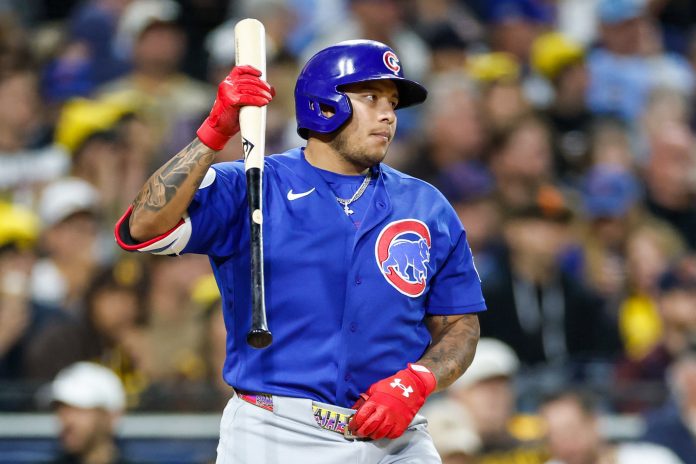
The 22-year-old was given, and well, he did earn a golden opportunity to be the regular designated hitter to begin this season after an impressive cup of coffee at the end of 2025. With Owen Caissie traded and Kyle Tucker signing with the Los Angeles Dodgers, Ballesteros had the path cleared out from the left side of the plate as the primary DH, but he couldn’t hold down the spot after the first two months.
Ballesteros got off to a strong start, seemingly making hard contact every other at-bat, and the results matched the eye-test, as he had an 1.144 OPS through April 27. However, his last 34 games were brutal, as the rookie hit .128/.217/.170, with only one home run, a double, a 14 wRC+, and a 50.7 GB%. He was optioned to Triple-A on June 18, and at this point he won’t be called up unless there’s an injury on the active roster.
Hunter Harvey
The Cubs signed right-handed relief pitcher Hunter Harvey to a one-year deal that guaranteed him $6 million. That might not sound like a ton, but considering Harvey only pitched 10.2 innings with the Kansas City Royals in 2025 and had injury concerns, it was a pretty good chunk of change for the 31-year-old. And well, there’s no chance the Cubs are going to pick up $8 million option for next season as Harvey hasn’t been healthy since the first week of April.
Harvey only appeared in four games with the Cubs in the first half, and now that the All-Star break has passed, the right-hander still hasn’t gone out for a rehab assignment. The pitcher has been sidelined with right triceps inflammation, and time isn’t on his side now as we approach August.
Training Staff
Every single team will deal with injuries, some more than others, and while injuries can sometimes be bad luck, this is now the second consecutive year in which the Cubs have suffered an abnormally high amount of pitching injuries. What makes it even more problematic in 2026 is that not only have the injuries persisted on the active roster, they’ve spread throughout the entire organization, all the way down to the lowest level in the minor leagues.
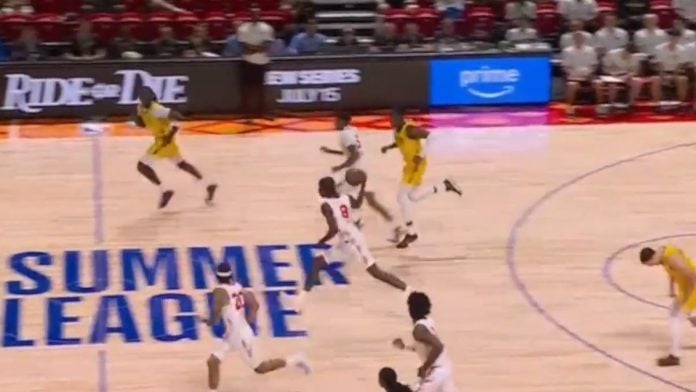
Bulls rookie Caleb Wilson fires a bounce pass to teammate Noa Essengue in the Summer League game against Los Angeles.
Caleb Wilson looked excellent in the Summer League over four games for the Chicago Bulls. He averaged 23 points, 9 rebounds, 3 blocks, and 1 steal per game on 50% shooting. That is really good for anybody, but especially a rookie, Summer League or not. Unfortunately, the team itself didn’t perform well. Chicago is 1-3 so far in league play. They’ve lost by an average of 17.7 points. That should tell you how thin the overall talent depth is for this team, and what VP of Basketball Operations Bryson Graham is trying to rebuild.
Fellow 1st round pick Dailyn Swain shot a dismal 12.9% from the field. Noa Essengue showed little progress from last season, struggling on the offensive side. Undrafted free agent Jaylin Sellers was 6-of-30 from three-point range. Just not a lot of efficient basketball. This may have leaned into one of Wilson’s more disappointing stats. For somebody who handled the ball as often as he did, the 4th overall pick only averaged 1.8 assists per game. Some may think that he was just looking to score every time.
In reality, a big part was the constant inability of his teammates to handle some pretty good passes.
Caleb Wilson is a better passer than he gets credit for.
People will go right to his college stats and look at his 2.7 assists per game and say he’s not. They should look at the overall team stat page. In reality, Wilson was tied for second on that North Carolina team in assist average. Remember, he isn’t a point guard. Distributing the basketball was never his role. So for him to still sit near the top of the team like that suggests there is significant untapped potential as a passer. This is something that was never really addressed with Michael Jordan.
Everybody remembers him for the obvious reasons: prolific scorer, elite rim-attacker, and great defender. What people often don’t remember is that he was also a really good passer. During a stretch late in the 1988-1989 season, injuries ravaged Chicago’s point guard position. Left with no options, Jordan took over that role through the end of the regular season. He averaged 30.5 points, 9.0 rebounds, and 10.4 assists over that stretch. It was a shocking reminder that just because somebody is great in one role doesn’t mean they can’t handle another.
Tiago Splitter should consider exploring this.
Right now, the Bulls don’t really need a facilitator on offense. That is what Josh Giddey is for. That said, having another tall player who can distribute the ball is a major boon. Point forwards exist for a reason. Head coach Tiago Splitter played against some really good ones in his career, like LeBron James, Kevin Garnett, and Hedo Turkoglu. He knows what players like that can do for your team. It grants so much versatility. In one lineup, you can deploy Caleb Wilson as a scorer, allowing him to seek points. Then, in a different lineup, he shifts to the point position, feeding the ball to other options.
It makes a team difficult to defend. One can safely assume Splitter and the coaches will have noticed Wilson’s passing capability. We already know the head coach isn’t afraid to make a forward the primary ball-handler. He did it with Deni Avdija in Portland, who plays the same position as Wilson. It’s not like fans needed more excuses to be excited about the upcoming season. The idea that their prized rookie’s supposed weakness was never a weakness at all certainly adds to the hype.