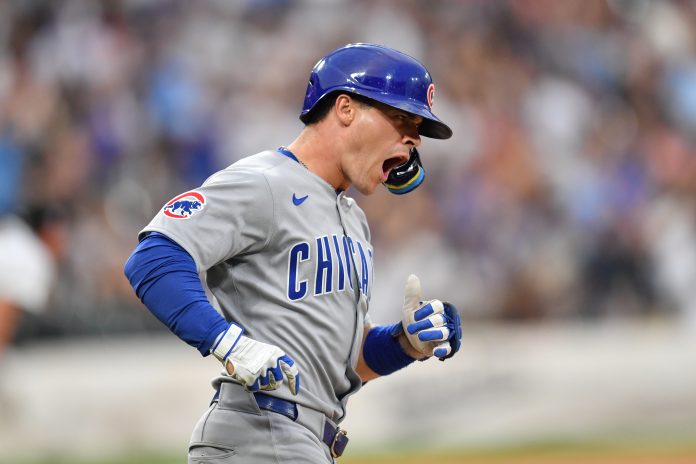
Jul 26, 2025; Chicago, Illinois, USA; Chicago Cubs third baseman Matt Shaw (6) celebrates his two-run home run during the seventh inning against the Chicago White Sox at Rate Field. Mandatory Credit: Patrick Gorski-Imagn Images
The Chicago Cubs already had a tough matchup in front of them on Wednesday night as Chris Sale is making the start for the Atlanta Braves in the series finale. Now, it’s a little tougher as the Cubs will be without one of their better hitters from the second half because of personal reasons. Less than an hour before first pitch the team announced that Matt Shaw had been scratched from the starting lineup.
So, who will be filling in for Shaw at third base? It’s none other than Willi Castro.
Lineup change:
– Matt Shaw has been scratched from tonight's lineup.
Castro has quietly been one of the biggest trade deadline flops in all of baseball. The Cubs traded for him after missing out on Eugenio Suarez and while the switch-hitting utility man got off to a solid start with the Cubs, collecting four hits in his first three games, Castro has been atrocious otherwise.
The Cubs probably should have seen his regression at the plate coming, especially because he was already declining on offense for more than a month before the Minnesota Twins shipped him off to Chicago.
If the Cubs do trade for Willi Castro, hopefully he'll break out of his slump. Since June 21: .177/.279/.310, 68 wRC+ in 130 PA
Castro’s slump has extended into September. Dating back to June 21, Castro has a 54 wRC+ in 211 plate appearances with a slash line of .175/.257/.286. His numbers have been worse since joining the Cubs on Aug. 1. Since then, Castro has a 33 wRC+ in 81 plate appearances, slashing .171/.222/.250.
Do you guys remember how bad Vidal Brujan was this year with the Cubs? Well, as bad as he was Brujan actually had slightly better numbers than Castro does. Awful. What sucks is that the Cubs don’t really have anyone else to backup third base if Shaw isn’t starting other than Castro. Stuck with him being the substitute and the only thing you can do is hope Castro turns it on ASAP.
I mean, the way the Cubs offense has been going tonight was probably an automatic loss anyway, with Shaw or without. Sale has a 2.38 ERA this year and the last time he gave up more than two runs in a start was back in the middle of April.
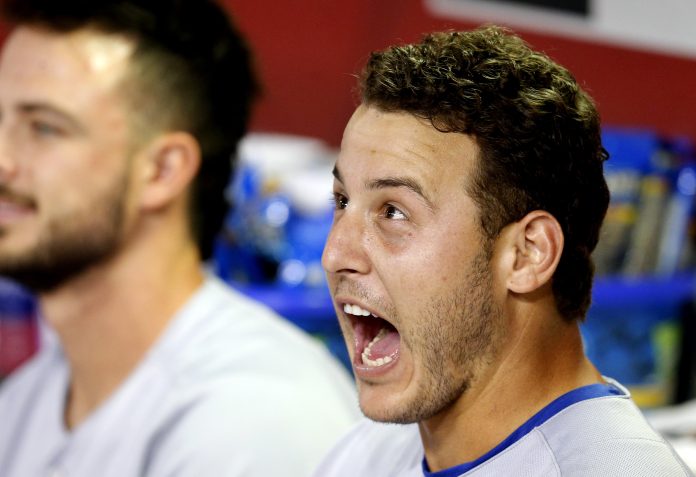
Sep 19, 2018; Phoenix, AZ, USA; Chicago Cubs first baseman Anthony Rizzo (44) reacts to teammates in the first inning against the Arizona Diamondbacks at Chase Field. Mandatory Credit: Rick Scuteri-USA TODAY Sports
Hey, hey, Anthony Rizzo is back with the Chicago Cubs! He’s officially retiring from MLB, but at this point I have more confidence in him getting on base than Carlos Santana. Rizzo surprised everyone on Wednesday, when news broke that he’s signing a one-day contract with the Cubs as the 2016 World Series champion will officially retire on Saturday, when the Cubs host the Tampa Bay Rays at Wrigley Field.
Rizzo, who was originally drafted by the Boston Red Sox, played for the San Diego Padres in 2011, and was then traded to the New York Yankees in 2021, played in 1,308 games with the Cubs between 2012-2021. The 35-year-old ends his 14-year MLB career with a World Series title, four Gold Glove awards, three All-Star Game nominations and a Silver Slugger award. Rizzo was also the 2017 winner of the Roberto Clemente Award.
Rizzo will now be a team ambassador for the Cubs.
News: Anthony Rizzo is retiring as a Cub and will be honored this Saturday at Wrigley Field. He'll also become an ambassador for the organization. The defacto captain of the 2016 World Series team has returned.
In 2024, Rizzo played in 92 games with the Yankees during the regular season and then appeared in 10 games during the postseason. After the season the Yankees declined Rizzo’s $17 million option for the 2025 season, making the veteran first baseman a free agent. Rizzo went unsigned and when discussing his decision to not take a low salary the Cubs’ legend said the following back in February.
Rizzo wants to play. He’s healthy enough to play. Yet he knows the end of his career might be near.
“I’ve definitely thought about it. I think I have a lot to give to the game still,” the three-time All-Star and four-time Gold Glove winner at first base said Friday in a telephone interview.
“But at the same time, if teams are not going to want to pay a few million dollars for veterans, I’ve seen it the last 10 years of my career. It’s what happens to the older guys. They kind of get squeezed. You’ve seen it happen more and more. I’m not naive to it. It could be it.”
So, after more than 1,700 games in the show Rizzo wraps up his career with 303 home runs, 965 RBI and an .828 OPS. How is he celebrating his retirement back at Wrigley Field?
The best way possible. In the bleachers.
Anthony Rizzo told @mullyhaugh he's going to sit in the Wrigley Field bleachers this weekend in retiring with the Cubs: "Overwhelmed with joy right now. I couldn't be happier to be coming back to Chicago. This weekend is going to be really special."
Rizzo made his debut with the Cubs on June 26, 2012, against the New York Mets at Wrigley Field. He hit his first home run with the Cubs against the Houston Astros on June 30, 2012, in a 3-2 Cubs win.
An absolute legend and the iconic figure of the Cubs during the 2010s. Great to have him back in the Cubs’ family.
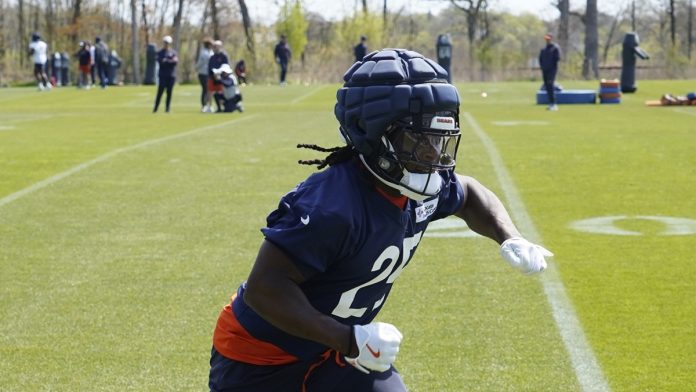
May 10, 2025; Lake Forest, IL, USA; Chicago Bears running back (25) Kyle Monangai participates during rookie minicamp at Halas Hall. Mandatory Credit: David Banks-Imagn Images
The Chicago Bears couldn’t get it done on opening night against the Minnesota Vikings. There were multiple reasons why. Caleb Williams went through a bad stretch where he missed open receivers. The defense allowed three consecutive touchdowns in the 4th quarter. Cairo Santos missed a crucial field goal and failed to kick the ball out of the end zone on the final kickoff, costing the Bears the two-minute warning. However, one thing that wasn’t talked about enough was the complete disappearance of the running game.
Excluding Williams’ scrambles, the Bears managed just 61 yards on 20 carries in the game. D’Andre Swift averaged 3.1 yards per carry. Not all of that was on him. Minnesota’s defensive line did a good job controlling the line of scrimmage, and Brian Flores loaded the box frequently. That said, Swift still missed opportunities. It sounds like head coach Ben Johnson is planning to shake things up going into Detroit this weekend. That means getting rookie Kyle Monangai more touches.
“I need to call more runs. We probably were at, what, under 20 for called runs in the game. I need to call more so that we get him in the game a little bit more. That’s something EB (Eric Bieniemy) and I have talked about, making sure he has more carries going forward.”
This was a move that felt inevitable for the Chicago Bears.
Swift is a talented player who can do many good things. However, he never felt like a good fit for Johnson’s offense. The Bears head coach runs a primarily wide-zone scheme, which demands a running back with good vision who can see where the lanes will develop. Swift has never been able to do that consistently. By contrast, Monangai may not have the same speed or athleticism, but his vision is excellent. He demonstrated a great sense of where the holes would be countless times at Rutgers. He’s also more of a downhill runner, something Johnson prefers as his primary back. It isn’t clear why Chicago didn’t get him more involved against Minnesota, but he was coming off an injury. Whatever the case, it sounds like the training wheels are off. Monangai will get his shot on Sunday.
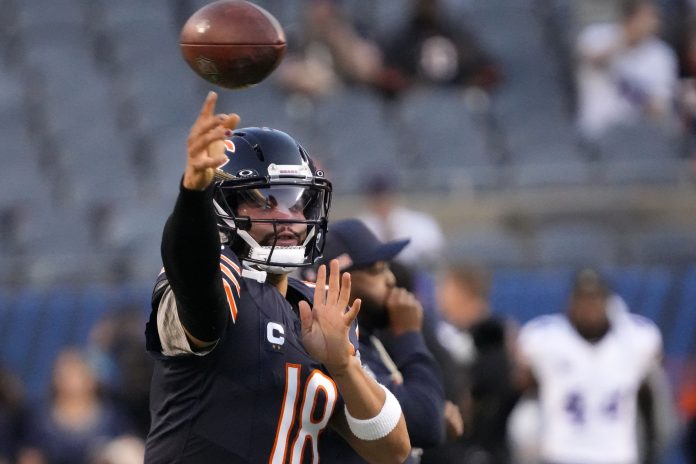
Sep 8, 2025; Chicago, Illinois, USA; Chicago Bears quarterback Caleb Williams (18) practices before the game against the Minnesota Vikings at Soldier Field. Mandatory Credit: David Banks-Imagn Images
Caleb Williams was at the heart of the Chicago Bears‘ painful opening night loss to Minnesota. While he didn’t have a bad game statistically, his inability to score more than 17 points despite numerous opportunities left the door open for the Vikings. People couldn’t get over his accuracy issues. There were several moments where he had receivers open and failed to hit them. He never seemed comfortable, and Minnesota’s aggressive front only exacerbated that. Nobody from the locker room blamed Williams for the loss. There was plenty of that to go around.
Still, Adam Jahns of CHGO did mention that some frustration is bubbling up among teammates about Williams. It isn’t for the reasons you think, though. The issue is pre-snap cadence. For those who don’t know, quarterbacks use a cadence to do several things:
Communicate with teammates
Identify defensive looks
Time the snap to give the offense a rhythm
Adjust plays at the line of scrimmage
Keep the defense off-balance with variations
The problem is that cadences involve a lot of information. Quarterbacks must digest it quickly. If they don’t, mistakes—in most cases, penalties—result. Chicago was hit with four false starts on Monday night. Ben Johnson admitted after the game that the cadence issues were to blame. It’s been something Williams has struggled with for months.
It’s having an impact on his teammates. The false starts are credited to them – not Williams – on the scoresheet. Right now, they’re all saying the right things. Everyone’s execution needs to be better. But if the problems continue and the Bears’ offense continues to play behind the sticks, I think it’s fair to wonder how some players, particularly those tasked with protecting Williams, deal with the cadence issues.
Caleb Williams is hardly the first to deal with this problem.
Young quarterbacks don’t use verbal cadences much anymore in college. Offenses have shifted to ones involving clapping, which decreases confusion and allows offenses to play faster. Caleb Williams did this at both Oklahoma and USC. Most college quarterbacks are totally unprepared for verbal cadences in the NFL. It is not anywhere close to as easy as guys like Patrick Mahomes, Joe Burrow, and Josh Allen make it look. Johnson’s offense is the truest pro experience. It is detailed and complex. Cadences are required because adjustments are built into every single play. The quarterback is required to know which ones go against which defensive look.
This is why Johnson wants Williams out of the huddle as quickly as possible. The faster he gets to the line of scrimmage, the more time he has to assess the situation and make the call. So far, the quarterback isn’t getting it. Either the Bears must hope things eventually click, or they may have to adjust their plans to accommodate Williams.
Sep 8, 2025; Chicago, Illinois, USA; Chicago Bears quarterback Caleb Williams (18) practices before the game at Soldier Field. Mandatory Credit: David Banks-Imagn Images
Caleb Williams had us pissed off by the final whistle — but the All‑22 tells a different story: flashes of franchise upside mixed with second year QB mistakes, and a whole lot that’s fixable if the coaches do their jobs. This breakdown pulls apart the tape and the film‑room calls from Kurt Warner, Tim Jenkins, and The QB School to tell you exactly what worked, what didn’t, and what straight-up cost the Bears the game.
The Good — reasons we’re not burning jerseys yet
Let’s be honest: some of what you saw Monday night convinced you, for a minute, that we might have moody greatness on our hands. Here’s why.
1. Opening-drive precision that built hope
Caleb started hot — laser-accurate, decisive, and calm. He completed his first 10 passes and looked like a QB who had practiced that opening-drive rhythm a thousand times. That sequence wasn’t garbage-time luck; it was a demonstration of timing, anticipation, and the pocket poise Ben Johnson’s scheme is supposed to create. Soldier Field got loud for a reason.
That drive gave the offense life and set the tone. It’s the blueprint: quick, decisive reads, high-percentage throws, and aggressive playcalling that forces defenses to respect the intermediate game.
2. Athleticism — used to win, not to bail out mistakes
Last year we worried Caleb’s legs often became punishment — running backward into sacks or making panicked scrambles. Against Minnesota he used his mobility more intelligently. Instead of fleeing to avoid contact, he extended plays laterally, picked up first downs, and scrambled forward for positive yardage when the pocket collapsed. Those plays changed manageable third-and-longs into sustainable drives.
This is critical: a QB who buys time and gains yards is a nightmare for defenses. The improved decision to run — and to run forward — is a step in the right direction.
3. Elite throws under pressure
On the tape there were throws that made you stop and rewind. Off-platform darts into tight windows, velocity on deep shots, and touch throws that landed where only his receiver could catch them. Kurt Warner flagged multiple plays that were straight-up elite — not because they were pretty, but because they were made with the pocket collapsing and the defense in his face.
Those throws aren’t flukes. That arm is real. If you want franchise upside, these are the exact plays that justify it.
4. Ben Johnson’s scheme created openings
It’s worth repeating: the scheme worked. Pre-snap motion, quick-game concepts, and route structures designed to create one-on-one matchups were on display. The offense got players open; a lot of the failures were execution on the QB/receiver level, not schematic misfires. When Johnson’s plan connected with Caleb’s strengths, the offense hummed.
The Bad — recurring problems that need coach-level fixes
Now the stuff that actually costs wins if it keeps happening.
1. Accuracy — hot then cold, and that’s a problem
Caleb’s accuracy was excellent in the first half (he completed over 80% in that frame) and cratered in the second (down to roughly 42%). That swing is enormous. What began as surgical effectiveness devolved into a steady string of near-misses and off-target throws.
This wasn’t all wind or receiver error. Plays that should’ve been touchdowns were left on the field because throws were off. The film room marked a worrying off-target rate that simply can’t continue if the Bears expect to win close games.
2. Issues throwing to his left and skipping progressions
Multiple evaluators saw the same pattern: Caleb was noticeably less consistent when throwing to his left. Add to that a habit of locking on the first read — sometimes to his detriment — and you get a QB who can be exploited by mixing coverages and late-developing routes.
Being labeled a ‘one-read’ quarterback on tape is not a death sentence, but it’s a blueprint for how defenses will pressure you and take away your go-to, forcing you to beat them in other ways.
3. Timing and the internal clock
Football isn’t just physical; it’s rhythm. Several routes on the playbook are designed to clear or open at specific beats. On film, Caleb looked rushed on a handful of these, throwing before routes finished or yanking the ball away when a second read would have paid dividends. That impatience — whether from nerves, pressure, or mechanical inconsistency — turned potential chunks into punts.
4. Missed explosive opportunities
The offense had multiple plays where receivers sat practically uncovered in the seam or behind defenders. Those are not “close” calls — those are plays you capitalize on. Missing them isn’t luck. It’s either vision or accuracy, and both have to improve.
The Ugly — the mistakes that directly handed the game away
This is where fans get unforgiving. These are the errors that cost points and momentum.
1. The fourth-quarter collapse
Leading 17–6, the Bears had the game within their grasp. Instead, the offense stalled and Minnesota put together a 21-point streak to win. That wasn’t a single blown assignment; it was a failure to sustain drives, adjust to defensive changes, and make plays when the game mattered most.
Late-game football is where leadership shows up. On these drives, there was neither consistent rhythm nor the clutch playmaking you need from your QB.
2. Protection breakdowns — especially on the right
The right side of the line had a rough night. Pressure up the gut and from the edges collapsed pockets and forced hurried mechanics. When your QB is off-balance, velocity and accuracy vanish. Those breakdowns contributed to off-target throws and poor decisions under duress. It’s a team problem — but when it happens on a directional basis (right side), it points to an area that requires immediate attention.
3. Receiver effort on scramble situations
If the QB is extending plays and receivers quit on their routes, you’re not building a winning offense. There were moments where Caleb was scrapping for yards and the receivers seemed to bail on their responsibilities. That lack of effort on scramble plays was called out by film analysts, and it’s the kind of thing that can be fixed within practice windows. If it isn’t, though, it becomes a character concern.
4. Game-changing misses (fourth-down throw to DJ Moore)
There was a fourth-down target to DJ Moore that, had it connected, would have essentially sealed a different narrative for the night. Missing those throws turns drama into regret, and one or two of those in a season are the difference between a playoff push and an “if-only” argument at the bar.
What the experts said
The expert consensus landed somewhere between optimism and frustration. Kurt Warner took a forgiving tone: there were plays on tape that only a special QB can make. Tim Jenkins and The QB School were more blunt about fixable but concerning recurring issues — timing, accuracy, and progression reads. The unified message: the ceiling is real; the inconsistencies are coachable, but they must be addressed now.
That’s not hedge-talk. It’s a roadmap. This is the moment where coaching matters.
Week 2 will give us the real answers
Detroit will test interior protection and the Bears’ willingness to keep Caleb clean and in rhythm. If the Bears adjust with quicker reads and more built-in protection schemes, they can keep this game controlled. If they fall back into one-read patterns with the same timing issues, the Lions will feast on third-and-longs.
In short: Week 2 answers whether Monday was an anomaly or a trend. I don’t like betting against talent, but I do like watching systems that protect it.
Final Verdict
Caleb Williams is a high-ceiling quarterback who showed why the Bears spent draft capital and faith on him. The arm, the savviness on certain plays, and the athleticism are all real. So are the mistakes: accuracy dips, progression skips, and a fourth-quarter inability to sustain drives.
Call it what it is: high upside, suspiciously brittle floor. That’s not a condemnation; it’s a challenge. If the coaching staff and the roster fix the mechanical and situational issues, we’re looking at a star. If they don’t, we’ll be having this same argument in Week 7 — and fans will have less patience.
Be loud, be opinionated, but don’t confuse passion with reality: the tape shows the path. Coaches need to walk it.
Bears quarterback Tyson Bagent leads a 4th quarter comeback in the preseason against Kansas City
Opening night was too familiar for Chicago Bears fans. Once again, their quarterback couldn’t execute with any consistency, and they lost the game. Caleb Williams had months to prepare for this game. He was coached by Ben Johnson, one of the best in the business. While his numbers weren’t terrible, he missed several open receivers with throws that were just plain off target. If he’d hit even half of them, there is a strong probability the Bears win that game. It led to immediate speculation whether Williams might ever get over his bad tendencies of holding the ball too long and his streaks of inaccuracy. It has already led to the forbidden question that was inevitable if this situation came up.
The backup recently signed a contract extension to stay in Chicago, which was a mild surprise, considering many feel he could compete for a starting job elsewhere. Everybody in the building loves him, including Johnson. He’s been so impressed with his intelligence and work ethic. Still, it seems crazy to think the head coach would abandon Williams this year, right? Well, one source dropped some details on that. While it sounds like there is no plan to make a change anytime soon, it’s believed Johnson won’t tolerate games like Monday night for long.
“Nobody is panicking in the building, but Ben isn’t going to watch him miss big plays for 10 weeks.”
Ben Johnson won’t be afraid to pull the trigger if necessary.
It is abundantly clear that the head coach has high standards for the quarterback position. He will give Williams a grace period because it’s a new offense, and it should take a few weeks to get comfortable. That said, Ben Johnson wasn’t the problem in that game. He gave Williams multiple opportunities to hit big plays. Far too many of them were either missed or passed on because the quarterback didn’t see it or wasn’t willing to test the coverage.
Bagent doesn’t have the same arm talent as Williams or the same athleticism. However, he does have size and accuracy and has demonstrated a clear command of the line of scrimmage. He sees the game the way a professional should. Johnson wants somebody under center he can trust. He might be willing to sacrifice the talent gap in favor of consistency.
You never want to admit your favorite team failed to learn from its mistakes. Sadly, it doesn’t always work that way in sports. For over thirty years, the Chicago Bears have felt trapped in perpetual purgatory. Outside of some brief stretches of success, they’ve been mired in mediocrity or outright awfulness. However, as time has gone on over the past decade, that assessment isn’t true. It is now becoming clear that the Bears are in hell and seem to have no way of escaping it.
The new evidence came courtesy of a new graphic from Jrfortgang on Twitter (X). It shows every starting quarterback and their average time to throw, which shows how long they often hold the ball before throwing. Take a look at where Caleb Williams sits, and who happens to be right next to him.
That’s right. Williams is in the same area as Justin Fields, the quarterback Chicago got rid of before drafting him. If that doesn’t sum up the Bears’ luck at the position, nothing will. However, it gets even better (or in this case, worse). WTF Stats dropped this gem on Threads.
Time is a flat circle for the Chicago Bears.
Not only did they seemingly fail to learn from their mistakes at quarterback, but they seem to have hired another head coach who can’t pull the team out of its disappointing tendency to wilt under pressure. Now, in fairness, Ben Johnson is not Matt Nagy. His career will likely unfold in very different ways. It’s just eerie seeing his stint begin the exact same way Nagy’s did. Then again, maybe that’s a sign. Nagy overcame that brutal loss to go 12-4 that 2018 season. Maybe Johnson turns the loss into fuel for a rebound. Whether he can do it with a quarterback who still holds the ball too long remains to be determined. This partnership is central to the Bears’ success this year. Can they mesh in ways Nagy never could with Fields or Mitch Trubisky? We should know by midseason.
In his first game as a head coach, Ben Johnson got dealt a learning experience. His Chicago Bears started with a purpose, seizing control of the game early. However, things unraveled in the second half as the offense went cold and bad mistakes allowed the Minnesota Vikings to rally. To his credit, and probably the surprise of many, Johnson took ownership of many of those issues. During a teleconference on Tuesday, he admitted that he didn’t call a good game offensively. Allowing Cairo Santos to attempt kicking it through the end zone was also a mistake he admitted.
However, his most telling answer came when breaking down his biggest error. It came in the third quarter. Minnesota hit T.J. Hockenson on a short pass with the tight end going to his knees. He appeared to try standing up. Right as that happened, linebacker Noah Sewell punched the ball out. Hockenson was ruled down by contact, though. Johnson challenged the play, believing the knees were off the turf. They were not. That decision cost the Bears a timeout, which proved crucial in the game’s final minutes.
Johnson admitted that his people in the booth told him not to challenge it. He did anyway.
“I thought I saw knees up, and so that’s on me. I’ve got to do a better job listening to the guys up top. I get influenced a little bit for the first time with the people around me, and I’ve just got to stay true to the process.
“Those (timeouts) are very valuable, and having that at the end of the game would have been huge for us.”
Ben Johnson made what anybody would call a rookie mistake.
He was caught up in the moment, believing he had a chance at getting the ball back and putting the game away. More seasoned coaches wouldn’t have taken the risk, knowing they’d need the timeouts later. Ben Johnson recognized the mistake and, again, owned up to it. He is learning quickly who and who not to trust with big decisions. In this case, trust the people you hired to watch replay videos, but don’t trust a kicker you should know doesn’t have a strong leg to do something only strong-legged kickers can. These are all things head coaches learn on the job, often the hard way. At least Johnson isn’t trying to bury his head in the sand until people stop talking about it. Don’t be surprised if he doesn’t make those mistakes a second time.
Sep 8, 2025; Chicago, Illinois, USA; Chicago Bears quarterback Caleb Williams (18) reacts against the Minnesota Vikings during the second half at Soldier Field. Mandatory Credit: Matt Marton-Imagn Images
Caleb Williams did not have the opener he wanted. On the surface, he didn’t play poorly. He had over 200 yards passing, led the team in rushing, and scored two touchdowns. However, he only completed 60% of his passes. A closer look at the tape showed him missing some premium opportunities for big plays because of inaccuracy. Unsurprisingly, the media sphere lambasted him for it. The Chicago Bears had a 17-6 lead, and Williams’ inability to close the door in the third quarter allowed the Vikings to rally for the win. It was a gut punch.
Already, people are talking about a possible QB change. That won’t happen anytime soon, but it tells you how nervous people are about Williams’ lack of progress. Then you have Kurt Warner. The Hall of Fame quarterback is notorious for his criticism of the Bears quarterback last season. However, that was not the case after Monday night. After watching the film, Warner revealed that he thinks Williams played better than he got credit for. He made mostly good decisions all night and had four outstanding plays and 25 good ones. The primary issue was inaccuracy and his tendency to play the game too fast.
It wasn’t helped by the lack of a running game and not always being in the right play call. Things his counterpart, J.J. McCarthy, didn’t have to worry about.
Just finished the #CalebWilliams film & thought it was pretty darn good! Here’s how I would grade him:
1st Half: 2 ++: making a play that not everyone makes 12 +: Right play for QB 1 +-: Missed something but made up for it with positive 1 O: play out to his hands 4 -: Bad…
This offense he’s learning under Johnson is almost totally alien to him. Caleb Williams spent almost his entire football life playing a shotgun, spread offense, where he used his natural gifts to make plays. Johnson runs the more classic under-center system, built around running the ball and play action. It requires precise footwork and timing, and a quarterback needs to process a lot of knowledge in such a system. Williams only just started learning to do such things last year and that was under an atrocious staff. What Johnson has done with him over the summer is load his plate with everything. In such cases, you’ll often see a young quarterback struggle.
Warner understands that. His eye is far better trained than most people’s. He believes there were a lot of encouraging things about Williams’ performance in the game. With time and growing comfort in the system, he should play much better in the coming weeks.
Sep 8, 2025; Chicago, Illinois, USA; Chicago Bears place kicker Cairo Santos (8) kicks a field goal against the Minnesota Vikings during the second half at Soldier Field. Mandatory Credit: Matt Marton-Imagn Images
The Chicago Bears don’t want to overreact to the first game of the season, as painful as it was. There are 16 more to go. A lot can happen in that time. Still, head coach Ben Johnson doesn’t seem like the type with extensive patience. He isn’t going to bench quarterback Caleb Williams for one uneven performance. The same goes for others on the offense. However, there might be one particular player who should be very careful about erasing his mistakes in the next couple of weeks.
It was a rough evening for the veteran. He made life harder for the team by missing a 50-yard field goal, which proved the difference in the game. Then, in the final moments, the Bears needed a touchback to preserve the two-minute warning. Santos insisted he could get the ball through the back of the end zone. He didn’t get enough. Minnesota returned it and erased the time before the two-minute warning. That robbed the Bears of a precious time stoppage that killed their last opportunity. Johnson clearly wasn’t happy about it.
ben johnson on @ESPN1000 with joniak on cairo: “we had the discussion about kicking it out of the end zone, cairo felt like he could. it really hurt us.”
okay, then cut him. we’ve got teams whacking their kickers left and right. how does this guy stick around?
Here’s the hard truth. The Bears have accommodated Santos for years because he’s one of the most accurate kickers in the league inside 45 yards. However, his lack of leg strength has put them at a disadvantage since field goal range is much further away on offensive drives and offers return opportunities on kickoffs. Meanwhile, other teams have guys who can routinely hit bombs from 60 yards now. Santos has to prove he has more value somehow. Ben Johnson won’t continue letting mistakes like that cost the team victories. Kickers are much easier to replace than quarterbacks. As good as Santos has been, there must be a time when the Bears stop handicapping themselves. It may come sooner than we think.