Wednesday, April 8, 2026
✶ Untold Chicago Stories ✶ Amazon Music
Home Blog Page 3114

The New Food And Drink Options At Wrigley Field Are Incredible

PHOTO CREDIT: Chicago Cubs

With the Cubs home opener less than three days away, it’s time to give fans a glance at some of the new food and drink options for the 2017 Chicago Cubs season. I’ll admit that I’m not usually focused on food because all it does is soak up the beer in my stomach but I’m also aware that not everyone enjoys drinking copious amounts of beer at every Cubs game.

So, for those people — here’s a look at the new food options at Wrigley.

Per James Neveau of NBC Chicago,

“Hot Doug’s will be back in the outfield bleachers, but that isn’t the only good news for fans. The team will also offer a variety of options at the Sheffield Counter, including the Wrigley Dog (a classic Chicago hot dog in an easier to eat version) and the Marquee Melter, a grilled cheese sandwich made with two different cheeses, smoked brisket, and caramelized onions.”

Ariel Chung of DNAinfo Chicago shares some more interesting items on the menu this season. Those items include: al pastor chicken tacos, brown sugar-coated bacon bites, buffalo chicken sandwich topped with gorgonzola and ranch dressing, a pulled pork sandwich served on a bao bun and brown sugar-coated “Pig Candy” bacon bites.

Local restaurants such as Giordanos, Buona Beef, and Pork and Mindy’s will also be serving up their best selections in the stadium as well.

Not exactly your father’s traditional hot dog and beer type of menu anymore huh?

Speaking of beer, Goose Island will offer a new 1060 Wit beer which will be featured on taps throughout the ballpark. Cost of that beer is yet to be determined but I’d imagine it’ll run somewhere in the neighborhood of $9.75 a beer.

Ahh, the joys of craft beer.

If beer doesn’t get you hammered quick enough, the Cubs will be offering up a variety of hard liquor options to help you make some poor decisions much more quickly. These drinks will be served at the new Jim Beam patio and will serve up cocktails made with Jim Beam, Maker’s Mark, EFFEN Vodka, Cruzan Rum and Hornitos Tequila.

This has “bad decisions” written all over it.

So as we prepare to embark upon another lovely season at Wrigley, maybe this will be the year that I’ll buy a $9 dollar beer to help wash down the grilled chicken sandwich topped with a sweet chili glaze, Asian slaw and sautéed pineapple that I just devoured.

Never mind, I’ll just stick with an Old Style and a dog.


How A Bears Trade For Richard Sherman Is Possible

bears trade for richard sherman

Would the Chicago Bears trade for Richard Sherman? Oh that’s definitely a question fans are asking themselves over the past few days. Ever since the Seattle Seahawks made it clear that they’d be listening to offers for the All-Pro cornerback. Something that would’ve seemed utterly incomprehensible last year. In fact it still feels that way.

Sherman is still one of the best corners in the NFL. He hasn’t missed a game in his entire career and is coming off a season where he delivered four interceptions and 13 passes defended. Sure he’s dealt with some health concerns but not enough to lessen his overall impact. In truth the Seahawks might be falling into that “got to stay young” pit teams reach from time to time.

Now keep in mind Sherman is not elderly by any stretch. He just turned 29-years old. There is every reason to think he has at least 3-4 good years left in him. One thing that is certain. He’s far and away better than anything the Bears have. So what would his price tag be?

How the Bears trade for Richard Sherman can happen

Of course given his accomplishments one would expect a first round pick to be the line. By that same token no team would like the idea of unloading that high a draft choice for a 29-year old corner. Even one as great as Sherman. Thus the Bears are faced with a conundrum. Is there a way they could entice the Seahawks into a deal without sacrificing that first rounder?

It would center around the biggest advantage the Bears hold. That being their high position with the #3 overall pick. Seattle currently sits at the #26 spot. This trade idea would not involve a swapping of a pick for Sherman. It instead would revolve around the Bears giving up their third pick in exchange for Sherman and #26. In essence the Seahawks gain 23 slots of draft position into the top five.

According to draft trade charts, a jump from #26 to #3 is 1,500 points difference. For those wondering, 1,500 is considered the exact same value as the #7 overall pick. In others words Seattle would gain the equivalent of a top 10 pick by making this deal. It’s probably as good as any offer they’re likely to get. Meanwhile the Bears get that star cornerback they so desperately need and still have a first round pick to spend.

The hard sell

The difficult part for the Bears will be convincing Sherman himself it’s a worthwhile move. Word is the veteran would prefer to be traded to a contender. Something they can’t offer coming out of a 3-13 season. However, they do have Vic Fangio whom Sherman is very familiar with from their time playing against each other between 2011 and 2014. Fangio loves big, long cornerbacks and would know exactly how to use Sherman.

Chicago and indeed much of the NFL knows this team is close to featuring one of the top defenses in the league. A shutdown cornerback is one of the key missing ingredients. It’s nice to be wanted in this business. Sherman would be an instant hit with the people of this city and a great influence for the young players on that defense.

Once Roommates, Dylan Covey And Kris Bryant’s Paths To The MLB Were Drastically Different

I would like to think that by now most of you guys reading my articles have figured out that I’m one of the biggest Cubs fans on planet Earth. So the fact that I’m choosing to write about a pitcher for the hated Chicago White Sox will probably make some people’s eye brows raise. However, the story of Dylan Covey goes way beyond team loyalties and hatred for other baseball teams — it’s a story that is beyond inspirational.

(Plus he was Kris Bryant’s college roommate so I guess there’s kind of a Cubs aspect to it?)

Covey was drafted by the Milwaukee Brewers with the fourteenth overall selection in the 2010 MLB draft after a completely dominant senior year at Maranatha High School in Pasadena, California. He finished the year 7-1 with a microscopic 0.40 ERA.

The Brewers were scouting Covey before his senior year and were blown away at the arsenal of pitches Covey featured as an 18-year-old kid.

“Covey features one of the most polished arsenals at the high school level in this draft…Featuring a low- to mid-90s fastball…His breaking ball, a true power CURVE BALL, is also a plus pitch. It has reached 85 to become a powerful secondary weapon with his plus fastball…Unlike a lot of top prep pitchers, he does have extensive experience with a change up.”

Milwaukee believed it would take a small miracle for Covey to still be available for them to take at fourteen because they thought the Oakland A’s would select Covey with the 10th overall pick. Much to their surprise, the A’s decided to select Michael Choice with that pick instead. Milwaukee now only had to worry about the team picking right before them to draft Covey — the Chicago White Sox.

The White Sox, like Oakland, decided to pass on Covey for another power pitcher in that draft, Chris Sale. With the Sox drafting Sale, the Brewers jumped on Covey immediately and took him number fourteen overall.

Being drafted in the first round of the MLB draft and having the opportunity to sign a $2.5 million dollar signing bonus as a high school senior should have been one of the greatest moments of Covey’s life.

Should have.

Two months after being drafted, Covey’s father received a phone call from Milwaukee team doctors informing him that they discovered Dylan had Type 1 Diabetes and critically high hemoglobin results. The discovery was made during a pre-draft physical and doctors told Dylan’s father that had they not detected it at that point, there would have been a good chance Dylan would have died.

“Had he not been diagnosed, and gone out to Arizona in that hot sun,’’ Darrell Covey says, “he could have gone into diabetic shock.”

Covey still could have signed with the Brewers after the results came back but the team decided to cut the offer from $2.5 to $1.6 million dollars because of his health. He decided to turn down the offer to focus on his health and managing his new condition at a place where he could be closer to his doctors and his parents in California. He decided to enroll and play baseball at the University of San Diego where he’d end up being roommates with Cubs superstar Kris Bryant.

Bryant and Covey still talk to this day and the Cubs third baseman is excited to see his former roommate get a shot in the big leagues.

“He’s one of the best guys I know. To see him overcome so much, taking all of those insulin shots, trying to build himself back up, having to perform going through all of that. I can’t even imagine everything he dealt with. And now to see him get his chance, my goodness, I get goosebumps just talking about him.’’

Covey was a middle of the road pitcher during his time at USD where he finished his three-year career 12-10 with a 3.19 ERA. Taking into considerations the health issues that Covey was facing, I think those numbers are pretty goddamn impressive.

The Oakland Athletics passed on Covey in the 2010 draft but eventually selected him in the fourth round, with the 131st overall selection, of the 2013 MLB draft. He bounced around the A’s minor league system before the Chicago White Sox (who also passed on Covey in 2010) selected him in the 2016 Rule 5 draft.

Covey ended up making the White Sox opening day roster and is penciled in to be their fifth starter. He’s now living life with an automated insulin pump hooked to his body and is still awaiting to make his big league debut seven years later when another curve ball was thrown his way.

This time however, it was mother nature that was throwing the curve.

With two of the first three Sox games being rained out, Covey’s anticipated April 6th start will probably be pushed back to April 14th against the Twins.

Just like the diabetes, Covey is taking everything in stride.

“This is nothing. I’ve waited such a long time for this. I can wait a little longer.’’

I’ll never cheer for the White Sox in any way, shape, or form but I can now say there’s at least one White Sox player that I’ll be pulling for.

This List Of Future Stars The Chicago Bears Traded Will Make You Cry

chicago bears traded

Normally an NFL team gets the benefit of the doubt when they ship out a player. It usually means the guy couldn’t cut it on their roster. Odds are he wouldn’t on another. Look at the long list of names the Chicago Bears traded over the years and there is plenty of truth to that statement. Unfortunately this franchise is far from batting 1.000 on this front. In fact they have some rather dubious dark spots on their record.

Moment where they inexplicably dealt a really good talent for one reason or another, then inevitably watched him ascend with his new team. A bitter pill to swallow both for them and the city of Chicago. How deep does the list of mistakes go?

Deeper than anybody would care to admit. Here is a list of names they gave away, often for peanut. Try not to weep, at least for the first few slides.

Bill Brown

Nobody remembers Bill Brown these days. Likely because the Bears were fortunate enough to land Gale Sayers a few years after trading him. Then again considering he was a fullback, the Bears would then have had two Pro Bowlers in the same backfield. That would’ve been something to rival the Packers of the 1960s with Paul Hornung and Jim Taylor. Instead George Halas chose to trade Brown after just one year to the upstart Minnesota Vikings.

It was a move they would rue for the next 13 years. From 1962 through 1974, Brown went to four Pro Bowls. He produced over 1,000 yards from scrimmage in four seasons and scored 77 touchdowns. Minnesota made the playoffs six times during that stretch. The Bears only once. That included three trips to the Super Bowl. He only missed two games in his career as well. Sayers, for all his greatness, missed almost entire seasons.

Ryan Hartman Takes A Vicious Slash From Anaheim’s Corey Perry

The Chicago Blackhawks are just trying to play out the string. The remaining games on their schedule are essentially meaningless, which you could infer from Joel Quenneville’s decision to rest Jonathan Toews, Duncan Keith, Brent Seabrook, Niklas Hjalmarsson and Marian Hossa against the Anaheim Ducks Thursday night.

This just in, the Hawks don’t give a hoot about the rest of the regular season. That’s the luxury (we’ll see if it helps at all come playoff time) of clinching the Central Division with a handful of games remaining.

The one thing the Blackhawks can’t afford to happen is an injury to a key player. On Thursday, they had a brief scare thanks to everyone’s favorite jerk, Corey Perry.

Perry took a vicious slash at winger Ryan Hartman late in the first period. It was well after the play was over and it left Hartman grimacing on the ice momentarily with what looked to be a right hand injury. He went straight to the locker room afterward.

Perry received a two-minute minor for slashing, but he deserves a lot more. This is a blatant example of the phrase “intent to injure,” and deserves consideration for suspension, at the very least.

The last thing the Hawks need is an injury to one of their budding young stars in a game that means about as much as an exhibition contest. Perhaps the meaningless nature of tonight’s showdown makes Perry’s infraction even more frustrating.

ESPN Chose The Best Bears Draft Ever, So Naturally It’s Wrong

jordan vs. lebron
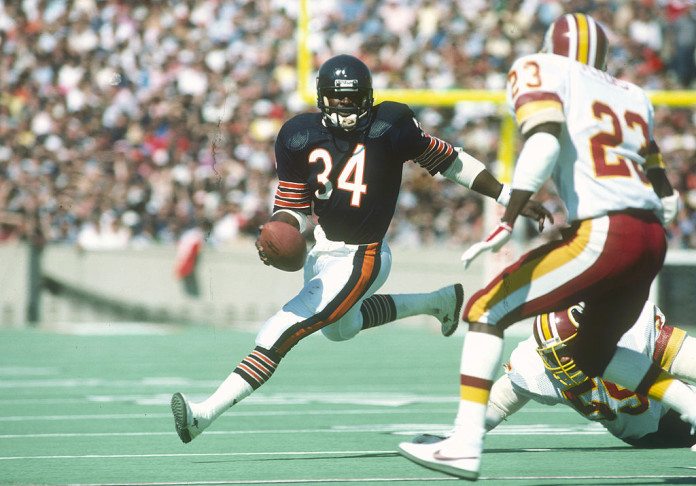
Pro Football Hall of Fame and Chicago Bears running back Walter Payton (34) breaking tackles in the Bears 45-10 victory over the Washington Redskins on 9/29/1985 at Soldier Field in Chicago Illinois. (Photo by James V. Biever/Getty Images)

Chicago Bears draft fans, like regular fans, have a love-hate relationship with ESPN. These days it’s still a respected venue that puts out some really good work. Some of its writers are fair and honest in evaluations. Then again, it’s always felt like the sports giant finds a way to disrespect the franchise in one form or another. Most often by not having any real clue about its history in terms of what is perceived and what is true.

Sadly that was on display again with one of their most recent power rankings. Columnists Brian Burke and Doug Clawson set about listing the 32 greatest draft classes of the Super Bowl era. Their method was using the website Pro-Football-Reference and their Approximate Value stat. The reason for this choice?

“It is a composite measure of a player’s value to his team, based roughly on game appearances, game starts and awards such as Pro Bowl and All-Pro selections. Meaningful individual stats also help determine a player’s AV, and the metric is boosted for players who are members of winning teams.”

Getting the wrong Chicago Bears draft

Fair enough. Sounds pretty interesting. It turned out well for the Bears. One of their draft classes ranked fourth overall on the list. The problem is which class it ended up being. That of 1975, the first under well-known former GM Jim Finks. They explained how the conclusion was reached on this.

“This very deep class is headlined by one of the greatest running backs in NFL history, Walter Payton, who would carry the Bears’ Super Bowl XX offense a decade later. Defensive end Mike Hartenstine was the other standout from this class. He played for 13 seasons and had eight starts for the ’85 championship defense.

The 1965 class was before the common draft era, but it featured Hall of Famers Gale Sayers and Dick Butkus, who were picked Nos. 3 and No. 4 overall, respectively. But even if we included this group, its 347 AV pales in comparison with the ’75 Bears class because of Sayers’ and Butkus’ relatively short careers.”

With respect to the work the two men did, and it’s an understandable approach, the fact of the matter is they’re wrong. The best Bears draft in franchise history was not 1975. Look, Walter Payton was an all-time great. He deserves every bit of adulation he ever got and still gets to this day. That being said most of his biggest accomplishments didn’t amount to much for the team. The same goes for the rest of that draft class.

The real winner

Chicago made the playoffs twice when the bulk of that group was together. Not a terrible accomplishment but nowhere near the impact of the actual best class in Bears history. That being the 1983 group:

  • Jimbo Covert
  • Willie Gault
  • Mike Richardson
  • Dave Duerson
  • Tom Thayer
  • Richard Dent
  • Mark Bortz

Understand that this class had four men reach at least two Pro Bowls in their career. It had seven players start at least five seasons or more for the Bears. Two of them started 10 seasons or more. Also they collectively helped the team reach the playoffs five times. All of those stats are superior to the 1975 class. Not to mention they were more directly responsible for winning the Super Bowl in 1985. Even more so than Payton.

Sweetness was and remains the best player in history the Bears franchise has ever drafted. Yet one man, not even with his aura, can carry an entire draft class. The 1975 group is forgettable without him. With him it rise to become really good. Still, the fact remains that the 1983 class was far superior. The stats, depth and impact prove that much.

Using fancy metric systems to decide such things can be fun and novel at times. Then again there comes a moment where common sense has to take over. This is one of those moments.

Cardinals Pitchers Are Helping Kyle Schwarber Set Personal Home Run Records

Even though Kyle Schwarber has only played in 73 regular season games since 2015, it appears he has found a pitching staff that he enjoys hitting goddamn moon shots off of.

Schwarber launched a bomb in the top of the seventh inning today to help spark the Cubs to a 6-4 come from behind win. I don’t know what was better — Schwarber admiring his missile or the Cardinals “big free agent signing” Brett Cecil knowing immediately that he just fucked up big time.

Welcome to the National League, Brett.

That shot was the first home run off of Cardinals pitchers for Schwarber in regular season games but not his first home run off Cardinals pitchers overall. Every single Cubs fan knows Schwarber’s cannon shot that he hit during Game 4 of the 2015 NLDS against the Cardinals that ended up on top of the Wrigley Field video board.

That shot actually followed his first home run off Cardinals pitchers when he went yard in Game 3 of the 2015 NLDS but it was his Game 4 home run that will forever go down in Cubs lore.

While the height and distance of Schwarber’s bombs are jaw-dropping by themselves, it may be the ball’s exit velocity that is even more impressive. Schwarber’s average exit velocity in 2015 was 93.2 mph and he technically “led” the Cubs in exit velocity last year at 101.7 mph even though he only had four at-bats before being sidelined for the entire regular season.

Schwarber’s first home run of 2017 and his “video board” bomb were almost identical in terms of the speed the ball came off the bat.

Obviously, the top two fastest home run balls off his bat came off Cardinals pitchers so it’s safe to say that the War Bear has found a staff stupid enough to keep challenging him with fastballs.

Keep feeding him the heat guys, I love watching him hit bombs.


Dennis Rodman Is 100% Right About Michael Jordan & LeBron James

dennis rodman lebron james michael jordan rest nba
(Photo: Huffington Post)

To rest or not to rest. That is the question of the season in the NBA, and it’s generating endless discord between players, fans and league executives. Players in today’s NBA believe resting on some nights can better prepare their bodies for a long playoff run, and most coaches of contenders are using that strategy more and more. Fans, meanwhile, are rightfully upset when they pay good money to see their favorite team only to find out the biggest stars are sitting out to rest. This conundrum has reached a boiling point, and folks are wondering if the league should shorten its 82-game season to squash this problem.

But it wasn’t always a problem. Former NBA players who now wear suits and microphones and talk hoops on studio sets are recalling their heyday when playing 82 games was a badge of honor rather than something to complain about. Former Bulls champion and Hall of Famer Dennis Rodman just threw his hat in the ring. Unlike some of his competitors of the ’80s and ’90s, The Worm didn’t sugarcoat anything about his take. Instead, he called out LeBron James – unquestionably the game’s biggest star for the last 10 years – in a recent interview with CBS Sports.

“You know what, LeBron’s doing one thing that I always said that Michael Jordan never did. He never rested. He played every game. LeBron has the position to do this now, because they need him. The league needs him, and that’s why he’s doing all this crazy shit now, like bitching and complaining and all this bullshit.” – Dennis Rodman

Rodman’s never been a fan of censorship, so these words shouldn’t come as a shock to anyone. And while he might not be the most eloquent public speaker, the rebounding legend has an irrefutable point.

Coming At The King

LeBron James didn’t start this whole idea of resting when healthy. Gregg Popovich has used this tactic with his aging cast of stars in San Antonio for years. But James is the face of the league, not Pop. He’s the biggest star, so he deservedly draws the most attention. Even though several teams (including the showtime Warriors) are resting star players down the stretch, LeBron will take the brunt of the criticism. That’s just how it works.

But the crux of Rodman’s argument is simple. If you’re comparing the game’s greats, this new fad of players resting must be a factor in any comparison, and it will always give Jordan the edge over James.

Iron Mike vs The King

No, we’re not talking Ditka. The real Iron Mike in Chicago was and always will be Jordan. The GOAT played all 82 games in 8 of his 11 full seasons with the Bulls. (He missed most of the ’85-86 season with a broken foot and played just 17 games in ’94-95 after making his first comeback.) But eight of the full eleven, he didn’t miss a game. That’s insane. Even crazier is to realize that 3 of those 82-game marathons came during the second threepeat when Jordan was 32-34 years of age. In the three full seasons Jordan did not play all 82, he missed a combined 7 games. That’s it.

Now let’s look at LeBron. Nearly finished with his 14th season, King James has never played a full 82 games. While he does deserve credit for his overall durability (he’s never missed extended time or a full season for any injury) he still can’t even boast a single 82-game season on his record. Jordan wins 9-0 in that department if you include his final season with the Wizards. Assuming James plays every game on Cleveland’s remaining schedule this season, he will have missed a combined 68 games over his 14 seasons.

For perspective, that’s averaging 76.7 games played per 82-game season (and yes, I did factor in the lockout-shortened season of ’11-12.) Again, that’s a pretty impressive number for a 14-year career as one of the league’s best. But it’s not better than Jordan’s average of 81.4 games played in his 11 full seasons in Chicago.

Minutes Count Too

What’s the next logical argument for LeBron’s defenders in this argument? He has more miles on his legs than the average 32 year old in the NBA, because he entered the league at 18. He’s also played heavy minutes in the regular season and made deep playoff runs in most of them. Those minutes add up.

While this is true, it’s not like LeBron plays more minutes than Jordan did on a nightly basis. Not counting the 18 games he played on a minutes restriction after returning from the broken foot in ’86, Jordan averaged 38.9 minutes per game in his Bulls career. LeBron’s current career minutes average? An identical 38.9 minutes per game.

To be fair, let’s factor in LeBron’s early entry into the league by adding two years to his actual age when comparing him to Jordan. The GOAT was 32, 33 and 34 years old during the threepeat of ’96-98. He averaged 38.1 minutes per game across those seasons. LeBron’s (age-adjusted) matching seasons are 2014-15, ’15-16 and this season. In those three seasons, James is averaging just 36.4 minutes per contest. And remember, LeBron missed 25 games in those three seasons. Jordan missed zero in the equivalent span.

Different Time, Different Game

Another argument that Rodman astutely makes when comparing LeBron’s days off to Jordan’s stellar attendance record is the style of game in the NBA during their respective generations.

“Back then, when [Jordan] was getting his ass whupped, I mean beat down every game, and then when he played against us [the Pistons], he said — guess what — ‘I gotta go back in the gym.’ And he got tough. He got tough, and he got great. And greater. So that’s it.” – Dennis Rodman

The NBA of the ’80s and ’90s was undeniably much more physical than today’s game. This isn’t some stereotypical old grump-speak of, “back in my day…blah blah…these kids today are so soft…blah blah.” No. It’s true. The physicality of the older generations was brutal. Flagrant fouls in today’s NBA were common fouls back then. Elite scorers like Jordan would get absolutely hammered when they dared drive down the lane. Whether it was Rodman and his Bad Boy Pistons in the ’80s and early ’90s, or the hard-hitting Knicks and Pacers of the mid-late ’90s, Jordan took beating after beating.

LeBron often complains about getting unfair treatment from the officials. He argues that because of his size and strength, they often don’t call fouls when players hit LeBron because he can muscle through them. There is some truth to that, but LeBron doesn’t deal with half of the hard hits Jordan took. When you factor that into the resting debate, Jordan matching or exceeding LeBron’s durability is all the more impressive.

The Big Difference

You can compare MJ’s stats to LeBron’s until the cows come home. Given the longevity of James’ career and Michael’s foray into baseball, James is likely to pass Michael in most individual statistical categories. But when focusing on this current debate of whether or not players should rest – or be criticized for it – Jordan will always top James.

Here’s what LeBron had to say recently on the issue of modern NBA players resting:

“It’s a long, strenuous season and the NBA does a great job of putting the schedule together as best as they can. You’re going to have back-to-backs. You’re going to have certain games where certain things fall on certain nights, but a coach’s job is to figure out a way for their team to compete for a championship, not compete for a game.” – LeBron James

First of all, James tries to put this resting issue on the coaches. That’s nonsense. Everyone knows that when LeBron takes a night off, it’s his decision. The “DNP-CD”s that appear frequently next to his name in the box score should really say “DNP-LD”, as in “Lebron’s Decision.” By focusing on his coach‘s job, LeBron is directing attention away from the fact that he’s making the decision to take nights off from doing his job.

This is what it all comes down to. This is what will always separate Jordan and LeBron. MJ had a “love of the game” clause in his NBA contracts, which allowed him to play basketball anytime, anywhere. He didn’t just want to win NBA titles, he wanted to win every single game he played. Regular season, playoffs, scrimmage at practice, pickup game on the Warner Bros lot between shooting scenes of Space Jam. All of them. Jordan’s intense desire to be the best and win the most was and still is unparalleled by any NBA player in history.

LeBron is on record – during one of his many trips to the NBA Finals, no less – saying, “it’s just basketball.” He may profess his love for the game, but it will never match that of the GOAT he’s chasing. If LeBron loved the game as much as Jordan did, he wouldn’t regularly take nights off. He couldn’t. Michael fought like hell to come back early from his broken foot, and then fought the organization’s minutes restriction. When the front office tried to explain that the minutes restriction was about protecting Jordan’s health for the future, he couldn’t look that far ahead. He wanted to win the next game. He played through aches, bumps and bruised bones. He played through illness. (Pour one out for the Flu Game.) The GOAT did all of that because that’s how much he loved winning and basketball.

LeBron just doesn’t love the game (or winning) that much. The unquenchable desire to win made Jordan who he was. That mental edge is one he’ll always hold over LeBron, and we may never see that level of competitive insanity again. If anyone came close, it was Kobe. It’s the underlying factor in the debate about whether or not players should rest, and whether or not anyone will ever be able to say they were as good or better than Jordan. Which players love playing and winning so much that rest doesn’t even cross their mind?

Dennis Rodman may be crazy, but he’s 100% correct about this debate and the numbers are there to prove it. LeBron rests when he wants to, or feels like he needs to. Jordan never did.

“So that’s it.”

Cubs Rally And Win After Possibly Catching The Cardinals Cheating

The Chicago Cubs were trailing 4-2 in the top of the seventh inning, when Matt Szczur struck out swinging to begin the comeback against the St. Louis Cardinals on Thursday. On the swing and miss, Yadier Molina couldn’t locate the ball in the dirt because the ball wasn’t on the ground at all. Thanks to some sort of substance, most likely pine tar, the ball got stuck to Molina’s chest protector and by the time the catcher realized what had happened, Szczur was safe at first base. A few batters later, the Cubs were up 5-4.

So, why did that ball stick to Molina? There’s no doubt there was something fishy about the play, but did the Cubs actually catch the Cardinals cheating?

Let’s take a look.

As much as I want to jump down the Cardinals throats here, the most likely outcome is that nothing illegal was actually done. Yes, you can see a brown smudge on Molina’s chest protector, but this has happened before and it’s pretty much accepted in MLB.

For example, during the 2015 World Seres between the Royals and Mets, Salvador Perez had pine tar on his shin guard and nothing was really made of it by the Mets. The argument being that catchers need it for better grip, especially during cold games. Anyway, if Joe Maddon thought something was illegal he would’ve said something.

So, unless Cardinals pitcher Brett Cecil was using pine tar, there’s no controversy here. However, that doesn’t mean this wasn’t absolutely hilarious because after Szczur reached, Jon Jay walked and then Kyle Schwarber ripped the hearts out of Cardinals fans…again.

The Cubs added another run later in the seventh to make it 6-4. Hector Rondon pitched a perfect inning and then Carl Edwards Jr. bailed out Pedro Strop in the eighth. Edwards came in with two runners on and one out, but got out of the jam by striking out Randal Grichuk and Jedd Gyorko.

Wade Davis gave up a double in the ninth, but worked around it to pick up his second save of the year. A nice little series win to open up the 2017 season for the World Champs.

Oh, by the way, if a Cardinals fan ever tells you how bad Kyle Schwarber is as an outfielder, which he isn’t really, just show them this to shut them up.

Kyle Schwarber Hits A 3-Run Bomb To Give Cubs Lead Over Cardinals

Kyle Schwarber to the rescue!!!!

Down all game after a brutal misplay by Ben Zobrist that led to three St. Louis Cardinals runs, the Chicago Cubs slowly battled back to a 4-2 deficit. Then, in the seventh inning, with two runners on, Schwarber drilled a three-run home run to give the Cubs a 5-4 lead.

RIP baseball.

Beautiful swing.