Monday, November 16, 2026
EDGE is live. Chicago fans can now access and explore the beta.
Home Blog Page 2892

The Most Unexpected Pitchers Are Now Getting The Most Important Outs For The Cubs Bullpen

A year ago the Cubs and fans wanted no part of Justin Wilson on the playoff roster after trading for him in July from the Detroit Tigers to help solidify the bullpen. Now, Wilson is the third maybe the second most trusted reliever coming out of the pen down the stretch?

It is wild how one year can change everything. Wilson is now responsible for getting some of the biggest outs for the Cubs in a division race after looking like Tyler Chatwood last year.

During Tuesday’s 3-0 win over the Milwaukee Brewers, Jose Quintana pitched brilliantly and should have had seven shutout innings. However, Daniel Murphy’s poor play on a slow grounder really put the Cubs in a tough spot with the bases loaded when the inning should have been over.

Luckily, Wilson came in and struck out Manny Pina to bail out Murphy.

Since July, Wilson has a 2.50 ERA, allowing five earned runs in 18 innings during 30 appearances.

He’ll certainly be in more high leverage situations down the stretch, especially against lefties, who Wilson is holding to a .195 batting average this season.

Yet, Wilson’s strikeout with the bases loaded might not have even been the most impressive performance from a reliever last night.

After Victor Caratini added an insurance run in the seventh to make it 3-0, Joe Maddon went to Jorge de la Rosa in the eighth. De la Rosa faced a pinch hitter in Tyler Saladino, Lorenzo Cain, who’s killed the Cubs this year and then Christian Yelich, who’s been the best hitter since the All-Star break.

And by now you already know what happened. De la Rosa, who the Cubs signed on Aug. 10, after the Arizona Diamondbacks released him, set the Brewers down in order, striking out both Cain and Yelich.

Since joining the Cubs, de la Rosa has mainly been used in mop up duty, but he’s provided the team more than what was expected, only allowing three earned runs in 15.1 innings. And now all of a sudden he’s getting big outs in the middle of a division race in September?

Ah yes, just like we all imagined back in April.

And by the way, the two most trusted guys in the bullpen right now are Pedro Strop, who some Cubs fans still don’t trust despite his 2.33 ERA and Jesse Chavez, who the Cubs traded for back in July.

Oh how things change in one year.

The Cubs are still hopeful to get Brandon Morrow as soon as next week, although he won’t be coming back right into the closer position.

So for now, the Cubs will have to rely on some unexpected names to continue and come up big. Though, if they really want to be a threat, Carl Edwards Jr. and Steve Cishek have to return to their elite level because it’s been pretty bad the past couple weeks for those two.

Blackhawks Will Honor Mikita On October 7 And Throughout Season

Today the Blackhawks announced that they will be be honoring the life of Stan Mikita on October 7. The ceremony will be during the pregame of their home opener against the Toronto Maple Leafs. Fans are being encouraged to arrive early before the 6pm CST puck drop.

Blackhawks players will be donning patches with Mikita’s number 21 on their jerseys throughout the season. In addition, the United Center ice will have his number painted on the ice behind each of the goals for the entirety of the 2018-2019 campaign.

Mikita played 22 years with the Blackhawks and is the franchise’s all-time leader in points (1,467) and games played (1,394). He is second only to Bobby Hull in goals with 541.

This will be the first patch commemorating a fallen member of the organization since the 2007-2008 season when the team wore “WWW” for longtime owner William Wadsworth Wirtz.

Last I checked there are still tickets available for the October 7 tilt versus Toronto but I have a feeling those will be going fast.

Follow @Pappy_Hour on twitter for more Blackhawks news and musings. 


White Sox Mailbag: Second-Tier Pitching And Is Lopez The New Quintana

Since the last White Sox mailbag, we received 1,000 percent more questions. Thank you. Many of the questions were challenging and I’ll do my best to provide a fair answer.

****

Matt: Which second-tier pitching prospect (Adams, Guerrero, Clarkin, Flores, Puckett, Stephens, etc.) has the best chance at making an impact as a major-league starter?

Wow! Great question. Finding left-handed pitching is always difficult and with only one southpaw in the current rotation, I’d like to see Jordan Guerrero or Bernardo Flores succeed. Neither are going to blow the doors off opposing lineups, but given the power arms set to enter the rotation (including Michael Kopech when he returns from Tommy John surgery) mixing in a crafty lefty would compliment the rotation nicely.

Yet, Jordan Stephens and Spencer Adams were value picks early in the draft and while not sexy compared to flamethrowers Kopech and Dylan Cease, might serve mid-rotation roles if injuries infect the rebuild. Adams posted a 3.79 earned run average this season but his WHIP was surprisingly high (1.38). Stephens suffered a bit more this season with an ERA over four and similar WHIP to Adams, and given his “advanced” age (he’s already 26) I’d say he needs to make noise right now and could even be a cut candidate this offseason.

Ian Clarkin and A.J. Puckett could easily fill the gap left by Stephens and by most accounts, have higher ceilings anyway. But if I had to choose one that would have an impact on the rotation in the next two seasons I’d say it’s likely to be Adams given his youth and performance at Triple-A.

****

@CooleyTerron: Is Lopez the next Quintana for the White Sox?

If you’re referring to sandbagged wins and no decisions, I don’t think anyone will ever match Jose Quintana. My feeling is that Reynaldo Lopez has a far superior repertoire than Quintana eve has.

Lopez has a plus curveball that enhances the deception in his changeup if he pitches off the fastball well. And the fastball can reach triple digits making it a supreme out pitch. If he runs into trouble he can reach back for a heater that beats bats.

The difference will be his command. Quintana was sharp for most of his career, but if Lopez can tame his pure stuff he has a chance to be much better than Quintana, and that speaks volumes about his ceiling.

****

Colin: When is Eloy coming up?

Monday, April 15, 2019, against the Kansas City Royals. Book it!

****

Colin: Given the lack of on-base skills on the current White Sox roster, is our batting coaching flawed somehow or is it purely the lack of talent? Would changing coaches or other changes improve us?

I’d say the lack of situational hitting with runners on base is more unnerving than the merely getting hits. Coaching plays a role in building an offensive philosophy and general approach at the plate, but the players have to execute at some point.

It’s no secret that I like bunting and Rick Renteria‘s commitment to this practice and refusal to accept excuses when players don’t get the job done is music to my ears. Players have to play to the situation. The White Sox have more talent on the roster than people acknowledge (as a fan base I think we’re dangerously blinded by the reflection of prospect promise) and the roster is built for speed, so situational hitting should be their strength.

A coaching change might help wake some players up from the general malaise of the past two seasons, but the most glaring issue in the lineup is Yoan Moncada‘s refusal to swing at anything close with two strikes. If there’s someone in this universe that can help him with this I’d like to bring him in.

****

Thank you for your questions. We’ll keep this effort rolling, so make sure you submit your questions to the next White Sox mailbag.

Jose Quintana Is A Ferrari, The Brewers Are A Ford Pinto

Without Jose Quintana, the Cubs don’t win the division last year and once again he’s coming up big in the most important time of the season. His dominance against the Brewers continued Tuesday night and it also extended Quintana’s success over the past month.

Let’s begin with the Brewers.

In his last two starts Quintana has pitched a total of 13.1 innings, allowing two combined runs. Both of those outings were against the Brewers and included last night’s 6.2 innings of shutout baseball.

Overall in 2018, Quintana has pitched against the Brewers six times. Here are his numbers in those games.

4-1, 2.17 ERA, 0.88 WHIP, 33 strikeouts, 10 walks, 23 hits, 37.1 innings.

Since the beginning of August, Quintana has a 3.28 ERA in eight starts and he’s been amazing in his last five. Plus, check out his career against the Brewers.

Quintana for whatever reason just seems to own the Brewers. Last year he made two starts against Milwaukee and he only allowed two runs on seven hits and four walks in 15 innings. That included a complete-game, three-hit shutout on Sept. 24.

So, Quintana is revving up right on time for the stretch run. Just remember what Willson Contreras said earlier this season.

Jose Quintana is a Ferrari and the Brewers are a Ford Pinto.

Akiem Hicks Was Dumbstruck by How Good Khalil Mack Was

akiem hicks

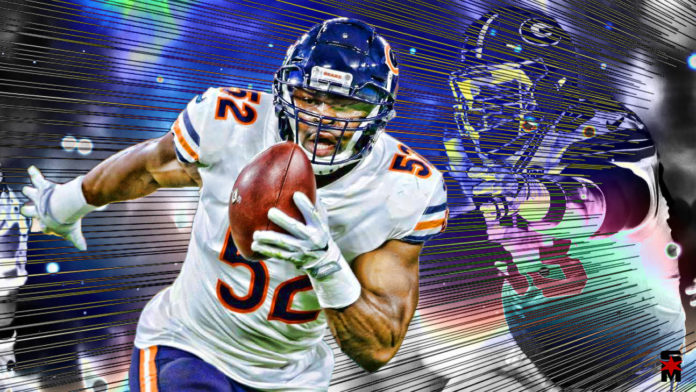
Khalil Mack was a machine in his first game for the Chicago Bears. In one half of football, he delivered a sack, a forced fumble, a recovered fumble, and a pick-six. Considering he missed all of training camp, all of the preseason and had spent just one week practicing in the Bears defensive system, that’s utterly baffling. It’s also a testament to how gifted he is. Akiem Hicks was right there in the middle of it.

Hicks has played with some great players in the past, but it was evident during and after the game that he had never seen something like that before. One need only watch his reactions during the game. Hicks had been mic’d up by the Bears given his place as team captain and one of the more notorious talkers.

As great as that reaction was, Hicks seemed to grow even more in awe of his new teammate a couple days later. Speaking to the media on Wednesday, he talked about the difficulty of the loss, how to get over it and what to expect in Seattle. Soon enough the topic of Mack came up. Hicks referenced one play in particular that blew him away.

“Did you see Khalil’s (strip-sack) where he just snatched the ball from (Kizer)? Like, who does that? You dream about that type of play.”

Clearly, Hicks didn’t watch film of Mack because the star pass rusher has actually done that a number of times in his career. He’s a master at going after the ball. As he works his way into proper football shape, he figures to become even better than he was at Lambeau. Hicks sounds like a man who is dying to see what he does next. No doubt the rest of Chicago is right there with him.

Chicago plays the Seattle Seahawks on Monday Night of week two. Russell Wilson was sacked six times in the season opener against Denver.

Cubs Class-A Minor League Team Wins Championship In The Most Devastating Way Possible

Nothing is more unpredictable than the postseason in baseball and that includes the minor leagues too. Last night the Eugene Emeralds, the class-A short season affiliate of the Cubs, won the Northwest League Title in what has to be the most devastating way possible. For the other team anyway.

First, let’s get to how the Emeralds even reached the playoffs.

Eugene actually finished with the worst record in the Northwest League at 31-45, but because the league splits the season into two halves the Emeralds won the second half Wild Card spot and qualified for the playoffs.

In the first round, the Emeralds swept the Hillsboro Hops, winning a pair of games 3-2 to reach the championship round against Spokane. Hillsboro had the best record in the league at 51-25. See, the postseason is unpredictable.

Anyway, Eugene quickly went up 2-0 in its series against Spokane and with a chance to sweep the Emeralds started the bottom of the ninth inning of Game 3 trailing 2-1. Then, things got crazy.

With runners at second and third and one out, Jake Slaughter was hit by a pitch to load the bases. Then, Andy Weber walked to tie the game at two and with the bases still loaded with one out and a title in sight, Nelson Velazquez stepped up to the plate, probably hoping he could pull a David Bote.

Instead, Velazquez never had to take his bat off his shoulder because Spokane’s pitcher Emmanuel Clase balked in the championship-winning run.

From worst to first.

So, the Emeralds proved once again that all you need to do is get to the playoffs and then anything can happen. Just play a few weeks of good baseball and all a sudden you’re a champion.

But oh boy, imagine that happening to your team in the World Series. Losing that way? You may never want to watch baseball ever again. I mean, bases loaded walk and then a balk? Brutal.

Congrats to the Emeralds though, as they’ve won two championships in the past three seasons. Hey, so now it’s the Cubs turn, as both teams won back in 2016.

I Can’t Believe I’m About To Say This About The Cubs

I mean, this wasn’t even a feasible thought two weeks ago, but right now it’s fact and I still can’t believe I’m saying this, but the Chicago Cubs are better off giving Victor Caratini more starts in place of Willson Contreras.

Of course the caveat is that this is only true for the moment. I’m not saying that Caratini all of a sudden deserves or should be the every day starting catcher over Contreras, but at right now he should be in there more often. And if you’ve noticed, the Cubs have actually been doing that in September, as Contreras has definitely tired and his play has suffered, mainly on offense.

During Tuesday’s 3-0 win over the Brewers, Caratini had two huge hits, including a 10-pitch at-bat in the second inning that concluded with an RBI-single to put the Cubs ahead 2-0.

While it wasn’t the hardest hit ball, he got the job done with the infield drawn, grinding out the plate appearance, fouling off several pitches and making contact with a runner at third and less than two outs.

Then, Caratini added an insurance run in the seventh, doubling in Tommy La Stella with a two-out, two-run double.

Since Aug. 28, Caratini is batting .308, with two home runs and eight RBIs.

So far in September, Contreras has a slash line of .150/.261/.200, with two walks and three hits in 20 at-bats. He’s caught more innings than anyone else in MLB, so the fatigue may just be setting in. Also, his power has been down since the first couple months, hitting only nine home runs all season. Contreras’ last home run came on Aug. 1.

So yeah, at this very moment you can make more than a valid argument that Victor Caratini is giving better at-bats for the Cubs than Willson Contreras.

I know, I don’t believe it either, but it’s true.

Hopefully Contreras gets enough rest to turn it back on for the final few weeks because the bottom of the Cubs lineup really does need a boost. But for now, it looks like Caratini is stepping up when the team needs production from anyone.

Here Are Some Reasons the Chicago Bears Can (and Will) Beat Seattle

khalil mack

The Chicago Bears should’ve beaten the Green Bay Packers on Sunday night. Everybody knows it. In the end, their own mistakes led to a painful collapse and a 24-23 loss. At the same time, the game was a revelation. This is not the same Bears team from the past few years. It’s young, it’s talented and it played with serious energy. The only obstacle in their way is learning how to finish.

They’ll get another chance in Week 2 against the Seattle Seahawks who are coming off a tough road loss of their own in Denver. It was clear it was no longer the Seahawks of yesteryear with that ferocious defense and power running game. It looked like a team struggling to stay relevant.

Outside of their quarterback and a couple studs on defense, they don’t look nearly as formidable as they once were. That’s why the Bears can and probably should beat them on Monday Night Football. Here are a few key reasons why.

Vic Fangio haunts Wilson

The Bears already have somebody on their team who knows Seattle well. Vic Fangio has coached again them, and especially quarterback Russell Wilson many times. He was the defensive coordinator for the 49ers from 2011 to 2014, so he witnessed the rise of the Seahawks star first hand, and got to see him multiple times a year. Wilson likely remembers Fangio too, and not in a fond way.

Wilson has rarely played his best against Fangio. Four of those 10 touchdowns he threw came in one game. Take that away and it looks even worse. Fangio knows how to force the quarterback into mistakes and knows how to get him on the ground, averaging 3.25 sacks across those meetings. Speaking of.

Mack vs. Ifedi

The Seahawks offensive line is and has been notorious for its problems protecting Wilson over the past few years. The season opener in Denver showed there was no sign of big improvements. Wilson was sacked six times on the afternoon. His right tackle, Germain Ifedi, was responsible for giving up two of them. That has to frighten Seattle.

Why?

Khalil Mack is one of the best pass rushers in football. The Bears were rewarded in their trade to get him right away as he devastated the Packers offensive line for the first half in Green Bay with multiple pressures, a sack, a forced fumble, and a pick-six. Considering he did that having missed all of training camp and preseason with only one week of practice? Wilson is in trouble.

There’s also one other note. The last time Mack played against Wilson was as a rookie in 2014. He pressured the QB eight times in that game, hitting him twice. Wilson completed less than half his passes for 179 yards. Mack must be licking his chops.

WR Baldwin is out with a knee injury

Making matters worse is the fact that Wilson won’t have his best passing target Monday night. Doug Baldwin left the season opener against Denver with a knee injury. It was later revealed he had a Grade 2 MCL tear. This means he’s likely to miss a couple weeks of action. If so, it will mark the first time since 2012 that Wilson won’t have his best wide receiver on the field with him.

The question is can a 34-year old Brandon Marshall and primarily special teams threat Tyler Lockett carry the load in the passing game without him. They did fine in Denver but much of the success that day was thanks to tight end Will Dissly and the screen game to the running backs. One can bet the Bears will be ready for that. It’s worth noting that the Seahawks are 11-7 in games where Baldwin registers one catch or fewer.

The Seahawks run defense

This might be the one people have missed. People have talked about the Legion of Boom’s demise and all that, but amidst that talk is the reality that their run defense has steadily deteriorated since the beginning of last season. Seattle ranked 19th last year stopping the run and they didn’t get off to a good start in Denver where the Broncos piled up 146 yards on them.

That’s not good news with Jordan Howard and Tarik Cohen looming up next. Those two combined for 107 yards on just 20 carries in Green Bay, averaging 5.35 yards a pop. That was with a strong defensive line, something Seattle doesn’t have. Also, Howard was better at home than he was on the road last season.

It’s worth noting the Bears are 5-2 when Howard rushes for 100 yards or more at Soldier Field. Something to keep an eye on.

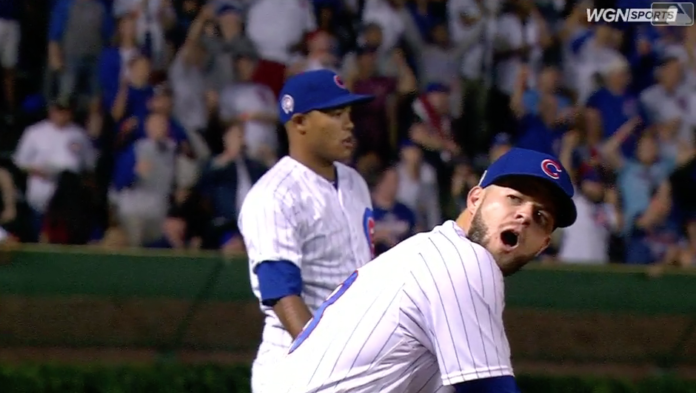
David Bote Was Every Cubs Fan Watching Addison Russell Pull Off An Amazing Play

I’m not sure why Addison Russell wasn’t in the game in the seventh inning, with Javier Baez moving over to second for Daniel Murphy, but he was in there in the ninth and made an amazing play that gave Cubs fan a new favorite GIF.

With a 3-0 lead over the Brewers, Ryan Braun stepped up with one out against Pedro Strop and ripped a liner to the left side of the infield. Russell ranged over, made an unbelievable stop, rolled over and then threw out Braun at first for the second out of the ninth.

David Bote’s reaction was perfect.

Now, let’s just have Russell sooner in the game so that the Cubs don’t almost blow a game because Daniel Murphy is a trash defender.

How Long It Will Take Mitch Trubisky to Click in the Nagy Offense

mitch trubisky

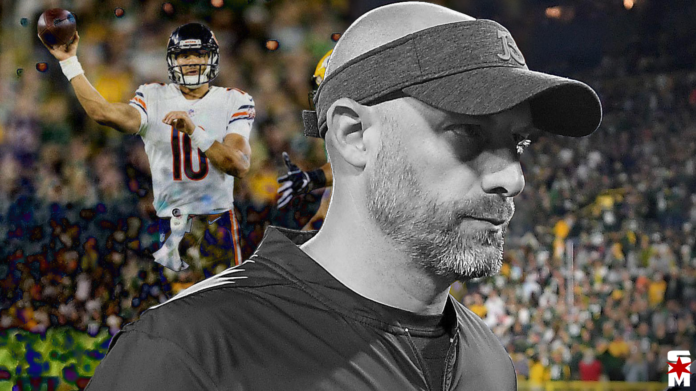
Mitch Trubisky is under a rather incredible amount of scrutiny after the Sunday night loss in Green Bay to open the season. He finished with 174 yards, no TD passes, and no interceptions. It was a rather quiet night for him as a passer, though he did rush for a touchdown early in the game. Yet people are making it out to seem like he threw the game away.

Yes, he didn’t play his best but he was not the reason that the team lost. The defense giving up 21 points in the fourth quarter is a big reason. Conservative play calling is another. Trubisky missed some opportunities, but he didn’t give the game away. Care to know some other quarterbacks around the league who had worse games than him?

All had lower and sometimes much lower quarterback ratings than Trubisky. So what’s the deal? It likely comes down to a lack of patience. People wanted to see him click in that Matt Nagy offense right away. That West Coast-college spread hybrid that did such good things in Kansas City. Why didn’t it happen?

The answer is rather simple, and history explains it.

History says Mitch Trubisky doesn’t need changes, he needs time

Here’s the thing about the West Coast offense. It’s hard. Really hard. There’s a reason it’s been around for over four decades. It is incredibly complex and has only grown more so over the years as coaches like Nagy put their own spin on it. Certain plays can have 10 words or more in it just to pronounce, laying out what everybody is expected to do.

It’s unreasonable to expect a quarterback to memorize a full playbook of that and then execute flawlessly right away. it doesn’t work like that. History proves that much. Here is a rundown of many notable QBs who experienced the West Coast system, how they started and when they truly figured it out.

Joe Montana – 2nd year
  • First start:  5-of-12, 36 yards, 0 TDs, 0 INTs
  • First season (1980):  176-of-273, 1,795 yards, 15 TDs, 9 INTs
  • Second season (1981):  311-of-488, 3,565 yards, 19 TDs, 12 INTs

Of course, the original maestro of the “West Coast” scheme was Ken Anderson in Cincinnati but the man who made it go viral was Joe Montana with the San Francisco 49ers. Believe it or not, even the future Hall of Famer went through some early headaches. It took Walsh a full season to get the proper mechanics ingrained in him. By Year 2 in 1981 though, it paid off with a Super Bowl title.

Boomer Esiason – 2nd year
  • First start:  13-of-24, 159 yards, 0 TDs, 2 INTs
  • First season (1984):  51-of-102, 530 yards, 3 TDs, 3 INTs
  • Second season (1985):  251-of-431, 3,443 yards, 27 TDs, 12 INTs

Esiason was inherited by Walsh disciple Sam Wyche, who’d been Montana’s quarterback coach in San Francisco. The two didn’t get off to the best start. Boomer was a wild buck who tended to be undisciplined with his approach. Soon enough that changed and he broke out in his second year. He eventually became league MVP in 1988.

Brett Favre – 3rd year
  • First start:  14-of-19, 210 yards, 2 TDs, 0 INTs
  • First season (1992):  302-of-471, 3,227 yards, 18 TDs, 13 INTs
  • Second season (1993):  318-of-522, 3,303 yards, 19 TDs, 24 INTs
  • Third season (1994):  363-of-582, 3,882 yards, 33 TDs, 14 INTs

There was no questioning Favre’s talent. His arm was otherworldly and he was a better athlete than he got credit for. Walsh’s protege Mike Holmgren, who was the offensive coordinator for the 49ers during their 1988 and 1989 championship runs, still needed time to break the young QB of some bad habits. Namely poor decision-making and inconsistent mechanics.

Warren Moon – 2nd year
  • First start:  20-of-37, 166 yards, 0 TDs, 3 INTs
  • First season (1993):  371-of-601, 4,264 yards, 18 TDs, 19 INTs
  • Second season (1994):  377-of-606, 4,228 yards, 33 TDs, 14 INTs

It wasn’t until 38-years old that Moon got his first taste of the West Coast offense. Before that he’d made his name in the Run-and-Shoot with the Houston Oilers. The change came as quite a shock, but head coach Dennis Green was undeterred. Green had been with Walsh from 1986 to 1988 in San Francisco. He trusted that with time the old veteran would catch on. He was right.

Donovan McNabb – 2nd year
  • First start:  8-of-21, 60 yards, 0 TDs, 0 INTs
  • First season (1999):  106-of-216, 948 yards, 8 TDs, 7 INTs
  • Second season (2000):  330-of-569, 3,365 yards, 21 TDs, 13 INTs

People were concerned about McNabb coming out of Syracuse. They felt that he had too much of a run-first mentality and wouldn’t be able to adapt into the pocket passer he needed to be. Andy Reid, who’d just taken over in Philadelphia and was a Holmgren disciple, disagreed. It took some adjusting but McNabb caught on and went to the Pro Bowl his second year.

Jeff Garcia – 2nd year
  • First start:  21-of-33, 243 yards, 2 TDs, 0 INTs
  • First season (1999):  225-of-375, 2,544 yards, 11 TDs, 11 INTs
  • Second season (2000):  355-of-561, 4,278 yards, 31 TDs, 10 INTs

Garcia was a fish out of water in 1999. He’d come over from the CFL and had the dubious honor of having to replace 49ers legend Steve Young. He’d never seen something like the West Coast system up north and it showed. Steve Mariucci, who’d taken over for longtime Walsh right-hand man George Seifert, stuck it out and was rewarded with a Pro Bowl the next year.

Rich Gannon – 2nd year
  • First start:  21-of-44, 266 yards, 2 TDs, 1 INT
  • First season (1992):  159-of-279, 1,905 yards, 12 TDs, 13 INTs
  • Second season (1999):  304-of-515, 3,840 yards, 24 TDs, 14 INTs

The amazing thing about Gannon is he played in the West Coast offense for the first time as a starter in ’92 and then was released to sign elsewhere. He didn’t find a team that implemented it again until Jon Gruden came calling in 1999 with the Oakland Raiders. Clearly, Gannon hadn’t forgotten what he learned seven years earlier in Minnesota.

Matt Hasselbeck – 3rd year
  • First start:  20-of-34, 178 yards, 0 TDs, 2 INTs
  • First season (2001):  176-of-321, 2,023 yards, 7 TDs, 8 INTs
  • Second season (2002):  267-of-419, 3,075 yards, 15 TDs, 10 INTs
  • Third season (2003):  313-of-513, 3,841 yards, 26 TDs, 15 INTs

Hasselbeck had actually learned the system during his long stint as backup quarterback of Favre in Green Bay. Then when Holmgren took over in Seattle in 2001, he finally got his chance. He quickly learned that understanding a system and executing it are two different things. Over time though he began to master it and was in the Pro Bowl by his third year.

Kirk Cousins – 2nd year
  • First start:  26-of-37, 329 yards, 2 TDs, 1 INT
  • First season (2014):  126-of-204, 1,710 yards, 10 TDs, 9 INTs
  • Second season (2015):  379-of-543, 4,166 yards, 29 TDs, 11 INTs

The West Coast experience for Cousins actually began as a rookie in 2012 under Kyle Shanahan, who was the son to Mike Shanahan, a former 49ers offensive coordinator in the mid-1990s. However, he was gone by 2014 and replaced by Jay Gruden, brother to Jon Gruden. It was only when he arrived that Cousins became the starter. Things were a rollercoaster at the start, but he broke out in a big way the next year.

Bears examples:

Believe it or not, there are a few Bears nuggets in the history vault to help further drive home the details of this offense. This one was actually a variation of it created by former offensive coordinator Ron Turner who employed many similar concepts. The results were quite similar as well.

Erik Kramer – 2nd year
  • First start:  18-of-25, 212 yards, 2 TDs, 0 INTs
  • First season:  99-of-158, 1,129 yards, 8 TDs, 8 INTs
  • Second season:  315-of-522, 3,838 yards, 29 TDs, 10 INTs

Kramer still holds the Bears single-season passing records for both most yards and most touchdown passes. Considering he was a journeyman his entire career, that’s fairly impressive. Chicago did the right thing back then surrounding him with proper weapons like Curtis Conway and Jeff Graham.

Rex Grossman – 3rd year
  • First start:  16-of-35, 227 yards, 0 TDs, 2 INTs
  • First season:  47-of-84, 607 yards, 1 TD, 3 INTs
  • Second season:  28-of-64, 358 yards, 2 TDs, 3 INTs
  • Third season:  262-of-480, 3,193 yards, 23 TDs, 20 INTs

Yes, even the man they call “Gross, man” showcased improvement in Turner’s variation system. Grossman went through some injury troubles his first two seasons, which stunted his progress. Still, by 2006 he was finally healthy and ended up having the best year of his career. It wasn’t great but the improvement was still substantial in context.

The verdict throughout all of that? Quarterbacks usually have the system nailed down by their second year and no later than their third. This might not satisfy a lot of Bears fans. They demand Trubisky be great now. They’ve waited too long to be relevant at quarterback. So here’s an olive branch.

Quarterbacks consistently began to show progress towards the end of their first years in the offense. Montana had 3 TDs and 3 INTs in his first three starts. He had 7 TDs and 3 INTs in his final four. Favre? He had 3 TDs and 5 INTs respectively in his first six starts with 10 and 7 over the remaining seven. The point remains the same.

Give Trubisky time.