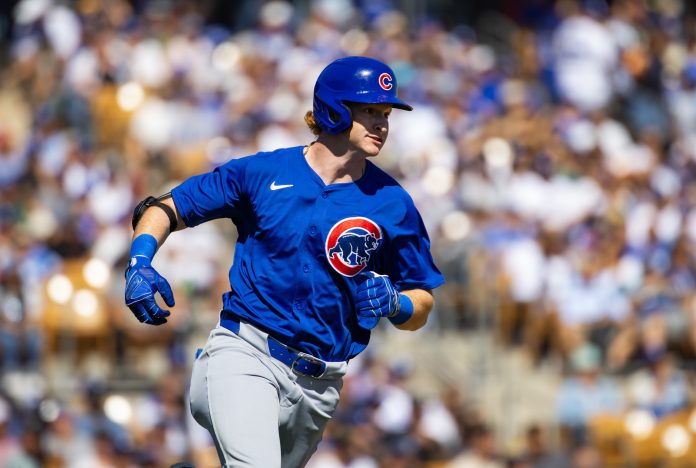
Mar 2, 2024; Phoenix, Arizona, USA; Chicago Cubs outfielder Owen Caissie against the Los Angeles Dodgers during a spring training game at Camelback Ranch-Glendale. Mandatory Credit: Mark J. Rebilas-USA TODAY Sports
According to reports the Chicago Cubs are calling up their top prospect Owen Caissie. In the team’s 4-1 win over the Toronto Blue Jays Wednesday night catcher Miguel Amaya suffered a gruesome injury in the eighth inning, when he stumbled over first base and needed to be carted off. Instead of calling up Moises Ballesteros, who has been up twice this year, the Cubs are reportedly bringing up Caissie from Triple-A.
Caissie, 23, is in his second year with the Iowa Cubs at Triple-A, and he’s been red-hot since late May. Since May 20, the left-handed hitting outfielder has recorded a slash line of .330/.424/.633 with 16 home runs. Now, he’ll be getting a chance in the majors.
News: The Cubs are calling up their top prospect, outfielder Owen Caissie, sources tell ESPN. Caissie was a key piece coming back from the Padres in the Yu Darvish trade in 2020. The native Canadian could make his debut in Chicago's series finale in Toronto tomorrow.
The Cubs acquired the outfielder back in Dec. 2020, when Caissie and three other teenage prospects were brought into Chicago from the San Diego Padres in exchange for Yu Darvish and Victor Caratini.
The Chicago Cubs won 4-1 Wednesday night, but they’ve lost catcher Miguel Amaya to a devastating injury. The 26-year-old made his return to the starting lineup against the Toronto Blue Jays as Amaya appeared in his first game for the Cubs since May 24, when he suffered an oblique injury. A day after coming off the 60-day injured list, Amaya was carted off with a leg injury after beating out an infield hit in the top of the eighth inning.
Amaya stumbled over the first base bag, flipped over and was immediately met by the team trainer.
The catcher was in tears as he was driven off the field in Toronto.
"I don't know that I've ever wanted to cry for a guy more than I want to cry for Miguel Amaya right now. So disappointing." – Jim Deshaies
Amaya returned from the 60-day IL (oblique injury) on Wednesday before being carted off with a leg injury tonight in Toronto. pic.twitter.com/72uozJ7lOv
Amaya, who has been with the Cubs since 2015, when he signed as an international free agent, battled through a few injuries as he climbed up the minor league system as a top prospect. Amaya made it up to the majors in 2023 and after some struggles in 2024, he finally turned a corner at the plate. Prior to his oblique injury earlier in May, Amaya was helping the Cubs put up the best offensive productive out of the catcher position by recording an .819 OPS through 27 games.
Following Wednesday’s game Cubs manager Craig Counsell delivered as good of news as one could have hoped. It definitely looked like Amaya may have badly injured his knee, but it turns out that it’s a sprained ankle. Still, a trip back to the injured list will be required for the Cubs’ catcher.
Craig Counsell said Miguel Amaya exited today's game with an ankle sprain.
The Cubs were carrying three catchers with Amaya’s return on Tuesday as Reese McGuire remained on the active roster, while Jon Berti was designated for assignment. So, the team doesn’t have to scramble for a backup catcher following Amaya’s ankle injury.
Cubs’ prospect Moises Ballesteros has been called up a few times already in 2025, and he could getting another stint in the majors to take Amaya’s spot on the 26-man roster.
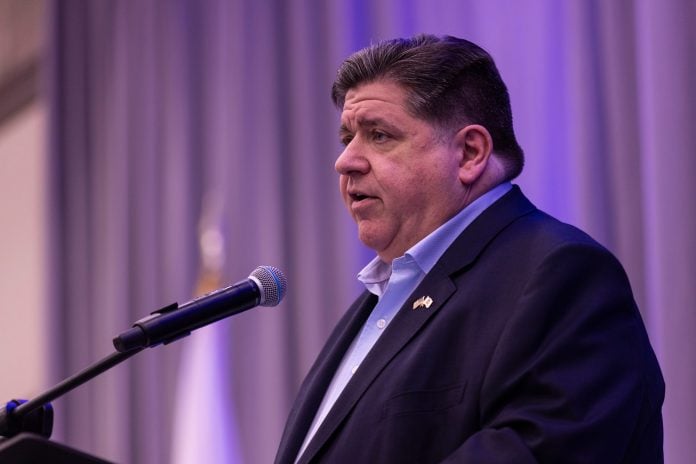
Illinois Gov. JB Pritzker speaks during the 2024 Midwest Aerospace Conference Thursday, Oct. 17, 2024, at the Embassy Suites in downtown Rockford.
Kevin Warren and George McCaskey announced last week what many had expected was coming. After extensive efforts to get a new downtown stadium off the ground, the Chicago Bears brass have shifted their focus back to Arlington Heights. They have all the resources in place to begin construction by the end of this year. There is only one hurdle left. Legislation from the state is needed to provide the necessary tax clarity for them to move forward. A veto session in October is their best chance to get that done.
Part of the problem is Governor JB Pritzker. He has stonewalled the Bears at every turn, stating he has no interest in giving the franchise any tax breaks when it doesn’t benefit the state. Longtime stadium expert Marc Ganis told 670 The Score that this hardline approach could have dire consequences.
“Gov. (JB) Pritzker is acting like there isn’t a state just a few minutes away that has legislation that wants to try to bring the Bears to Northwest Indiana,” Ganis said. “He’s acting like he’s the only game in town and the Bears haven’t approached (Indiana). They’ve ignored what Indiana has put forth, but if this keeps going in the state of Illinois — and the state of Illinois continues to act the way it has — maybe they won’t have a choice but to at least open the door to that option.”
Rumors surfaced a few months ago that lawmakers in Indiana quietly approached the Bears about a stadium deal. It would establish the organization somewhere between East Chicago and Gary, just across the state line. This would be a significant blow to Illinois’ overall revenue, shifting it to Indiana.
The Chicago Bears would forever change history if they did that.
For over a century, the organization has played every one of its NFL home games in Illinois. Such a move would end that, leaving the state without a professional football team for the first time since 1919. Does Pritzker want that to be part of his legacy? It certainly won’t make him popular with a lot of the Illinois voting bloc, despite his well-meaning intentions. William Stratton was the state governor for most of the 1950s. Then the Chicago Cardinals left town after the 1959 season. Barely over a year later, Stratton lost his reelection bid. The team’s leaving wasn’t the only reason that happened, but it probably didn’t help. That is the danger Pritzker faces if he maintains his stubborn stance against the Chicago Bears. He won against the push for an expensive downtown stadium. The Bears will pay for the Arlington Heights one without public money. All they need is a little tax help.
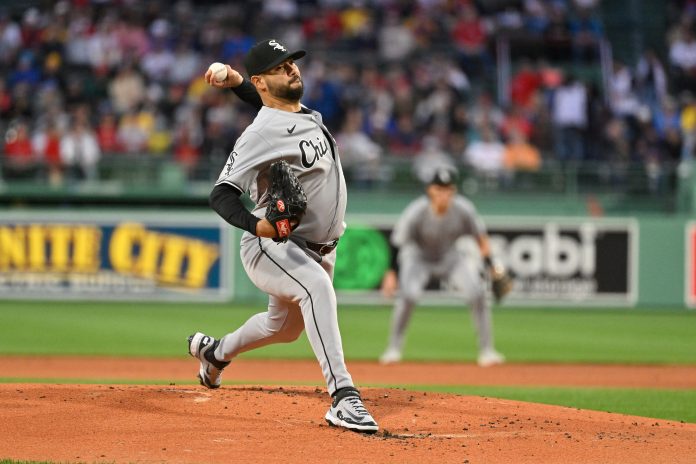
Aug 12, 2025; Chicago, Illinois, USA; Chicago White Sox pitcher Yoendrys Gomez delivers during the first inning against the Detroit Tigers at Rate Field. Mandatory Credit: Matt Marton-Imagn Images
The White Sox hoped for at least four innings from Yoendrys Gómez after selecting his contract from Triple-A Charlotte before Tuesday night’s game against the Tigers. The 25-year-old right-hander not only exceeded expectations but also could have secured himself another opportunity.
After optioning Jonathan Cannon to Triple-A, the White Sox needed an emergency starter to eat innings. Gómez was tapped to take the ball against a potent Tigers offense that ranks eighth in the MLB in runs scored.
Despite it being his first career MLB start, the Venezuelan hurler looked completely unfazed. Gómez struck out a career-high seven batters across five innings of work, allowing just one run on one hit and a walk. He commanded the strike zone for most of the night, throwing 56 of his 89 pitches for strikes.
The performance led White Sox manager Will Venable to float the idea of Gómez possibly getting another start to reporters. However, when that start will come is unknown as the White Sox with Aaron Civale, Sean Burke, and Davis Martin listed as the team’s next three probable starters.
While Gómez is not one of the more well-known arms in the White Sox system, the early success came as no surprise to anyone who has watched him in Triple-A Charlotte this season.
Gomez started the season as a long reliever with the Yankees, but was out of minor league options. Despite posting a 2.70 ERA in 10 innings, he was placed on waivers and claimed by the Dodgers. His stint with the Dodgers lasted just three games after he was tagged for seven runs in 4.1 innings, leading him to once again getting DFA’d.
The White Sox snatched him off the waiver wire on May 10th and placed him in Charlotte to try to develop him into a starter. The reset in the minors proved to be beneficial as Gómez proceeded to post a 2.12 ERA in 46.2 innings, with a 32% strikeout rate. Of the 14 appearances he has made for the Knights this season, 11 of them were starts.
Gómez made a strong first impression during his first opportunity with the White Sox and could parlay it into an audition for the rest of the season to try and crack a spot on the roster next year. If he is able to stick on the White Sox big league roster into next season, the organization would have six full seasons of control heading into 2026.
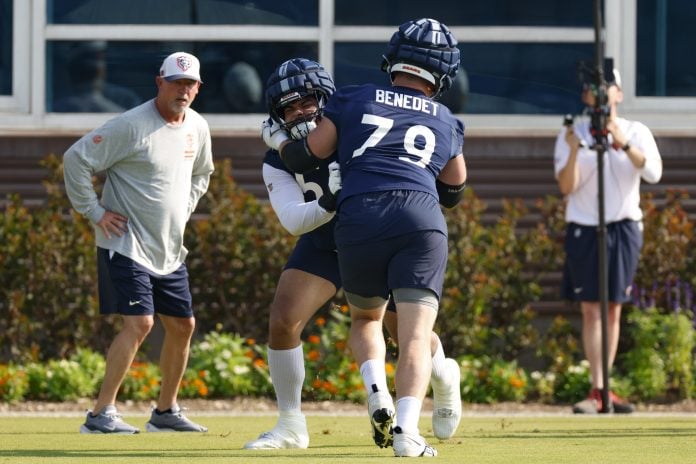
Jul 23, 2025; Lake Forest, IL, USA; Chicago Bears guard Theo Benedet (79) and offensive tackle Darnell Wright (58) run a drill during training camp at Halas Hall. Mandatory Credit: Kamil Krzaczynski-Imagn Images
The Chicago Bears made it their mission to assemble the best offensive line possible going into this season. That is hardly a surprise after allowing 68 sacks last year. Dan Roushar was the man they put in charge of that quest. Few have a stronger track record for identifying and developing offensive line talent. Pretty much everything has gone as expected this summer. Four of the five starting jobs are locked up. However, things have been slower at left tackle. Braxton Jones, Ozzy Trapilo, and Kiran Amegadjie started training camp battling for the job.
Going into Sunday’s preseason opener against Miami, it felt like the battle had narrowed to Jones and Trapilo. Apparently, what Roushar and head coach Ben Johnson saw in that game wasn’t good enough. So in a surprise twist, there was another shakeup to the competition on Wednesday. Theo Benedet, the former undrafted free agent Chicago got from Canada last year, received several reps with the first-team offense. This was the first time for him the entire camp. It was impossible to miss the significance.
Theo Benedet has entered the Bears’ competition at left tackle. He rotated with the 1s today with Braxton Jones. Ozzy Trapilo was at RT with the 2s.
If you don’t believe this is real, listen to Roushar’s comments on Jones’ performance against Miami courtesy of CHGO. It is clear as day that he’s not happy.
Dan Roushar will do whatever is necessary to assemble the five best players.
Yes, Jones is the Bears’ most experienced tackle, and yes, Trapilo is a 2nd round pick. None of that changes the bottom line. Neither has performed up to the team’s high standards. Meanwhile, Benedet has improved steadily throughout camp and didn’t allow a single pressure in 29 snaps on Sunday. He has earned this opportunity. Background doesn’t matter. Past accomplishments don’t matter. Dan Roushar knows his job. It is to ensure Caleb Williams has the best blindside protection possible. Jones and Trapilo both have the capability. Neither has found the consistency. Despite his inexperience, Benedet is rising to the occasion. This could become one of the wildest developments in recent Bears memory.
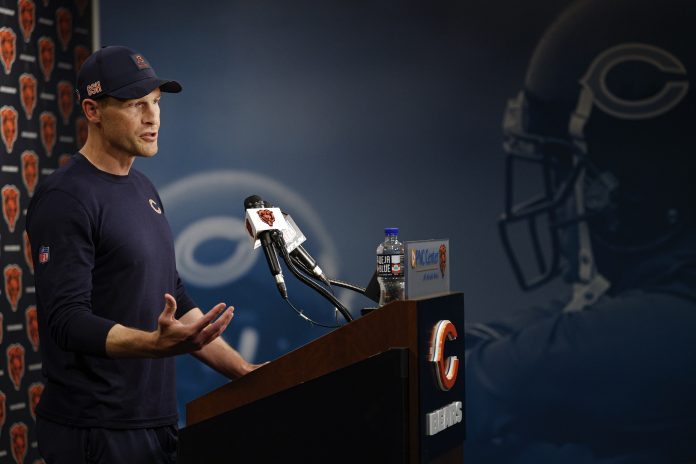
Jun 3, 2025; Lake Forest, IL, USA; Chicago Bears head coach Ben Johnson speaks during minicamp at Halas Hall. Mandatory Credit: Kamil Krzaczynski-Imagn Images
The Chicago Bears opted not to play their starters last weekend in the preseason opener against the Miami Dolphins. It was a somewhat controversial decision by head coach Ben Johnson. Players are learning new systems, especially on the offensive side. One would think quarterback Caleb Williams and others could use some live game reps to work out some kinks. However, Johnson felt a joint practice two days prior and extra work before the game was enough for the time being. Many wondered if the head coach had serious misgivings about Williams’ preparedness.
Those concerns were finally quelled on Wednesday. Johnson told the media that all starters will play in Sunday’s second preseason game against the Buffalo Bills. The reasoning behind the delay isn’t entirely clear. Perhaps Johnson wanted to avoid any unnecessary injuries. After all, they were already down two key guys in teh secondary before the game (Jaylon Johnson and Kyler Gordon). The primary goal for the coaches is getting this team to opening night as healthy as possible.
Ben Johnson has his reasons for doing it this way.
Truthfully, there is no real evidence to suggest a player is better or worse based on how many preseason snaps they take. The Bears’ offense looked pretty good in the preseason last year, but it ended up being one of the worst in the NFL. It feels like Ben Johnson chose this game because it will feel as close to a big-time atmosphere as you can get. It will be in the evening at Soldier Field against one of the best teams in the AFC. He probably wants to see how Williams handles that. He wasn’t always ready for such games last season. This will be a way to see where his readiness is. Smart money says the starting units will play at least the first quarter. That could be stretched to the first half, depending on how things go.
Apr 18, 2025; Boston, Massachusetts, USA; Chicago White Sox starting pitcher Martin Perez (54) pitches against the Boston Red Sox during the first inning at Fenway Park. Mandatory Credit: Eric Canha-Imagn Images
The White Sox announced Wednesday that Pérez had returned from his rehab assignment. In corresponding moves, the club optioned left-handed reliever Cam Booser to Triple-A Charlotte and designated fellow left-hander Jared Shuster for assignment.
After optioning Jonathan Cannon to Triple-A, getting Perez back gives the White Sox rotation a much-needed boost. Perez was initially signed this offseason to be a veteran presence and innings eater, but coming off an injury, it is unclear how much of a workload the southpaw will be able to take on.
Pérez was diagnosed with a left forearm strain after being removed from his fourth start of the season on April 18 at Fenway Park. Pérez only made it through three innings, leaving the game with left forearm inflammation after just 52 pitches. He allowed four runs on five hits with a pair of walks and no strikeouts in a 10-3 blowout loss.
The White Sox later placed him on the 60-day IL. Under that initial timeline, ESPN’s Jesse Rogers reported that while the southpaw avoided Tommy John surgery, he likely wouldn’t start throwing again until September, adding that for all practical purposes, his year was over.
But Pérez was eager to return to the mound. By late July, he was already facing live hitters, and he began a rehab assignment in August. His return gives him a chance to audition for other teams and demonstrate his health ahead of free agency this offseason, assuming the mutual option in his one-year contract is declined.
Before the injury, Perez had been throwing the ball well for the White Sox. Through his first four starts, he posted a 1-1 record and 3.15 ERA, while leading the team in innings pitched (22.1), strikeouts (18), WHIP (1.25), and opponent batting average (.197), all without throwing a pitch over 90 mph.
Shuster Designated For Assignment
Shuster now leaves the team after two seasons with the White Sox. The 27-year-old was acquired in the five-player swap from the Braves for Aaron Bummer. Shuster was once considered a top prospect after getting drafted by the Braves in the first round of the 2020 draft.
He now marks the third player the White Sox acquired in that trade to be cut loose, joining Braden Shewmake, Michael Soroka, and Nicky Lopez. Shuster pitched in 51 games for the Southsiders, with 45 of them coming out of the bullpen. In 89 innings of work, he posted a 4.96 ERA with a sub-par 16.9% strikeout rate and 9.4% walk rate.
The bulk of his time in the organization has been spent yo-yoing between Chicago and Charlotte, with his Triple-A numbers proving even worse than his big league stats. He owns a 6.04 ERA in Triple-A while allowing an average of two homers per nine innings this year.
Other teams have a week to claim Shuster off waivers; otherwise, the White Sox can re-sign him and return him to Triple-A Charlotte.
The Chicago Bears have always been careful with their comments about Luther Burden since they drafted him in April. They’ve praised his talent coming out of Missouri, believing he possesses all the tools necessary to thrive in the NFL. Head coach Ben Johnson has done the same, but with a caveat. He’s made sure to point out at every opportunity that Burden is trailing behind others in absorbing the playbook. Until that changes, he isn’t likely to get the same playing time as other receivers.
However, this could be just a long, elaborate con. It is possible the Bears are doing everything they can to throw other teams off the scent of what they really think. Jordan Schultz of Bleacher Report dropped a notable update, detailing what the coaches actually think of their young receiver. Put simply? They can’t understand how Burden fell to 39th overall in the 2nd round. His ability is so far above that, and he’s learning the offense much faster than anticipated. At this rate, he could be an X-factor in the offense far sooner than anybody anticipated.
#Bears rookie WR Luther Burden III has earned strong praise over the last week for the work he’s put in to grasp Ben Johnson’s offense, along with his attention to detail.
Several Chicago coaches tell me there’s no hiding Burden’s immense talent … it’s far better than where he… pic.twitter.com/AE4Exgl6WM
Luther Burden could make the Bears the deepest WR corps in football.
They already have a perennial 1000-yard machine in D.J. Moore. Rome Odunze had a solid rookie season and looks poised for a breakout year. Then you add Olamide Zaccheaus, who’s had arguably the best training camp of anybody on the team. If Luther Burden ascends on top of that, it is frightening to think what this Bears offense around Caleb Williams could be. This organization has been lucky to have one or two good receivers at most during various periods in history. Having four is anathema to them. It speaks to the great job done by GM Ryan Poles in piecing it together. Still, it must be proven on the field. Burden flashed his skills against Miami in the preseason opener. The key will be how many opportunities he gets when the games become serious.
Ben Johnson didn’t come to Chicago just to run an offense — he came to tear it down and rebuild it into a machine that keeps defensive coordinators awake at night.
And lucky for Luther Burden III, he’s about to be the crown jewel of this operation.
Johnson’s resume is already ridiculous. In Detroit, he took a team that had been allergic to the end zone and made them the No. 1 scoring offense in 2024, averaging 33.2 points per game. He didn’t do it with overwhelming talent — he did it with a master plan built on formation manipulation, calculated deception, and precise timing. Think less “run-of-the-mill OC” and more “NFL chess grandmaster.”
Now he’s got Burden, who combines elite yards-after-catch ability, positional flexibility, and slot dominance. That’s like handing a samurai a lightsaber.
Johnson’s Chessmaster Approach
In Detroit, Johnson’s offense revolved around three pillars — each tailor-made for Burden’s skill set:
1. Formation-Based Deception
Johnson’s love for 12 personnel (1 RB, 2 TE) was borderline obsessive. He used it on 33% of snaps — well above the league average — but passed out of it on nearly half of those plays. Defenses load the box expecting the run, only for Johnson to punish them with intermediate and deep routes. Putting Burden in the slot against a linebacker in this setup? That’s not just a mismatch — it’s grand larceny.
The Bunch Right formation is a prime example of Johnson’s compressed alignment philosophy. The tight ends and slot receiver are aligned close together, creating natural pick opportunities and forcing defenders into awkward coverage decisions. From here, Burden can use coordinated releases with his teammates, stem his routes to manipulate leverage, and incorporate pre-snap motion to diagnose coverage before the ball is even snapped.
Key Elements:
Compressed spacing creates built-in traffic for defenders, leading to coverage confusion
Multiple route combinations from the same pre-snap picture keep defenses guessing
Motion opportunities provide easy coverage reads and open up favorable matchups
Diagram of a 12 personnel bunch right formation showing offensive positions and tight receiver grouping.
2. Motion and Misdirection
His pre-snap motion isn’t just for show — it’s a precision instrument for diagnosing coverage, engineering natural pick routes, and springing his playmakers into open space. It’s the same approach that turned Amon-Ra St. Brown into a Pro Bowl weapon, and with Burden’s comparable skill set plus superior burst and agility, the upside is even greater.
This motion concept diagram captures how Johnson uses pre-snap movement to tilt the field in his favor. Burden’s versatility means he can shift from slot to outside seamlessly, forcing defenses to communicate and adjust while still hitting his routes on time and within the structure of the play.
Football play diagram showing offensive routes and motion concepts in a formation relevant to Ben Johnson’s coaching style.
3. Layered Play Calling
Johnson plays the long game. He’ll run a certain look early to set a defensive tendency, then dismantle that tendency later with a counter concept. With Burden able to line up in the backfield, slot, or wide, the possibilities are endless.
The Luther Burden Advantage
At Missouri, Burden operated out of the slot on 85.3% of his snaps in 2024. He averaged 7.4 YAC per reception and forced 30 missed tackles — more than any other FBS receiver. He’s versatile enough to line up in bunch, motion across the formation, or even take direct handoffs.
Versatility – He’s done it all: backfield snaps, punt returns, blocking in heavy sets.
Gadget Weapon – Johnson loves gadget plays, from offensive linemen catching TDs to fake fumbles. Burden’s special teams background makes him a perfect candidate for trickery.
Bigger, Faster, Stronger – Compared to St. Brown, Burden’s size-speed combo means more explosive plays and more ways to weaponize him.
How Johnson Will Deploy Burden
12 Personnel Bunch Concepts
Johnson aligns Burden tight with Cole Kmet and Colston Loveland, creating a compressed formation that forces predictable defensive spacing. From there, Burden motions out to diagnose coverage, giving Caleb Williams a pre-snap tell and instantly tipping whether it’s man or zone. Once identified, Johnson loves to call his signature “Dagger” concept — TE clears vertically to pull the safety, while Burden attacks the dig route underneath at a precise 12–14 yard depth. In Detroit, this set-up produced a near-90% catch rate for St. Brown; with Burden’s burst and YAC skills, those routine completions can explode into chunk plays.
Johnson can also manipulate defensive keys by running the same formation multiple times in a drive, mixing in wheel routes, option routes, and quick screens from the identical pre-snap picture. This forces defenses into hesitation, and hesitation is death against a receiver who forced 30 missed tackles last season. The Dagger Concept itself is tailor-made for Burden’s ability to win in traffic and separate out of breaks, making it not just a bread-and-butter call, but a consistent drive-sustainer and field-flipper.
Diagram of the football Dagger Concept illustrating routes and yardage for offensive receivers in a specific formation.
Empty Formation RPOs
Empty sets aren’t just pass formations in Johnson’s playbook — they’re opportunities to stress a defense in multiple ways at once. Burden lines up in the slot with Williams keying the linebacker, reading his first step like a poker tell. If the LB jumps Burden’s route, Williams keeps the ball on a designed QB run. If the LB stays home, Burden catches it in stride with space to attack. Johnson layers the look by shifting from empty to bunch post-snap, forcing defenders to diagnose two concepts in rapid succession — a mental tax that often leads to blown assignments.
This Inside Zone Slants RPO is a perfect example of Johnson’s approach to simplifying quarterback reads without making the play predictable. Williams will have the option to hand off or hit Burden on a quick slant depending on that linebacker’s reaction. It’s a read that develops instantly, rewarding decisiveness and punishing hesitation. Johnson leaned on these designs with Jared Goff in Detroit to rack up easy completions and keep drives on schedule — now, with Williams’ mobility and Burden’s burst, the ceiling for these plays is even higher.
Diagram of inside zone slants run-pass option (RPO) football play illustrating player routes and assignments.
Motion-Heavy Screen Game
Johnson’s screen designs marry deception with timing, creating plays that feel like traps for overaggressive defenses. He’ll motion Burden across the formation to sell jet sweep or outside zone, baiting defenders to flow one way before slipping him the ball behind a convoy of blockers going the other direction. In Detroit, St. Brown racked up 441 yards on slot screens in 2024, but with Burden’s superior tackle-breaking ability, those numbers could be shattered in Year 1. Johnson will also adjust the depth, angle, and timing of these screens to punish corners who try to jump routes or safeties who overcommit.
Johnson’s motion screen concepts highlight his mastery of pre-snap movement as a setup for explosive YAC opportunities. Burden’s 30 forced missed tackles in 2024 show why he’s perfect for these manufactured touches. The motion doesn’t just disguise the play — it actively manipulates the defense, selling run action and freezing pursuit before the ball ever hits Burden’s hands.
Diagram of a football screen play showing slot receiver motion, blocking, and defense alignment.
Red Zone Gadget Packages
Inside the 20, Johnson’s creativity goes into overdrive. Burden could be featured on reverses, jet sweeps, or even designed double passes, keeping defenses in constant conflict. His punt return vision and contact balance make him lethal in tight spaces, and his sturdy frame lets him absorb the hits that come with goal-line work. Johnson may also use Burden as a high-impact decoy, drawing coverage away to open shovel passes or quick hitters for other targets.
Johnson’s red zone creativity isn’t just flash — it’s calculated. His shovel pass concepts and misdirection plays are built to exploit Burden’s open-field vision, quick reaction time, and 206-pound build. The combination of deceptive play design and Burden’s physicality makes him perfect for close-quarters situations where yards are scarce and every touch matters.
Diagram of a shovel pass option football play showing routes and player roles with yard distances.
The 2×2 Pistol Doubles formation is one of Johnson’s foundational packages for showcasing Burden’s versatility. With two receivers to each side in a balanced pistol alignment, the offense can mask intentions while keeping every concept in the playbook available. From this look, Burden can motion across the formation, shift into the backfield, or widen outside without tipping whether the play is run or pass. That ability to morph his role pre-snap allows Johnson to disguise concepts, dictate matchups, and stress defenders’ communication. In Detroit, this same flexibility was a major factor in St. Brown’s production — and with Burden’s added size, burst, and YAC skills, the formation’s potential impact is even greater.
Diagram of a 2×2 pistol doubles football formation showing defensive assignments and player movements.
These 3×1 alignment diagrams illustrate one of Johnson’s most reliable tools for manufacturing coverage stress. By stacking three receivers to one side, he forces the defense to declare its coverage shell and reveal matchups before the snap. From the cluster, Burden can run a variety of routes — quick outs, seams, option routes, or deep overs — depending on the coverage read. Johnson will frequently layer in pre-snap motion from this look to confirm whether the defense is in man or zone, and that information allows him to dial up the exact route combination to exploit leverage. This alignment also creates natural space on the back side for isolation plays, meaning Burden’s presence on the strong side not only threatens his own matchup but manipulates defensive resources across the field.
Examples of 2×2, 3×1 alignments, and Pseudo-21 personnel formations in football offense.
Jumbo Sets – Decoy in heavy personnel, play-action shots.
Don’t overlook Johnson’s use of heavy personnel packages, which often fly under the radar but play a huge role in his offensive deception. In these jumbo formations — loaded with extra tight ends and an emphasis on run looks — Burden becomes a chess piece that tilts the board. Johnson can align him tight to the formation as a crack blocker or motion him into the backfield to influence linebacker fits. Even without touching the ball, Burden’s presence keeps defenses from committing fully to the run, opening up space for explosive play-action shots downfield. When Johnson does choose to get him the ball in these sets, it’s often after lulling defenders into thinking it’s a power run, only to spring a seam route, crossing pattern, or jet sweep for a chunk gain. This dual-threat role — part decoy, part dagger — makes heavy personnel a far more dangerous package than its name suggests.
Youth football jumbo formation diagram showing player positions and play routes.
The Caleb Williams Factor
Johnson made Jared Goff’s life easier by creating clear pre-snap reads, simplifying his decision-making and allowing him to play on time. For Caleb Williams, those same tools will be a developmental accelerator. Johnson will use motion, formation shifts, and route distribution to give Williams early answers:
Zone – Burden drifts into the soft spots between linebackers and safeties, presenting an easy, high-percentage throw.
Man – Burden leverages his quickness and physicality to win early, giving Williams an immediate outlet against pressure.
By marrying defined timing concepts with Burden’s versatility, Johnson ensures Williams rarely has to hold the ball and guess. The QB can trust his reads, anticipate throwing windows, and build chemistry with Burden through repeated reps. Over time, this approach won’t just protect Williams — it will make the passing game frighteningly efficient.
Projected 2025 Stat Line
Receptions: 90–110
Targets: 130–150
Catch Rate: 65–70%
Explosive Plays: 15–20 of 20+ yards
TDs: 8–12
Rushing Attempts: 8–12
Final Verdict
Johnson’s system doesn’t just use talented players — it maximizes them. He proved with Amon-Ra St. Brown that a receiver can become the ultimate chess piece when deployed with precision and creativity. That same philosophy — pushing limits — will be amplified with Burden, who brings more size, more burst, and more positional flexibility.
Johnson’s genius is in adaptation. He’s not tied to a rigid playbook, and he’ll “rip this thing down to the studs” to build around his strengths. Burden’s YAC dominance, gadget ability, and versatility mean Johnson can threaten every blade of grass without tipping his hand. Defensive coordinators will spend their week guessing which version of Burden they’ll get — slot assassin, motion ghost, or red zone hammer — and still guess wrong on Sunday.
Kyle Monangai has been a revelation for the Chicago Bears. Disappointment reigned everywhere during the NFL draft in April. Fans had been geared up for weeks, hoping the team would go after a running back early in what was billed as one of the strongest classes in recent memory. Unfortunately, they missed several opportunities in the first few rounds. Rather than force the issue, GM Ryan Poles opted to focus elsewhere. Not until the 7th round did he finally make the move, scooping Monangai up.
Most people didn’t know him. That comes with playing at Rutgers, the perennial bottom-feeder of the Big Ten. It didn’t help that he lacked what many saw as anything elite: size, strength, speed, and quickness. Nothing about the running back situation had changed. Then things began shifting. Monangai started getting more and more work with the top offense. People were surprised. How had it happened so fast? Adam Jahns of CHGO finally added crucial details on what the rookie did to win over the coaching staff.
It was simple, but not at all easy.
He’s in the door at Halas Hall by 6 a.m. – 6:30 a.m. at the latest, he said – and the earliest that he’s left so far is 7 p.m.
“That’s a typical day,” Monangai told CHGO. “It’s a grind. That’s what training camp is. I hear it from all my friends in the league that your rookie year is your longest year. So I went into this year with that mindset.”
Why is Monangai arriving at the Bears’ facility that early?
“It’s just the mental and physical part,” Monangai said. “Mentally, getting in my playbook and getting ready for the install for the day, reviewing the install from before. And then physically taking care of my body, getting my body ready to go perform. We got a walk-through and then we’ll have actual practice, so it gives me a lot of time to get my body right to go be at my best for practice.”
Kyle Monangai is merely the latest proof of the NFL.
It has never been all about the talent. It’s about what you get out of your talent. There are guys with elite ability who never made it beyond three or four years in the league. Meanwhile, more than a few who weren’t even considered draftable ended up in the Hall of Fame. Kyle Monangai is probably a six out of ten on the talent scale. To compensate for that, he couples it with an elite work ethic. Putting in over 12 hours a day honing your craft might be obsessive, but it’s necessary in this case. He doesn’t just want to be on a roster. Monangai wants to play. He wants to show everybody he belongs at this level. We already see how this guy delivered back-to-back 1200-yard seasons despite playing for a mediocre program in a top conference. Bet against him at your own peril.