The 19-year-old Swedish blueliner will become a restricted free agent at the end of the 2021-2022 season.
Chicago Blackhawks defenseman Adam Boqvist played in his 10th NHL game on Sunday night vs. Minnesota, triggering the first year of his entry-level contract. If Boqvist played in nine games or fewer this season, his contract wouldn’t have kicked in until next year, and he would have another season with an $894,167 cap hit.
The Blackhawks also recently announced that Boqvist will not be loaned to Team Sweden for the 2020 World Juniors. That decision was likely made because of the Blackhawks current situation on defense, as Duncan Keith and Calvin de Haan both remain out with injuries. With the possibility of de Haan missing significant time after reinjuring his right shoulder, Boqvist could remain with the Blackhawks for the long haul.
Earlier this season, 2019 No. 3 overall pick Kirby Dach also burned the first year of his entry-level contract when the Blackhawks announced he’d stay with the team for the remainder of the season. With Jonathan Toews and Patrick Kane’s $10.5 million and Brent Seabrook’s $6.88 million still on the books at that point, it’s interesting that the Hawks decided to have Dach and Boqvist become restricted free agents in the same offseason.
“Maybe that was a discussion very early on but as far as coach perspective, we like him,” coach Jeremy Colliton said about possible discussions with GM Stan Bowman on whether or not to burn Boqvist’s first year. “I think he’s played well and it’s an opportunity with some injuries to give him some ice time. He’s handled it well so far.”
Now the number to focus on with Boqvist and Dach is 40. If either player plays in 40 or more games this year, then it will count as a full season and bring him one year closer to becoming an unrestricted free agent. If a player has played seven full seasons or is at least 27 years old by the free agency period, he officially registers as an unrestricted free agent.
It’s an interesting decision to have Dach and Boqvist’s entry-level contracts expire at the same time, but it certainly will be fun to watch both players going forward for the Blackhawks.
For more Blackhawks news and updates, follow the author (@JackBushman2) on Twitter. Make sure to check out the author’s podcast, Talkin’ Hawkey, which can be found on Apple Podcasts, Spotify, and Twitter (@TalkinHawkey).
GREEN BAY, WISCONSIN - DECEMBER 15: Head coach Matt Nagy of the Chicago Bears looks on from the sidelines during the game against t Green Bay Packers at Lambeau Field on December 15, 2019 in Green Bay, Wisconsin. (Photo by Stacy Revere/Getty Images)
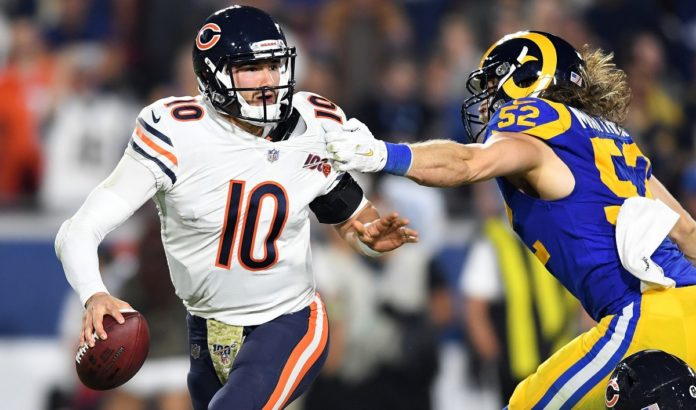
Mitch Trubisky is getting a large chunk of the blame for the Chicago Bears losing to the Green Bay Packers on Sunday. A loss that ended their playoff hopes. This might come across as surprising. Trubisky threw for 334 yards and ran for 29 more. He did throw two interceptions but one of those came on a Hail Mary at the end of the first half. It wasn’t a great game but was he the main reason they lost? No. That honor should be reserved for head coach Matt Nagy.
People have criticized him all year for his play calling issues. Sometimes it’s justified but others it can be a bit overblown. However, this time it was 100% on him. Why? Namely because he abandoned the style of offense that had finally started to bring the Bears offense some success in the past three or four weeks. One that involves getting Trubisky on the move, shifting the pocket and changing launch points to help slow down opposing pass rushes.
Despite facing a really good Green Bay Packers front on the road, one that had sacked Trubisky five times in their previous meeting, Nagy chose to not only lean away from that type of game plan. He basically abandoned it altogether. The Bears quarterback threw 53 passes total in that game. No fewer than 51 of them were straight dropbacks with no rollout or play action bootleg.
This big play to Anthony Miller was one of those two.
Nobody is disputing whether Nagy is a smart coach. He absolutely is. His ability to design plays is actually quite impressive. The problem is there is a significant difference between play designing and play calling. Designing can be done through study. Calling is more of an instinctive thing. Knowing the plays is only part of it. Knowing when to call them is the other and it’s this part that Nagy continues to struggle with. His lack of common sense remains a serious problem.
Rather than use the offensive approach that was finally starting to get things clicking for his team, he essentially reverted to the exact same game plan he used against the Packers back on opening night. Is it any surprise the results were basically the same? He had Trubisky throw the ball a total of 98 times between those two games, refusing to commit to running it. Proving again that despite what he says, he just can’t stick with the ground game if he senses it’s not working right away.
That is not what smart play callers do.
It’s little wonder that Trubisky was so frustrated after the game, even calling out the scheme approach and how it put way too much stress on what was an undermanned offensive line in a hostile environment.
“I felt like we could’ve taken more pressure off [the O-line] moving the pocket a little more and I getting out, but the [Packers rush] has done a great job of that all year long and that’s what they hang their hat on and they did that today.”
He has every right to feel that way because it’s true. It would’ve been one thing if Nagy employed that type of attack and it simply didn’t work. This was far worse because he didn’t even try. He played right into the Packers’ hands and that is unforgivable.
You know the countless rumors a decade ago about the Cubs and Brian Roberts and now the recent rumors about the Cubs and Whit Merrifield? So much noise, but nothing actually happening. Well, the Yankees also have a player that they’ve been interested in for a while, but despite the building speculation, a trade between the Cubs and Yankees involving Kyle Schwarber is just going to be something for fans to argue about and most likely nothing else.
This shouldn’t come as a surprise, especially this offseason when the Cubs are surely taking more calls about their players than ever before. Kris Bryant, Willson Contreras, Anthony Rizzo, Ian Happ, Albert Almora Jr. and even Yu Darvish have been mentioned in trade rumors, so it was only a matter of time before Schwarber was linked to a team.
The Yankees are interested in Schwarber, but even in his reporting The Athletic’s Ken Rosenthal pretty much says that nothing is pointing to a trade ever happening.
At this moment there is no momentum, according to major-league sources, and chances are there will never be. The Yankees’ interest in Schwarber is not new; they have been talking to the Cubs about him since at least 2016, sources said. The nature of the latest conversations also is not new. The teams are talking, yes, but again that’s all it is — talk.
You can read more below, as Rosenthal goes on to say that there’s not really a fit for Schwarber on the Yankees. And well, just like there have been reports about the Cubs asking for a huge haul for Bryant and Contreras, they’re not going to sell low on Schwarber either.
First base? Schwarber has yet to play an inning at that position professionally. The Yankees aren’t exactly set at first with their potential Luke Voit-Mike Ford platoon. But would they want to meet the Cubs’ price for Schwarber when he would be a potential liability in left and an outright gamble at first? That’s right, the Cubs are not going to sell low on a player who hit 38 home runs last season, a player who ranked eighth in the National League with a .997 OPS after the All-Star break.
Interesting talks, unlikely deals: What #Padres’ discussions for Lindor and #Yankees’ conversations about Schwarber really mean. https://t.co/2ybnZZG5qK
Rosenthal tries to make a case in which it could make sense for the Cubs. Schwarber is projected to make about $8 million in 2020. I guess if he’s traded that saves the Cubs some money, left field becomes open and in turn they could then “afford” to re-sign Nick Castellanos to replace Schwarber.
The thing is, right now the Cubs are all about getting as much value from their players and Schwarber would cost at least half of what Castellanos would. I know some of you don’t want to accept this because Castellanos was awesome with the Cubs, but Schwarber has been the better player so far in their careers.
Kyle Schwarber: .339 OBP, .829 OPS, 115 OPS+, 115 wRC+, 4.9 bWAR, 9.1 fWAR in 492 games
Nick Castellanos: .326 OBP, .797 OPS, 113 OPS+, 112 wRC+, 7.1 bWAR, 10.4 fWAR in 888 games
Yes, they offer different things at the plate, as Castellanos hits for a higher average and stepped up under a bigger stage for the Cubs. But, ugh, are we just going to ignore Schwarber’s incredible second half?
Anyway, argue all you want, but Schwarber to the Yankees might pop up again, yet the chances of a trade actually happening are super low. There’s just no way the Cubs get a good enough return to deal away Schwarber.
With 2019 now officially a lost cause, most people can start looking towards the Chicago Bears 2020 schedule to see if maybe that will be the year. Some people may not understand how the team can possibly know who their opponents will be but the reality is far different. Thanks to a streamlining of the NFL process and years of experience at breaking things down, it actually isn’t that hard to figure out.
The first part is easy enough. Chicago will face their three division rivals at home and on the road. That covers six games. Next will come the other divisions they play. In this case, it will happen to be both the NFC South and AFC South. That covers 14 of the 16 games. At that point comes something called “corresponding finishers.” In other words, the Bears will play teams who also finished 3rd in their divisions as they will in the North.
According to Brad Biggs of the Chicago Tribune, those finishers will come from the NFC West and NFC East. So looking at the entire landscape, here’s the full list of likely opponents the Bears will have next year.
Home:
Packers
Lions
Vikings
Buccaneers
Saints
Colts
Texans
Redskins/Giants
Road:
Packers
Lions
Vikings
Falcons
Panthers
Jaguars
Titans
Rams
Chicago Bears 2020 schedule has plenty of intrigue
As things stand today, the schedule looks tough. Green Bay and Minnesota will make things hard enough. Yet the Bears will also have to deal with New Orleans again. Not to mention a highly-anticipated first clash between Mitch Trubisky and Deshaun Watson. This presuming Trubisky is still the starting quarterback next year. At the same time, one could make the argument that this slate of games is a bit more manageable on paper.
Currently, it features no fewer than eight games against opponents who will not make the playoffs this year. It could be 10 if the Titans and Rams fail to qualify in the final two weeks of the season. Then again none of this really matters. The Bears didn’t exactly face a brutal schedule in 2019. Eight of their first 14 games were against teams that won’t be in the playoffs this year. Nine if the Rams fail to qualify. Chicago was 5-4 in those games.
Put simply, they need to focus on their own problems. The schedule will be what it will be. If the Bears want to prove they can be champions, they should not bank on other teams trying to help them. They have to go out and prove it every week. Something they failed to do this year.
Mitch Trubisky is in the public eye more than any player on the Chicago Bears roster. That isn’t a surprise. It comes with being the quarterback. So when he struggles, a lot of the blame for the team’s failure falls to him. There is no question that 2019 has been a major disappointment. The 25-year old was expected to take a significant step forward this year. It was the second in Matt Nagy’s system. He had a nice array of weapons and a decent offensive line. Sadly it hasn’t worked out that way. Currently, he’s on pace to finish with fewer yards, fewer touchdowns, and more interceptions than he had in 2018.
However, this has made it easy to overlook an even bigger flop this year.
That being outside linebacker Leonard Floyd.
One must understand this. Here is a player who has never had more than seven sacks in a season. He happens to finish last year pretty well with four sacks in his final six games. This convinces GM Ryan Pace not only to pick up the 5th year option in his rookie contract but also not make a significant push to find more meaningful help at outside linebacker during the offseason. The Bears settled for just re-signing Aaron Lynch and Isaiah Irving.
Time has proven this to be a catastrophic mistake.
Chicago Bears have gotten little of true value from Floyd
Now there is no doubt the defensive coaching staff is high on Floyd. They feel he does so many things really well from playing the run to dropping into coverage. That’s great and all but it’s not what the Bears are ultimately paying him to do. It isn’t what he was drafted to do. That was to get the quarterback on the ground. After dropping Aaron Rodgers twice in the season opener, Floyd has accounted for exactly one sack in the past 13 games.
One.
That is not good enough. Not even close. It’s been so inadequate that people have begun to attack Khalil Mack for his own limited production. They don’t understand that Floyd’s failure to be even a modest pass rusher has allowed offenses to freely double and triple-team Mack at will. The injury to Akiem Hicks didn’t help matters but the fact is Floyd has had countless one-on-one opportunities and consistently failed to take advantage of them.
Now the Bears look towards 2020 with a decision to make. Do they pay the soon-to-be 28-year old $13 million to continue being an average pass rusher or do they get proactive in solving one of their biggest issues? Pace will certainly have the ball in his court.
The Chicago Bears offense is sharing blame for being one of the worst in the NFL this season. That’s how it goes. However, not enough people are grasping just how useless the tight ends have been this season. In an era where they’re more crucial to offensive success than ever before. So how’s this for a fun stat? As a unit, the Bears tight ends have combined for 283 yards in 14 games. That includes five players. Nick Boyle, the third-string tight end for the Baltimore Ravens has 291 yards by himself.
It’s hard to know for certain but it feels like the Bears have reached a level of bad at that position that no team has seen in a long time. Injuries have played a part in that. Trey Burton and Adam Shaheen were never healthy since the season began and have since gone on Injured Reserve. Ben Braunecker recently joined them. This has left journeyman J.P. Holtz and undrafted rookie Jesper Horsted as their only viable options.
This lack of overall talent and production is hurting the bottom line. Since the start of 2018, the Bears are 14-3 when they get at least 20 yards out of a tight end in a game. That includes a 4-1 mark this season. Think about that. This team has gotten 20 or more yards out of a tight end just five times in 14 games this season. What’s worse? The offense just seems to function a lot better when they’re getting help from that position. Just look at Philadelphia and Kansas City for reminders of that.
Chicago Bears tight end position must be a 2020 priority
There are other positions that will need attention next year for the Bears, but it’s hard to argue that any of them are more pressing than tight end. Shaheen is probably gone. If not for his bad contract, the same would be said of Burton. Braunecker has special teams value but that might be enough to prevent an overhaul. Chicago needs one or preferably two new bodies in the mix. Not just cheap free agents or late round draft picks either. They have to get serious about trying to fix a problem that has plagued them for years.
They’ll have opportunities. Free agency will feature a number of interesting names including Austin Hooper, Hunter Henry, and Eric Ebron. The draft is not considered a hot spot this year for the position but experts do say there could be some quality talent available in the 2nd round. Fortunately, the Bears have two 2nd round picks, so they’ll have an opportunity to strike there as well. It comes down to whether or not they finally get the right guy for what they want to do. Thus far Ryan Pace’s track record is somewhat…dubious at that position.
The Chicago Bears team needs list is pretty much set in stone at this point. It’s also about to become a major topic of discussion as the team was officially eliminated from playoff contention following a loss in Green Bay and a Minnesota victory in Los Angeles. Honestly the fact they got this close is a minor miracle considering this team was 4-6 and completely lifeless a month ago. This latest stretch reinforces one thing.
This is still a good team but one that is in serious need of tweaking.
They have talent in several places but also a number of holes that popped up at inopportune times this season. GM Ryan Pace and head coach Matt Nagy must work hard in the coming months to plug them. After all, their jobs will almost certainly be on the line in 2020. The problem is the resources available. Chicago is projected to have no 1st round pick in the draft and less than $14 million in cap space next year.
That is not a lot to work with. This means they will have to carefully prioritize what their biggest needs are in order to ensure maximum results. So where would such a ranking sit as of today? Let’s find out.
Chicago Bears team needs rankings looking to 2020
#1 – Tight End
If this is a shock to anybody, then they haven’t been paying attention to the Bears all season long. Nagy has made it clear on multiple occasions how vital the tight end position is to the execution of his offense. So one can imagine why the offense is struggling this year when the tight end position as an entire unit has managed 37 catches for 283 yards and two touchdowns in 14 games. That isn’t bad. It’s catastrophic. Getting such little production from that position has made life so much hard for the receivers and running backs.
Adam Shaheen is probably gone. His 2nd round pick status officially a bust. Trey Burton will likely be back if only because of his bad contract that would saddle the team with a lot of dead cap if cut. Jesper Horsted and J.P. Holtz look like nice cheap depth options who will stick. Yet the Bears still don’t have a true threat in the passing game. This has to change next year.
#2 – Edge Rusher
Khalil Mack gets a ton of heat for not generating more sacks this year (6.5 through 14 games). Here’s the thing. As great as he is, the man can’t do it all himself. Akiem Hicks was injured most of the season, which in turn exposed once again how inadequate Leonard Floyd is as the #2 edge rusher on this team. His coaches can talk up his “complete game” all they want. He’s primary paid millions of dollars to sack the quarterback. He has three in 2019. Three.
If the Bears defense wants to regain its dominance next year, they have to find somebody who can take proper advantage of the near-constant double and triple teams that Mack sees each week.
#3 – Offensive Line
If one phrase properly describes the Bears offensive line this season it’s “disappointing.” They came in with all sorts of optimism. All five starters were returning, two of them on new contract extensions. Then as the games went on, things started to fall apart. Kyle Long went on Injured Reserve yet again. His future is cloudy. Bobby Massie hasn’t returned for weeks due to a back issue. In their places, both Rashaad Coward and Cornelius Lucas have looked adequate at best. This doesn’t include Charles Leno who continues to be a penalty machine.
This group consistently failed to control the line of scrimmage all season. The Bears have the 28th ranked rushing attack and have now allowed 38 sacks. It feels like a shuffle to this front is needed for next year, particularly on the edges if possible.
#4 – Quarterback
Mitch Trubisky did not live up to expectations this year. It’s a simple fact. He was supposed to take a step forward and instead he took one back for most of the season. He’s been slightly better in recent weeks but that’s a small consolation. The Bears needed him to step up and he couldn’t do it. Sure not everything was perfect around him but good quarterbacks find a way to execute in tough conditions. While he’s had good moments, he doesn’t have them often enough.
Will the Bears outright replace Trubisky in 2020? Unlikely. However, they can and should look to start ratcheting up the pressure. Find somebody, be it a free agent or a draft pick who can come in and push him from behind. See how he responds to legitimate competition. Something the team never bothered to do with Jay Cutler.
#5 – Cornerback
Prince Amukamara looks nothing like the player he was in 2018. He’s over 30 now and injuries have started to catch up. Odds favor the Bears moving on from him next year, collecting $8 million in cap space along the way. This will leave the depth chart behind him in question though. Kevin Toliver has played decent in his limited snaps. Behind him is rookie Duke Shelley. That doesn’t look like enough talent to tangle with the pass games in the NFC North.
Odds are they will look to add somebody of value between March and April. If it’s a free agent, fine. If it’s a 2nd or 4th round pick, also fine. They just need another body who can offer some competition alongside Kyle Fuller and Buster Skrine.
The 2019 season didn’t go as planned for the Chicago Bears. Hopes were so high after their previous year going 12-4 and winning the division. Sadly more of the same, old problems showed up this year. Namely the quarterback. Mitch Trubisky has endured a mostly forgettable season to this point. He’s had some nice high moments including the previous three weeks but another mistake-filled showing against the Green Bay Packers proves he just can’t deliver against good teams.
He missed too many easy throws and had a brutal interception in the 4th quarter that all but ruined their chances for a comeback. This not counting a number of other passes that could’ve been picked. He finished with 348 passing yards and 29 rushing yards but it was just empty calories. Every time he needed a money play, he came up short. Good quarterbacks can afford to do that from time to time, but not all the time.
Not against actual contenders in this league. This is why the narrative remains alive that the Bears can and should at least seek competition for him in 2020. Somebody who can come in and legitimately push the quarterback. See how he responds to something he hasn’t seen in the NFL yet: the threat of losing his job.
Some might think Chicago isn’t exactly a hot destination for quarterbacks who will be available next spring. However, that perception has begun to change in a big way over the past month.
Chicago Bears receiving corps now has two-headed monster
Typically when a quarterback goes hunting for a new team, he’s looking for two things: a good defense he can lean on and solid weapons. The Bears already have the former despite its recent struggles due in large part to injuries. However, the bigger surprise is that all of a sudden they have the other part as well. Not one but two legitimate playmakers at the wide receiver position. Something not seen in this city for half a decade.
Allen Robinson cemented what should be a Pro Bowl season by reaching 1,023 yards against the Packers. It’s the first time a Bears receiver has topped that mark since Alshon Jeffery way back in 2014. The best part is Robinson is only 26-years old. If the Bears move quickly they can lock him up to a long-term extension this offseason, securing themselves a legitimate #1 target for the next several years hopefully.
The bigger surprise is Anthony Miller. The former 2nd round pick had a strong rookie year in 2018 but struggled to start 2019. That began to change since the loss to the Rams a few weeks back. In the past five games, he has collected 431 yards and two touchdowns. He and Robinson together have combined for 836 yards and six touchdowns in just over a month.
Terrific production and proof the Bears have a true 1-2 punch on offense.
History shows that top quarterback free agents tend to gravitate towards teams with strong receiver parings. Kirk Cousins went to Minnesota who had Stefon Diggs and Adam Thielen last year. Peyton Manning went to Denver in 2012 because of Demaryius Thomas and Eric Decker. The 2020 free agent class is projected to have some interesting names available.
Drew Brees
Dak Prescott
Tom Brady
Philip Rivers
Teddy Bridgewater
Ryan Tannehill
Jameis Winston
Marcus Mariota
Obviously all of those names won’t be available come the end of March but there’s a strong likelihood some of them will be. If the Bears decide they’re willing to come up with the necessary cash, it wouldn’t be as hard of a sell to get one of them to Chicago if they wish. Rest assured that players scout teams just as much as teams scout players.
Madison Bumgarner was one of three “tier 2” pitchers available. The other two being Hin Jin Ryu and Dallas Keuchel. Teams who need pitching should be getting pretty desperate right about now, and the White Sox are no exception. Should they decide to not make Ryu or Keuchel a priority (which would be inexcusable), they can maybe get a deal done to land Robbie Ray from Arizona.
Ray is a lefty who gets a ton of strikeouts and is only 28 years old, so he should actually bring back a great package. He is also entering his last season before becoming a free agent. If the White Sox were to hypothetically trade for Ray, they could issue him the qualifying offer after 2020. This would ensure that he either stays for another year through 2021, or the Sox would obtain a draft pick from the team he eventually sides with.
Ray is interesting because while he does have the stuff to miss a lot of bats, he also walks more batters than you would like and gives up a lot of home runs. His ERA last year wasn’t anything special at just 4.34, but he also had a WAR of 2.4. He’s a very solid number 3 today but still has tremendous upside if he harnesses better control.
Furthermore, Ray was apparently on the trading block during the season last year. Bumgarner now coming to Arizona means 2 things: he lessens the loss of trading away Ray, and it causes teams to get more desperate. Ray’s value now may never be higher for a team that needs pitching.
The White Sox should still absolutely sign one of Keuchel or Ryu, but regardless of whether they do or not, they should still at least check in on bringing Ray to the South Side.
Mitch Trubisky has always been a team player but he’s also a competitor. It’s clear the loss to the Green Bay Packers on Sunday frustrated him to no end. It is easy to understand. He threw for 348 yards, ran for 29 more and only managed to put 13 points on the board. A lot of this was due to some mistakes he make but it was also a lack of help from the running game. Not to mention some spotty protection from his offensive line.
This is where it gets interesting. After the game, Trubisky stepped in front of the media for questions. He was soon asked about the Packers pass rush and how it make have caused him problems throughout the game. The quarterback started off by crediting Green Bay for their efforts, but then pulled a somewhat shocking swerve when he openly questioned the offensive play calling through much of the game.
“I feel like our O-line played really well. I thought we could’ve taken more pressure off them by moving the pocket a little more and me getting out. But, yeah, they’ve done a great job of that all year long, and that’s what they hang their hat on.”
Considering it’s Matt Nagy who calls plays, that is an interesting statement, to say the least. Here is the full quote below via Rich Campbell.
In Bears QB Mitch Trubisky's postgame press conference, he answered a question about the Packers pass rush with some noteworthy commentary on today's play selection and game plan. pic.twitter.com/Oq90urH7ng
Mitch Trubisky was right to grumble after the game
It’s fair to say he actually has a point. Over the previous couple of weeks, Nagy really made an emphasis to get Trubisky out on the move more. Lots of play action, bootlegs, and rollouts. It allowed the offensive line to easier control the opposing pass rush and Trubisky to make plays on the move. Something he’s been known for his entire career. There were also creative screens to the tight ends that were clearly absent as well. It seems like Nagy reverted to the play calling form he had for most of the first half of the season.
This is something the head coach has been under fire for all year. His critics believe that while he’s very good at designing plays, he lacks a certain instinct for knowing when and where to call them. Situational awareness is a problem. It seems like a challenge to find a rhythm for him every week. Clearly his quarterback is not happy with the decision to slip away from what was finally making the offense click. For all his coaching prowess when it comes to motivation, Nagy seems to lack common sense from time to time.