
Friday, November 13, 2026
EDGE is live. Chicago fans can now access and explore the beta.
Home Blog Page 176

Buzelis’ Breakout Goes Beyond The Box Score — And It’s Not Getting Enough Attention

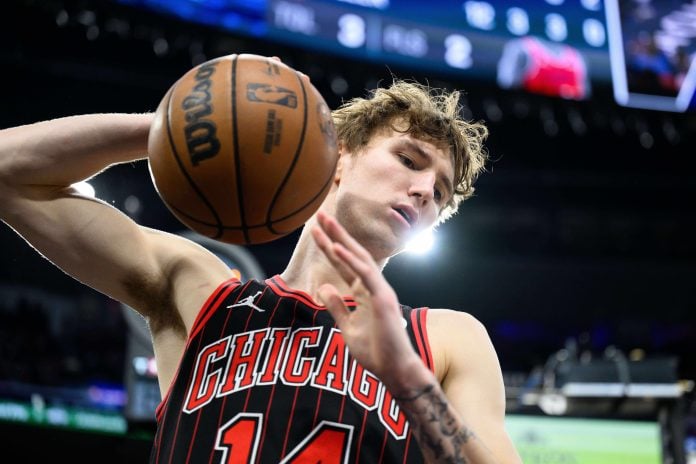
Mar 13, 2026; Inglewood, California, USA; Chicago Bulls forward Matas Buzelis (14) looks to slam the ball in frustration during the second half against the Los Angeles Clippers at Intuit Dome. Mandatory Credit: William Liang-Imagn Images

This season for the Chicago Bulls has had one major undertone, develop Matas Buzelis. The 21-year-old sophomore forward came into the year knowing it was his time to shine. After a rookie campaign that included coming off the bench for 49 games and seeing frequent stretches of minimal minutes or a quick trigger after mistakes, he didn’t crumble under the mounting frustrations. With a longer leash and more freedom on both sides of the ball, he’s excelled in every category. While playing 29.1 minutes per night, compared to last year’s 18.9, he’s nearly doubled his scoring average, increased his shooting percentages across the board, and added to his assist, rebound, block, and steal numbers. For a franchise that was longing for a player to show substantial development after their rookie year, Buzelis has delivered just that. While the dramatic increases in statistics have taken all of the headlines, this evolution from the youngster might be more important than any other category.

Becoming The Go-To Guy

Last year and halfway through this season, the Bulls struggled to find an identity. They featured a different leading scorer each night, offensive sets were run for nearly everyone on the roster at times, and with veteran pieces outlasting their welcome, nobody knew who the top dog was. Nikola Vucevic was often the option for game-winning shots, Coby White was the consistent offensive weapon in the fourth quarter of games, and Josh Giddey consistently runs the show as he becomes more acclimated to the roster. Over the last six weeks, Buzelis has cemented his position as the group’s leader.

In his last 13 outings, he’s scored 20 or more in eight of them, including a career-high 41 on 16-of-28 from the field. His rapid improvement in controlling pace and scoring at the highest level from anywhere on the floor has introduced All-Star potential.

Versatility Is Key

In today’s NBA, two things are key. Three-point shooting and defensive versatility have become king, and Buzelis is mastering both. His three-point shooting has improved from his rookie year, even as he has doubled his attempts per night, and in the explosive category, he joined some elite company with his sniping and shot-blocking.

Buzelis has shown improvements in any way, shape, or form this season, but above all, he’s learning to compete at the highest levels. He’s always said that he wants to be the best, and in order to do so, he’s got to beat the best. A clash with superstars Luka Doncic and Kevin Durant did just that, but the kid didn’t back down. Seeing a 21-year-old go toe-to-toe with legends of the game is a very promising sign for Bulls fans.

Even though the national media took this as an opportunity to school the sophomore on the levels in the NBA, Chicago should be proud. It’s tough to find many guys who would ruffle the feathers and go back and forth with a star of Doncic’s caliber in their second season in the league.

Buzelis’s pure talent and competitive personality have quickly made him a fan-favorite and franchise cornerstone.
New Data Warns Chicago Bears To Stay Away From These 1st Round EDGEs

tj parker
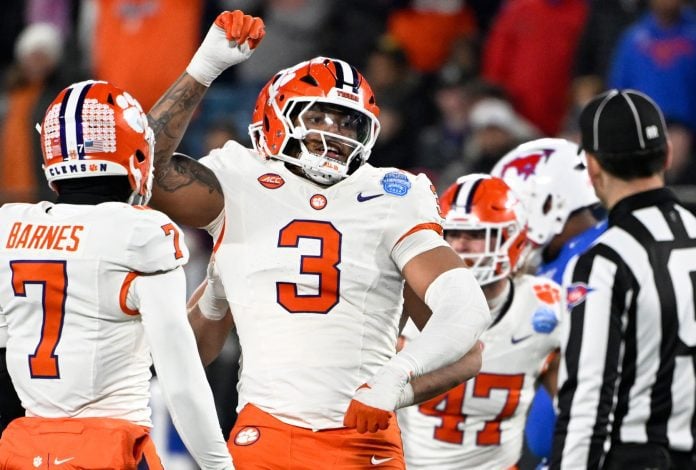
Dec 7, 2024; Charlotte, NC, USA; Clemson Tigers defensive end T.J. Parker (3) reacts after a play during the second quarter against the Southern Methodist Mustangs in the 2024 ACC Championship game at Bank of America Stadium. Mandatory Credit: Bob Donnan-Imagn Images

Edge rusher is a position that is 100% on the table for the Chicago Bears in the 1st round. Recently, I did a study on why the team has been so bad at identifying capable players at that position over the year, particularly in the 1st round. I found that they often didn’t account for the SPG (Sacks Per Game) metric. All of the prospects they drafted had below-average SPG numbers in college. Meanwhile, Richard Dent had one of the highest sack numbers per game they’ve ever drafted in the Super Bowl era. Go figure.

Still, plenty of people aren’t willing to accept sacks as a proper metric for determining future NFL pass rushers. The popular one these days is pass rush win rate, which is used by analytics experts across the board. Well, Football Insights compiled the latest data on the incoming 2026 draft class.

When comparing this chart to previous 1st round edge rushers going back to 2017, you find that the threshold most of the good ones need to cross is around 18.5%. After that, you start seeing quite a few more draft busts like Dallas Turner, Myles Murphy, Payton Turner, and Lukas Van Ness.

RankPlayerDraft YearCollegeCareer Win Rate %
1Myles Garrett2017Texas A&M31.7%
2Josh Allen2019Kentucky30.3%
3Laiatu Latu2024UCLA29.1%
4Chase Young2020Ohio State27.2%
5Will Anderson Jr.2023Alabama26.2%
6Nick Bosa2019Ohio State25.5%
7Will McDonald IV2023Iowa State25.2%
8Aidan Hutchinson2022Michigan25.0%
9Micah Parsons2021Penn State23.8%
10George Karlaftis2022Purdue23.6%
11Kayvon Thibodeaux2022Oregon22.8%
12Tyree Wilson2023Texas Tech22.6%
13Montez Sweat2019Mississippi St22.1%
14Jaelan Phillips2021Miami21.8%
15Gregory Rousseau2021Miami21.6%
16Clelin Ferrell2019Clemson21.3%
17Felix Anudike-Uzomah2023Kansas State20.5%
18Jared Verse2024Florida State20.2%
19Odafe Oweh2021Penn State18.9%
20Chop Robinson2024Penn State18.8%
21Brian Burns2019Florida State18.5%
22Darius Robinson2024Missouri18.4%
23Joe Tryon-Shoyinka2021Washington18.1%
24Kwity Paye2021Michigan18.0%
25Payton Turner2021Houston17.2%
26Bradley Chubb2018NC State17.2%
27Jermaine Johnson II2022Florida State16.8%
28Rashan Gary2019Michigan16.5%
29Lukas Van Ness2023Iowa16.2%
30Myles Murphy2023Clemson14.8%
31Dallas Turner2024Alabama13.6%
32Marcus Davenport2018UTSA13.5%
33K’Lavon Chaisson2020LSU13.1%
34Travon Walker2022Georgia10.1%

The Chicago Bears now have a good idea of who to avoid.

Now, with any data chart, there are outliers. Travon Walker has become a successful pass rusher despite being at the bottom of the list. Kayvon Thibodeaux, Tyree Wilson, and Clelin Ferrell have all been huge disappointments. Yet the trends still hold for the most part. Going by this, we now know the Bears should have some serious misgivings about some of the 1st round edge rushers they’ve been projected to select with that 25th overall pick.

  • Zion Young – 10.6%
  • T.J. Parker – 14.0%
  • Keldric Faulk – 10.3%
  • Gabe Jacas – 14.5%
  • Akheem Mesidor – 14.5%

It’s worth noting that these numbers are calculated over the entire college career. Sometimes it takes players some time to figure it out. So do the numbers change if we just focus on their final seasons?

  • Zion Young – 17.4%
  • T.J. Parker – 15.5%
  • Keldric Faulk – 9.9%
  • Gabe Jacas – 18.0%
  • Akheem Mesidor – 18.7%

So you see, Jacas and Mesidor seemed to figure things out a little more towards the end of college. Young improved as well, but is still below average. Faulk and Parker remain underwhelming. We already know the highest scorers, like David Bailey and Rueben Bain, won’t reach the 25th pick. Cashius Howell (19.7%) has a chance, but the Chicago Bears may not like his smaller frame.

The Bears must be careful who they gamble on.

While this edge rusher class is deep in terms of overall talent, finding one has been especially difficult for the Chicago Bears. Seeing this new data makes one wonder if taking one in the 1st round is the best idea. Unless someone big happens to fall, none of the available options will qualify as safe bets. That means they’ll have to gamble on projections or shift their focus to another position with less risk. They have two 2nd round picks in this draft. They can easily use one of those to get the edge-rush help they need.

This comes down to how confident they are that whichever player they target can make the transition. We already saw with Shemar Turner and Dayo Odeyingbo that the Bears aren’t exactly great at pinpointing quality defensive line talent. Having failed to make any additions in free agency this year, it feels like this draft is make-or-break for them. That means being extra careful with who they go after.

Jaden Ivey, Jalen Smith Out For The Year — Here’s Why All Eyes Turn To Karnisovas

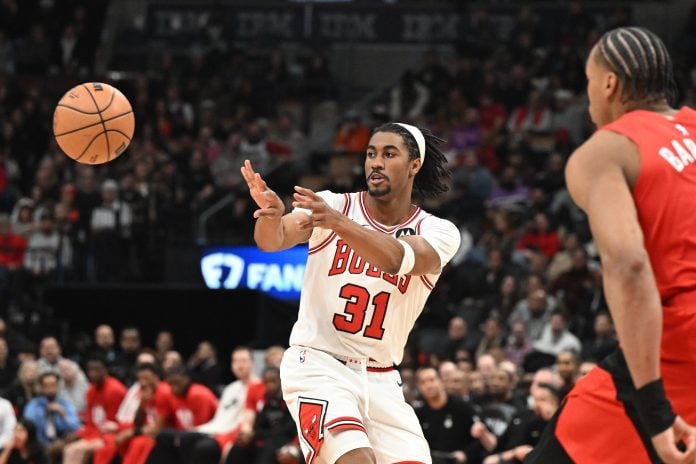
Feb 5, 2026; Toronto, Ontario, CAN; Chicago Bulls guard Jaden Ivey (31) passes against the Toronto Raptors in the second half at Scotiabank Arena. Mandatory Credit: Dan Hamilton-Imagn Images

Yesterday afternoon, the Chicago Bulls announced two names that’ll be sidelined for the remainder of the 2025-26 campaign. While this might only be ten games that’re largely meaningless in the long haul, both injuries might carry more significance as the team pivots to continue the rebuild project this summer. The Bulls finished in the top 10 leaguewide in games missed due to injury this season, per Statmuse, and struggled to maintain a consistent product, which contributed to the dysfunction between the lines. Luckily, only Noa Essengue’s left shoulder injury will take several months to recover from, and the rest are considered minor. In the cases of Jaden Ivey and Jalen Smith, here’s how it impacts Chicago’s long-term plans.

Trade Deadline Addition Fizzled Out

Jaden Ivey’s injury and his entire tenure with the Bulls were tough to watch. When he was acquired from the Detroit Pistons, fans thought they were adding a potential running mate to Josh Giddey for many years. Ivey is only 24 years old and averaged over 16 points per game in his first three seasons with Detroit before being derailed in his final year by a broken left fibula, followed by knee surgery prior to the start of the 2025-26 campaign. He hasn’t looked like the same explosive, downhill force ever since, and he’s been the first to admit it. In one of the more disheartening sound bites of the season, he spoke on his inability to return to his prior self.

Even though Ivey had to pass a physical to execute the trade to Chicago, this would’ve been something Karnisovas should’ve delved more into before committing to this deal. Instead, one of the most exciting adds at the deadline quickly became a horror story and unfortunate whiff of a deal, and will likely result in the former Purdue Boilermaker hitting free agency this summer. This offseason, he’ll be a restricted free agent. AK’s history suggests he will extend the guard despite all the red flags, but the smart move would be to cut ties, citing unavoidable injury deterioration.

Jalen Smith Will Stay As Long As He Wants

Chicago’s plan with Smith should be the exact opposite of Ivey’s. At only 26 years old and a proven stretch-five threat in either the starting center role or coming off the pine, he’s provided a stable offensive threat while providing solid rim-protection. In stretches this season, he also demonstrated the ability to play alongside an inside center and run a two-big system, further enhancing his value. He’s locked down through next season and will become an unrestricted free agent in the 2027 offseason. If he’s willing to stick with the franchise through a muddy rebuild phase, he should be granted an extension. The timeline fits closely with Matas Buzelis and Josh Giddey; the fit is ideal, and the versatility is undeniable.

In a season that was solely focused on finding assets to invest in beyond this season, Smith has proven his worth and earned his spot. Does Karnisovas see the value in his stretch-big, or does he opt to move on for someone younger in his place? The lack of centers on the roster and the immediate impact the former Indiana Pacers has had on Chicago since his arrival leans heavily toward the narrative that he’s here to stay.

One injury may mark the last time Ivey represents the Chicago Bulls, while the other is a precaution to protect a future investment in Smith. Would you gamble on Ivey despite his injury history, or let him walk this summer and admit failure on another trade deadline disaster?

You Won’t Believe How Much the Wind Screwed Ian Happ on Opening Day

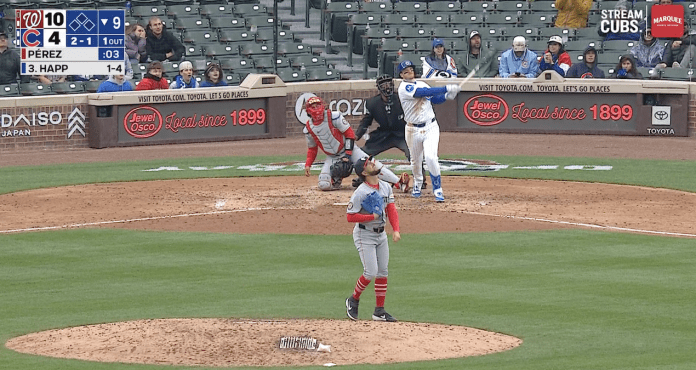
Sure, it came in garbage time, but it doesn’t make it any less annoying for Ian Happ, who absolutely crushed a ball in the ninth inning against the Washington Nationals on Opening Day. The Chicago Cubs lost 10-4, and this fly ball from Happ’s bat was only going to pad his stats, but it’s still insane how much yesterday’s wind at Wrigley Field affected this ball.

This wasn’t only supposed to be a home run, but you’re looking at Happ hitting a blast onto Waveland. Left-handed pitcher Cionel Perez left a 96mph fastball right down the middle of the plate, and Happ didn’t miss it. The Cubs’ left fielder crushed it, 108.5mph exit velocity, with a 31-degree launch angle.

The wind was blowing in from left field on Thursday, and unfortunately for Happ it got up to 30mph when he came to the plate in the ninth inning. You saw everyone’s reaction; it was crushed, but then James Wood started to fade back in after returning from the warning track.

All Happ could do was shake his head, grind his teeth, and trot back to the dugout. Meanwhile, Wood and Perez were laughing at how incredibly lucky they got.

That was a guaranteed home run off the bat, but according to MLB.com’s Mike Petriello, the wind cost Happ 113 feet of distance. So, instead of a 435-foot home run out of Wrigley Field and onto the street, it was a flyout that only went 322 feet.

According to the data available, no other flyout has ever been affected as much as that ball hit by Happ.

Nico Hoerner’s Contract Extension: More Changes Coming for the Chicago Cubs

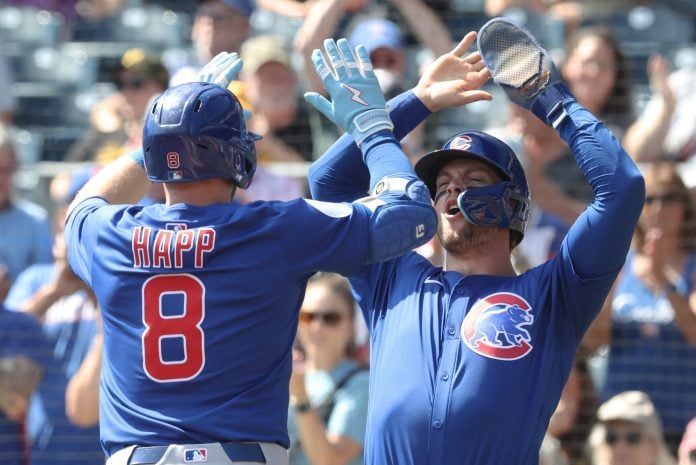
Sep 17, 2025; Pittsburgh, Pennsylvania, USA; Chicago Cubs second baseman Nico Hoerner (rioht) greets left fielder Ian Happ (8) crossing home plate on a two run home run against the Pittsburgh Pirates during the first inning at PNC Park. Mandatory Credit: Charles LeClaire-Imagn Images

The Chicago Cubs officially have a new core in place, as Nico Hoerner’s reported six-year contract extension cemented it. The new deal, which was revealed the same day the Cubs officially announced Pete Crow-Armstrong’s extension, also means more changes are coming around the field for the team.

First, the entire infield is locked up through at least the 2029 season.

1B Michael Busch – under team control through 2029
2B Nico Hoerner – signed through 2032
SS Dansby Swanson – signed through 2029
3B Alex Bregman – signed through 2030

Matt Shaw’s Future

Naturally, that leads to the first major question, looking at the rest of the roster, and you have to wonder about Matt Shaw’s future. Some fans have been quick to put Shaw back into trade talks, which could come up again as soon as this summer if the Cubs need to add a major piece for the stretch run. Shaw played pretty good defense at third base in 2025, and for a few years, he appeared to be the eventual replacement at second base if Hoerner moved on in free agency. That thought became much more prevalent after the Cubs signed Alex Bregman this past offseason, which meant Shaw was no longer the third baseman.

However, it doesn’t really seem like Shaw will be the odd man out. He was instructed to learn outfield defense this offseason, and right now he’s filling in for Seiya Suzuki in right field.

What Corner Outfielder Stays, If Any?

Shaw seems much more likely to stay with the Cubs and continue his career in either corner position in the outfield, which means Ian Happ or Suzuki won’t be returning to the team in 2027.

Happ and Suzuki are both headed to free agency following the 2026 season, and Happ’s previous comments suggest a player who knows what’s in his future. Happ is currently the longest tenured player in the organization, but he hasn’t had any extension talks with the Cubs, and neither has Suzuki.

Both are corner outfielders that are 30+ years old. There’s a good chance that the Cubs will look into possibly re-signing one of the two outfielders, but they’ll let them test free agency and circle back to see if the market works in the team’s favor.

Right now, I’m projecting Shaw as the Opening Day left fielder for the Cubs in 2027, with Happ on a different team. I don’t have a strong feeling about how the Cubs feel about Suzuki.

What About the Prospects?

Heading over to infield prospects, Jefferson Rojas and Pedro Ramirez suddenly don’t have a clear path for everyday playing time in the majors. Rojas, more than Ramirez, currently has a higher potential as a prospect, but now that Hoerner is locked up at second base, Swanson isn’t moving, which makes it a lot harder for any upcoming infielders to be anything more than a bench player.

Yet I think we sometimes forget how young some of these minor leaguers are. Rojas has been a popular name in the Cubs’ farm system for a few years, and you might be surprised to learn that he’s still 20-years-old. The right-handed hitting shortstop finished last year at Double-A, and after some struggles there, Rojas still has room to grow, as he continues his development.

However, as we saw throughout spring training, Rojas has immense talent, and many of us thought he’d be lined up to contribute in the majors soon. Now? Well, Rojas’ timeline probably gets delayed, but then you have to wonder if the Cubs would use him in a big trade if he continues to raise his stock as a prospect.

We talked about these things and had more fun reacting to the Hoerner extension news that broke after Opening Day on Thursday. Check out the latest Pinwheels And Ivy Podcast.

Nico Hoerner’s Opening Day Regret

We’re still waiting on the details for Nico Hoerner’s six-year contract extension with the Chicago Cubs, but for a quick moment, let’s talk about his pivotal at-bat on Opening Day against the Washington Nationals.

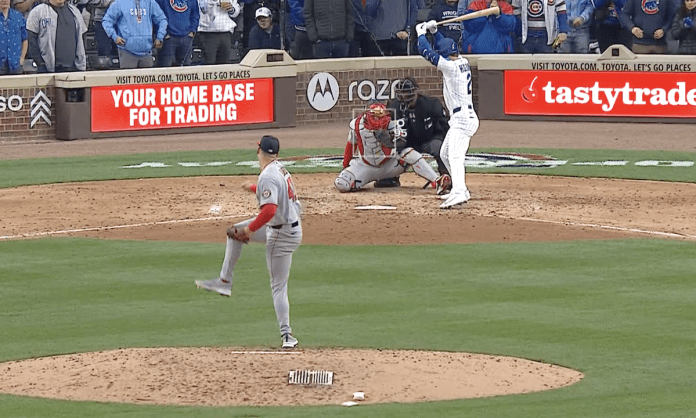
In the end, it may not have mattered, but with the ABS challenge system now in MLB, it will become another factor fans debate from time to time. The Cubs were trailing 8-4 in the seventh inning after Pete Crow-Armstrong put down a perfect bunt down the third base line that drove in Michael Busch. Hoerner stepped up to the plate with runners at first and second with one out.

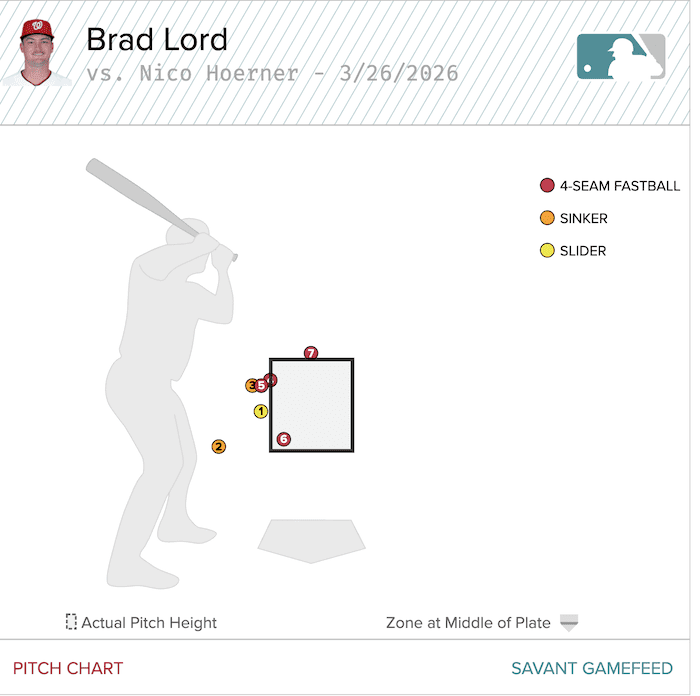
Washington reliever Brad Lord was shaky in his relief appearance, having already allowed a run, and then he fell behind 3-0 on Hoerner. A 3-0 fastball dotted in the inside corner for strike one, and then Lord doubled up, going inside on another fastball that was called strike two.

A few pitches later, Hoerner grounded into an inning-ending double that killed off the Cubs’ scoring threat.

The Cubs did not challenge a single pitch in their Opening Day 10-4 loss to the Nationals, and if there was ever a spot that called for one it was that 3-1 pitch from Lord to Hoerner. In the screenshot below you can it’s just off the plate, but it looks a lot more definitive on Baseball Savant’s graphic. The pitch was a ball, which meant if Hoerner would have challenged the call the Cubs would have had the bases loaded with one out, and Carson Kelly up at the plate with Moises Ballesteros on-deck.

It was the seventh inning, and the Cubs were down by four. There was really no reason not to challenge even if Hoerner wasn’t 100% confident. You get two guaranteed challenges to begin the game, and you can keep challenging after the first two if you keep getting them right. In this case, even if Hoerner was wrong the Cubs would have still had one challenge left.

But again, it all comes down to the situation. The Cubs were already trailing by four, and this was going to be their best chance at making the game close.

So, this should be a talking point inside the Cubs’ clubhouse. Whether it’s Craig Counsell or the entire coaching staff, they have to make a point of telling players and making it clear that these are the moments in games when one pitch can make a huge difference. Hopefully, it is a learning experience for all.

There was another call earlier in the game that also led to runs against the Cubs, and it came when Ben Brown came in relief of Matthew Boyd in the fourth inning. A 2-1 sinker that was supposed to be insider, missed it’s mark and forced Carson Kelly to reach across his body to make the grab. At first glance it seemed like an obvious ball, which is what the umpire called, but upon replay it still hit the strike zone.

Jacob Young then hit a two-run home run on the next pitch, taking a 3-1 fastball out to the basket in right field that gave the Nationals a 7-2 lead.

That one is maybe a little more nitpicky, and I guess what we learned on Opening Day is that the ABS challenge system is just another thing for fans to complain about.

Hey, at least Nico Hoerner is signing an extension, so Opening Day wasn’t so bad after all.

The Bears Are Very Interested In Kadyn Proctor — Here’s The Details

detroit lions
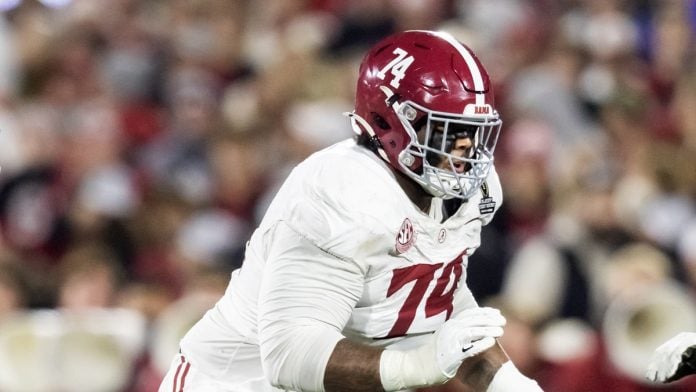
Dec 19, 2025; Norman, OK, USA; Alabama Crimson Tide offensive lineman Kadyn Proctor (74) against the Oklahoma Sooners during the CFP National Playoff First Round at Gaylord Family Oklahoma Memorial Stadium. Mandatory Credit: Mark J. Rebilas-Imagn Images

The signings of Braxton Jones and Jedrick Wills appeared to alleviate the major concerns at left tackle for the Chicago Bears. While neither is a long-term solution, both have starting experience and could hold down the fort until Ozzy Trapilo returns healthy. The focus now, going into the 2026 NFL draft, would be on defense, be it a defensive lineman or a safety in the 1st round. However, there are reasons to think the left tackle issue is not settled, and why Kadyn Proctor is the name to watch.

We’ll start with the assumption that Jones and Wills are considered the team’s solutions for the position. Insider Jeff Hughes of Sports Mockery made it clear from what he’s heard that left tackle remains very much in play at the 25th pick.

Now, you consider the most recent pro day Bears general manager Ryan Poles visited. His stops at Oklahoma and Miami made sense. Both programs feature prominent defensive linemen in this class, including some who could be options at #25. Then there’s Alabama. The Crimson Tide has no such defensive prospects this year. On the other hand, they do have one of the most prominent left tackles.

Kadyn Proctor is very much on the Bears’ radar.

SM has been informed that the Alabama left tackle has a lot of fans inside Halas Hall. It isn’t hard to see why. Few men who are 6’7″ and 352 lbs can move like Proctor can. His feet are surprisingly nimble for his size, enabling him to battle every type of pass rusher in pass protection. There is no doubt he’s a core asset in the running game, displaying the kind of power that drives open lanes. Most of the criticisms around him have focused on his inconsistent technique and limited range.

We already know Bears head coach Ben Johnson loves size. It started with the 6’5″, 331 lbs Penei Sewell in Detroit, and then the 6’8″, 316 lbs Trapilo last season. Johnson likely prefers bigger tackles because they tend to have strong anchors in protection and can generate more movement in the ground game. Both of those were cited as core things he looks for. Sacrificing a little range in protection seems like a reasonable trade-off. The obvious concern is whether Kadyn Proctor will even be available.

NFL ComparisonsPrimary Reasoning
Trent BrownRare combination of massive size and shocking foot speed.
Mekhi BectonElite length and physical frame; shared challenges with lateral agility.
Orlando Brown Jr.“Wall” style blocker who wins with immense reach and angles.
Jordan MailataHigh-tier explosive athleticism at a 350lb+ body weight.
JC LathamSimilar Alabama pedigree, power profile, and massive frame.
Evan NealHigh-profile Alabama tackle prospect with significant upper-body mass.
Rodger SaffoldProjects a similar raw power that could translate to tackle or guard.

Whispers indicate that Proctor falling to #25 isn’t likely.

The fact is that multiple teams picking in the first 24 spots have a need at left tackle. Cleveland (#6 and #24) and Detroit (#17) stand out as obvious landing spots. Cleveland lost their entire offensive line to free agency this offseason. They have to rebuild it quickly. Detroit also released longtime left tackle Taylor Decker, leaving that position open. Now, the good news from the Bears’ perspective is that Proctor isn’t the only option on the board. Francis Mauigoa, Spencer Fano, and Monroe Freeling are all considered contenders to be the first tackle off the board. If two of those three names end up going to the Browns and Lions, the door suddenly opens for Proctor to fall.

It’s worth noting that drafting offensive tackles of 350 lbs or more has become a dangerous gamble. The three most recent examples: Mekhi Becton, Isaiah Wilson, and Evan Neal were disappointments or outright busts. This might spook teams from going down that route despite Proctor showing enough evidence to believe he can handle the NFL level at that size. It will be fascinating to see if the rumblings about him going higher than expected are true. If not, keep his name circled.

Exploring The Chicago Bears’ Fatal Flaw When Drafting Edge Rushers

chicago bears
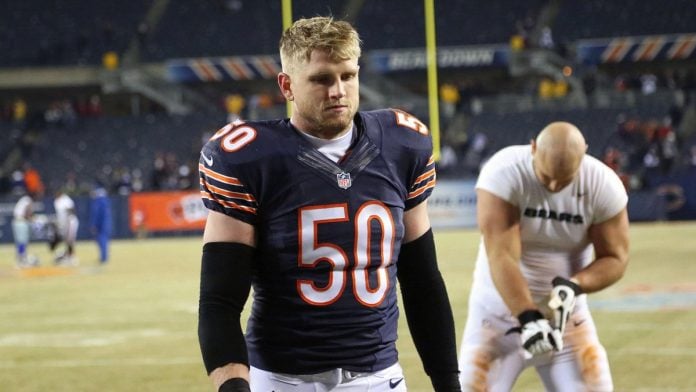
Dec 4, 2014; Chicago, IL, USA; Chicago Bears outside linebacker Shea McClellin (50) following the second half against the Dallas Cowboys at Soldier Field. Dallas won 41-28. Mandatory Credit: Dennis Wierzbicki-USA TODAY Sports

There is a very real chance the Chicago Bears will draft an edge rusher with their 1st round pick next month. If that happens, it would be the ninth time in the Super Bowl era that has happened. It is worth noting that none of the previous eight selected ever made a single Pro Bowl with the team. Not once. For such a critical position, that is a miserable hit rate. It goes a long way in explaining why the Bears have needed innovative defensive schemes like Buddy Ryan’s “46” blitz or Lovie Smith’s Tampa-2. Both can overcome the absence of a good edge rusher.

So what gives? Why have the Bears been so bad at this? Plenty of reasons will be listed. They have a poor eye for talent. Their developmental strategies have stunk. All carry valid points. However, the simplest explanation is that the team has too often focused on upside rather than proven production. I went back and looked at several of the top pass rushers from the past couple of decades to see whether their college production carried over to the NFL. For this, I used the Sacks Per Game metric. You’ll find that most of the biggest names averaged at least 0.50 sacks per game in college.

Player College (Draft Year)Career SacksGames PlayedSacks Per Game
Dwight FreeneySyracuse (2002)34.0211.61
Terrell SuggsArizona St (2003)44.0361.22
Robert MathisAlabama A&M (2003)44.0411.07
Simeon RiceIllinois (1996)44.5441.01
Michael StrahanTexas Southern (1993)41.5440.94
Jared AllenIdaho State (2004)38.5410.94
Julius PeppersN. Carolina (2002)30.5340.90
Myles GarrettTexas A&M (2017)32.5360.90
Elvis DumervilLouisville (2006)32.0440.73
Von MillerTexas A&M (2011)33.0470.70
Joey BosaOhio State (2016)26.0380.68
John AbrahamS. Carolina (2000)23.5360.65
Demarcus WareTroy (2005)27.5440.63
Nick BosaOhio State (2019)17.5290.60
Khalil MackBuffalo (2014)28.5480.59
Justin HoustonGeorgia (2011)20.0360.56
T.J. WattWisconsin (2017)11.5220.52
Aidan HutchinsonMichigan (2022)18.5430.43

The Chicago Bears can’t get lost in the measurables.

Before anybody asks, yes, there are exceptions to the rule. Danielle Hunter (0.12), Micah Parsons (0.25), and Travon Walker (0.26) are some recent examples of players who didn’t produce in college but took off in the NFL. Often, you’ll find this is less about the light switch going on and more about how they were used. Parsons wasn’t a full-time edge rusher in college. Hunter had lots of tackles for losses, but just not many sacks. Walker played a hybrid linebacker/edge-rusher role. Still, the rule holds. Since 1980, the Bears have selected seven 1st round edge rushers. Only two crossed the 0.50 sacks per game threshold. None were 0.60 or higher.

PlayerYear (Pick)CollegeCareer SacksGamesSacks Per Game
John Thierry1994 (#11)Alcorn State13.0220.59
Michael Haynes2003 (#14)Penn State25.5460.55
Leonard Floyd2016 (#9)Georgia17.0370.46
Al Harris1979 (#9)Arizona St19.0440.43
Shea McClellin2012 (#19)Boise State20.5480.43
Trace Armstrong1989 (#11)Florida/ASU15.0440.34
Alonzo Spellman1992 (#22)Ohio State9.0330.27

Even the two who reached the mark come with asterisks. Thierry played at Alcorn State, an FCS school at the time. Haynes got most of his sacks (15) in his final year at Penn State, making him a one-year wonder. Floyd was close at 0.46, eventually becoming a quality rusher in Los Angeles and San Francisco. Harris and McClellin were big disappointments. Spellman never lived up to his potential.

The Bears must think about striking early.

There is lots of talent in the 2026 draft class, but only five players cross that 0.50 threshold based on their college production. Most of the others fall into the low-floor-high-ceiling category. In other words, buyer beware. Two of those five names are almost certain to be gone before the Chicago Bears pick at #25 overall. One isn’t big enough for defensive coordinator Dennis Allen. That leaves two choices who fit the criteria: Clemson defensive end T.J. Parker and Illinois defensive end Gabe Jacas.

Player SchoolCareer SacksGames PlayedSacks Per Game
David BaileyTexas Tech29.0460.63
Trey MooreTexas / UTSA30.5570.54
Rueben Bain Jr.Miami (FL)20.5380.54
T.J. ParkerClemson21.5400.54
Gabe JacasIllinois27.0500.54
R Mason ThomasOklahoma17.0420.40
Dani Dennis-SuttonPenn State18.5510.36
Romello HeightTexas Tech16.5520.32
Keldric FaulkAuburn10.0380.26
Mason ReigerWisconsin13.0510.25
Zion YoungMissouri11.5460.25
Jaishawn BarhamMichigan12.0480.25
George Gumbs Jr.Florida11.0440.25
Keyron CrawfordAuburn11.0470.23
Joshua JosephsTennessee9.5480.20
LT OvertonAlabama7.0490.14

For all the buzz about Zion Young, Keldric Faulk, and Dani Dennis-Sutton, none of them produced at a level anywhere close to the desired level. Could they become exceptions in the NFL? Sure. It’s happened before. However, the odds aren’t nearly as favorable as one would think. The Bears are proof of that. They’ve been going after the toolsy players for long enough. Maybe it’s time to lean a little more into the productive ones.

This Kalif Raymond Update Proves Ben Johnson Is Done Being Patient With The Bears

allen robinson
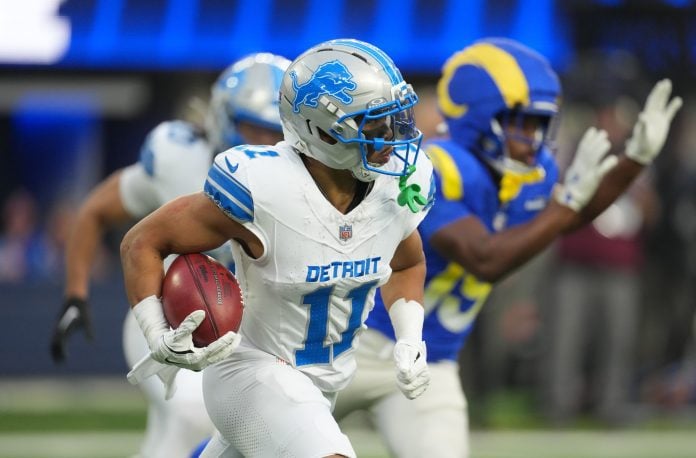
Dec 14, 2025; Inglewood, California, USA; Detroit Lions wide receiver Kalif Raymond (11) runs with the ball during the second quarter against the Los Angeles Rams at SoFi Stadium. Mandatory Credit: Kirby Lee-Imagn Images

The Chicago Bears always planned to reshape the wide receiver position this offseason. They traded D.J. Moore to Buffalo because of salary cap issues and allowed Olamide Zaccheaus to leave in free agency. That opened up two of the top four spots on the depth chart. While Jahdae Walker may get a chance to fill one of them, head coach Ben Johnson knew he had to insert some experience into that mix. He chose to go with a familiar face. Kalif Raymond had worked with the Bears head coach for five years in Detroit. There was a level of trust that made the signing easy.

However, Johnson doesn’t do anything by halves. He had a plan going into the offseason. Something needed to change with his roster. Signing Raymond wasn’t just about adding speed and experience. The 31-year-old brought something else to the table. Something the Bears seemed to lack too often last season. Dan Pompei of The Athletic discovered what it was.

As Ben Johnson considered how to elevate wide receiver impact, the head coach of the Chicago Bears didn’t think about downfield speed, playmaking ability or route running. He thought about grit…

…Raymond told him he was already looking forward to training camp. Especially one day.

“My favorite day of the season,” he told Johnson, “is the first day of pads.”

The first day of pads is when character is tested, courage emerges and timidity is exposed. It’s when suspicions become convictions and the pretending stops…

…Johnson wants his Bears to prepare more intensely and with more purpose. And he sees Raymond as a way to make that happen.

Kalif Raymond understands the NFL grind.

After all, the wide receiver had to fight just to stay in the league as an undrafted free agent. Nothing was ever handed to him. He knew that if he ever got comfortable and stopped working, teams wouldn’t pick up the phone anymore. That meant he must get accustomed to a relentless approach to the game. Prepare with a purpose. It’s little wonder Johnson grew to like him. Don’t forget he stated during the Bears’ rough start in September that the team’s preparation wasn’t anywhere close to championship caliber.

While it may have improved enough to make the playoffs, this move suggests the head coach still isn’t satisfied. Given the sloppy way the team performed in its playoff loss to Los Angeles, that isn’t surprising. This team is still not sharp enough to make a championship run. Raymond may not be a star, but he works harder than most. He doesn’t take anything for granted. He should be able to help instill that mentality in his new teammates in the coming months.

Raymond certainly seemed to have an impact on young teammates in Detroit.

He was there when the Lions drafted Amon-Ra St. Brown and Jameson Williams. Both eventually developed into Pro Bowl-caliber players. St. Brown called Kalif Raymond the best teammate he ever had. That offers a good idea of what the veteran brings to the table. He’s a good player. That was the main selling point, but such additions can’t be just about what someone does on the field. What do they offer in the locker room? That is what Johnson had in the back of his mind this offseason.

He recognized that the Bears had a highly talented group of young players. The problem with such a large collection is that they often lack a clear sense of what it takes to achieve greatness. Smart coaches often help with this by bringing in veteran players with notorious reputations for obsessive work ethics. Every athlete is competitive. They don’t want to lose in anything, including the idea that someone is outworking them. That is what Raymond will bring to the table.

One Trade Deadline Acquisition Has Earned His Place In Chicago’s Future

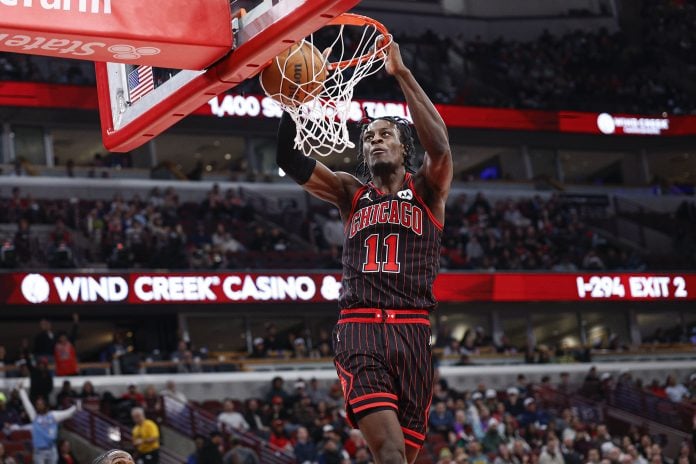
Mar 18, 2026; Chicago, Illinois, USA; Chicago Bulls forward Leonard Miller (11) scores against the Toronto Raptors during the second half at United Center. Mandatory Credit: Kamil Krzaczynski-Imagn Images

During the first week of February, Chicago’s entire roster, future, and outlook turned upside down. In some ways, it was for the better, finally moving on from the stockpile of mid-level talent making average salaries, leading the team to a mediocre record and three years in a row of Play-In tournament losses. In other ways, it was infuriating to watch Arturas Karnisovas swap fully deteriorated assets for extremely minimal returns, add a slew of expiring contracts, and fail to acquire any genuine young talent or highly valued draft picks. To make matters worse, after stating that he was not content with landing in the middle with each passing season, Chicago has found itself again with a high likelihood of drafting somewhere between the ninth and twelfth draft slots in the 2026 NBA Draft. Back to the bright side, they might be snagging a second selection in the first round if the Portland Trail Blazers can claw their way into the Western Conference playoffs. Despite the entire mess that’s been built up over the last seven weeks, one name has emerged as a potential future building block.

Leonard Miller Is An Upgraded Patrick Williams

Any Chicago fan who has endured the last six seasons of underwhelming play from Patrick Williams has had one thought watching Leonard Miller play: This is the next guy. He’s nothing flashy, not putting up record-breaking numbers, but he’s a solid contributor, plays above-average defense, crashes the glass, and complements Josh Giddey and Matas Buzelis perfectly. That last detail, being the most important, fitting alongside the two cornerstone assets, is what will earn Miller an extended stay with Chicago. This month, he’s posting 11.5 points and 6.3 rebounds per contest, while shooting 54.2% from the field. All three of those numbers would be career-bests for Williams, a former top-five pick from Arturas Karnisovas.

Worthy Of An Investment

In June of 2024, Williams inked a 5-year, $90 million dollar extension. His career-highs to that point were 10.2 points and 4.6 rebounds in a season, numbers he has failed to reach or surpass since earning the massive payday. He’s also 26 years old now, and not trending upwards. Miller, on the other hand, is 22 years old, earns less than $3 million annually, and is under contract through next season’s conclusion. The only worrisome fact is that if Karnisovas is still in charge, with his numbers already passing those of Williams, he might be granted a contract north of the $18 million annual value that the former Florida State Seminole secured. Since the goal at the trade deadline was to acquire young assets to build around the timeline of Buzelis and Giddey, this particular addition was a slam dunk.

Has Leonard Miller proved enough to lock a roster spot alongside his youthful running mates in Chicago, or do the Bulls let him walk next summer and look elsewhere for young depth to align with the development of their young stars?