
Thursday, November 26, 2026
EDGE is live. Chicago fans can now access and explore the beta.
Home Blog Page 1743

Chicago Bears 2022 Draft Sleepers: Offensive Line Edition

chicago bears
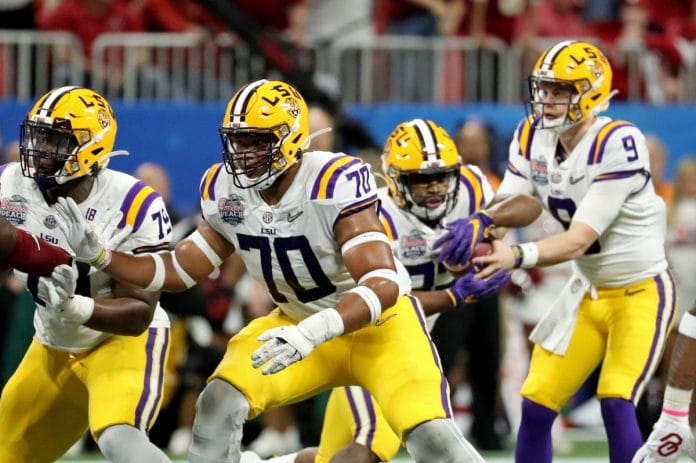
Dec 28, 2019; Atlanta, Georgia, USA; LSU Tigers offensive lineman Lloyd Cushenberry III (79) and Ed Ingram (70) blocks during the 2019 Peach Bowl college football playoff semifinal game against the Oklahoma Sooners at Mercedes-Benz Stadium. Mandatory Credit: Jason Getz-USA TODAY Sports

GM Ryan Poles declared the offensive line would be a primary focus for him moving forward. He certainly has work to do in that regard. Three of the Chicago Bears’ five starters from last season are free agents with no guarantee any of them will be back. Cody Whitehair and Teven Jenkins feel like the only locks to play next season with even Larry Borom surrounded by questions.

This will make life challenging for Poles. Filling one or two offensive line spots in a single offseason is hard enough. Three is pushing it. He will need some favorable luck involved. That may include scoring a hidden gem in the upcoming NFL draft. The good news is that this appears to be a class with some quality depth to it.

Enough to where the Bears might be able to find an eventual starter or two beyond the early rounds. Here are some names to keep an eye on.

Chicago Bears 2022 draft options are rich on the O-line

Tyler Smith (Tulsa)

Poles said that one of the priorities he’d have for offensive linemen moving forward is a greater emphasis on nastiness. He wants blockers ready and willing to fight. Few things sum up Smith better. He played with a constant edge at Tulsa, seizing every opportunity to punish defenders. Sometimes that got him in trouble, resulting in technique lapses that led to missed assignments or penalties. Still, his excellent mix of size (6’6, 330 lbs) and athleticism can make him a starting left tackle in the NFL. If not, he can be a mainstay at guard as well.

Tyler Vrabel (Boston College)

If the name sounds familiar, it should. This is the son of reigning NFL Coach of the Year Mike Vrabel. One thing that is always apparent with the sons of coaches is they understand the game far better than most kids their age. Vrabel is no exception. He proved this by playing well at both left and right tackle for Boston College. He’s big, strong, aggressive, and displays polished footwork. There are lingering concerns about his posture and bend, but those too can be fixed with persistent coaching. If the Chicago Bears don’t want to try him at tackle, then he should have no issues moving inside.

Ed Ingram (LSU)

LSU always puts great talent into the NFL. Probably one of the most overlooked areas they’ve delivered some gems is the offensive line. See Andrew Whitworth, Trai Turner, La’El Collins, and Lloyd Cushenberry III. Ingram is another talent that is getting overlooked. He played both guard spots in college and established a reputation as a powerful and nasty run blocker. This belies his technical prowess in pass protection and underrated athleticism. He can move well. This kid will start for somebody and be a good football player. It is just unfortunate he played when the program was in transition.

Cade Mays (Tennessee)

One trait that can never be appreciated enough in the NFL is versatility. The more you can do for a team, the higher your value. Mays understands this. He was a Swiss army knife for Tennessee, playing all five offensive line positions at various points during his time there. His size is premium for a center (6’6, 325 lbs) as he has the power to handle bull rushes but can still move well enough to operate in space. Most of his issues are technique-related. Not talent. Once he’s allowed to settle at one position, he should end up becoming an above-average starter. Poles is probably aware of him, having helped Kansas City draft teammate Trey Smith last year.

Spencer Burford (Texas-San Antonio)

Drafting prospects from smaller schools can be dangerous. The Chicago Bears know this well. There is no way to know if they can handle a steep jump in competition to the NFL. This is why two questions are asked. Are they really talented, and did they dominate their level of competition? For Burford, the answer is yes on both counts. His size and athleticism stood out often. Not to mention his energy and aggression. He loves playing physical. The best part is his natural football, and great length make him difficult to beat in pass protection. Like any small-school prospect, he has technique issues. With some cleaning up, he can play tackle or guard in the NFL.
Two Bears Fans Learned To Never, Ever Ask Dick Butkus For Life Advice

dick butkus
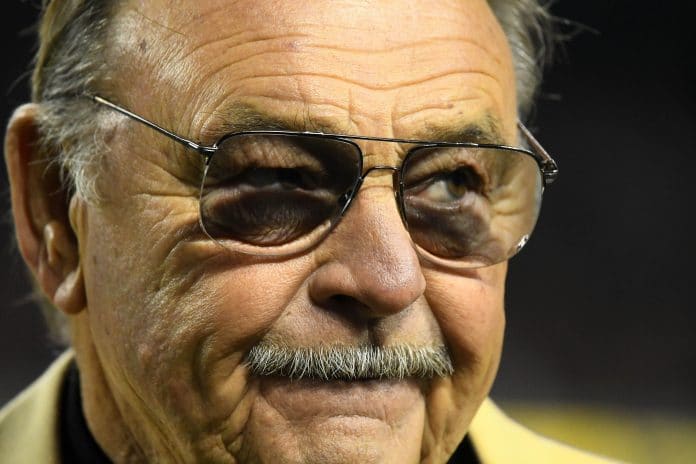
Oct 31, 2016; Chicago, IL, USA; Chicago Bear former linebacker Dick Butkus speaks to the crowd during the first half against the Minnesota Vikings at Soldier Field. Mandatory Credit: Mike DiNovo-USA TODAY Sports

Back in the 1960s and early 1970s, Dick Butkus established himself as the most feared man in the NFL. His hard-hitting style and vicious nature become legendary among those that had the misfortune of playing against him. It took over 50 years, but it seems the Chicago Bears icon has found his next calling. That of a roastmaster on social media. While the Wendy’s Twitter account may hold the championship belt in this regard, Butkus seems hell-bent on claiming it for himself.

He’s already delivered some knockout shots to various people. Most recently, Aaron Rodgers over his failed engagement to Shailene Woodley. Other targets of opportunity included 50 Cent, the sport of Curling, and Matthew McConaughey, among others. He doesn’t play favorites either. Two well-meaning but naive Bears fans found that out the hard way when they asked Butkus for advice.

Whew. True to form, the man always brings the wood.

Dick Butkus has proven one thing, though. He remains a national treasure. His killer instinct hasn’t died away despite not playing football since the early 1970s. It makes you wonder why Comedy Central hasn’t gotten him on some of those celebrity roast specials they do. He’d be an absolute gem. That aside, hopefully this serves as a lesson to Bears fans. The man loves you, but it’s tough love.

When the opportunity comes for him to deliver a hit, he will always bring everything he has. The target does not matter. So ask him for advice at your own risk. The odds are high that it won’t be the answer you’re hoping for. On the flip side, those following him no doubt hope such questions continue. They’ve made for some of the best entertainment any current or former Bears have provided in the past several years.

Maybe he will get a chance to tweet about a winning team soon.

How Nagy’s Andy Dalton Obsession Got Him Fired In One Damning Chart

andy dalton
Sep 19, 2021; Chicago, Illinois, USA; Chicago Bears quarterback Andy Dalton (14) talks with head coach Matt Nagy after throwing a touchdown pass to wide receiver Allen Robinson (not pictured) against the Cincinnati Bengals during the first quarter at Soldier Field. Mandatory Credit: Jon Durr-USA TODAY Sports

There were multiple reasons Matt Nagy got fired last month, but one almost always stands above the rest. One decision lit the fuse on the powder keg. For many, it was the decision by the former Chicago Bears head coach to bench Justin Fields in favor of Andy Dalton. Nagy made his agenda clear from the start. He intended to copy the Kansas City Chiefs’ approach with Patrick Mahomes. Sit the talented rookie behind an experienced veteran.

He never recognized the flaws with this approach from the start. Dalton was not the same player Alex Smith was back in 2017. Smith had been entrenched as a starter with Kansas City for years. He knew the offense inside and out by that point. Dalton had yet to take a single snap in Chicago. Assuming he’d be able to play at a Pro Bowl level as Smith did that year was a remarkable level of delusion.

Yet Nagy didn’t stop there.

He was so convinced the approach would work that he didn’t even give himself an outlet. Almost every single snap with the first-team offense was given to Dalton in training camp. Fields was relegated to the second team. He wasn’t even allowed a chance to compete for the starting job. This decision stunned many at the time. It was felt Nagy was inviting disaster if Dalton played bad or got injured.

Everybody knows what happened next. Dalton suffered a bone bruise in his knee in Week 2 against Cincinnati, forcing the rookie into action. Nagy was not prepared for this, and everything came to a head the following week in Cleveland, where Fields was sacked nine times and had one net passing yard. That was the true beginning of Nagy’s downfall.

Yet if people are more interested in hard evidence of how insane the entire situation was, look no further than this excellent chart created by Johnathan Wood of Da Bears Blog.

“I’ll get to a more typical table with concrete numbers in a second, but for now the graph below shows how many dropbacks (pass attempts + sacks) were needed to produce an explosive pass for all 33 QBs with 200+ passing attempts in 2021. The two Bears samples (Fields and the Dalton/Foles combo) have their dots shown in orange.”

Fields outdid Andy Dalton despite getting actively sabotaged

It took the veteran more than twice as long between explosive plays as it did the rookie. Dalton threw more interceptions than touchdowns too, just like Fields. This hammers home the entire point. Nagy’s logic behind the entire “plan” was flawed from the start. His willingness to double down on Dalton by intentionally robbing his talented rookie of reps with the starters. It was sheer lunacy.

If the head coach had devoted everything to Fields from the start or even just made it an open competition, he might’ve saved himself. Instead, he put all his eggs in the Andy Dalton basket and acted shocked when said basket splattered all over the Soldier Field turf. It was final proof that Nagy never had a firm grasp on how to handle developing players. His solution was always the same.

Just copy what the Chiefs did.

He never realized that doing such things is rarely a good idea. Both because the Bears didn’t have the same players as Kansas City, and Nagy himself is not Andy Reid. Competent coaches adapt to the situation they’re in. If he’d been more self-aware, he’d have recognized the odds of failure for Dalton were high. Yet he plowed ahead anyway. Now both men are unemployed.

Bargain Free Agents The Chicago Bears Could Target

chicago bears
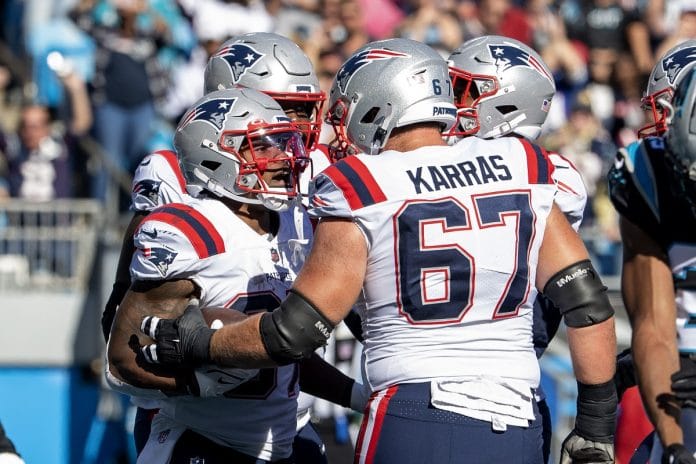
Nov 7, 2021; Charlotte, North Carolina, USA; New England Patriots running back Damien Harris (37) celebrates with guard Ted Karras (67) after scoring a touchdown in the first quarter at Bank of America Stadium. Mandatory Credit: Bob Donnan-USA TODAY Sports

Ryan Poles made it clear during his opening press conference. He intends to “build through the draft” and be “selective in free agency.” This would suggest that the Chicago Bears aren’t be big spenders when the market opens next month. Poles will most likely let the first couple of waves pass. Once prices start to drop, he’ll enact some serious bargain hunting to fill some key depth needs.

It isn’t the most exciting approach, but it can work if a team does its scouting well. The trick is finding players that don’t cost much but have a higher probability of their best football being ahead of them. An inexact science, to be sure, but effective when done right. There also could be some veteran bridge options. Solid players in their early 30s that can plug holes here and there for a season as the team works to fix other issues.

Here are some names that would make sense for the Bears.

Chicago Bears could find lots of value on the bargain market

Cedrick Wilson Jr. (WR)

Projected cost: 2-year deal for $11 million

It isn’t a secret the Bears need help at wide receiver. While they’d love to land a surefire superstar, they may have to be more pragmatic about trying to find one. Wilson took a big step forward in Dallas this past year, going for 602 yards and six touchdowns on just 61 targets. With injuries hitting the Cowboys receiving corps, he stepped up and showed everybody he is capable of more. His ability out of the slot should be desirable to this team, given Darnell Mooney’s threat on the outside.

Robert Tonyan (TE)

Projected cost: 1-year deal for $5.5 million

The former undrafted free agent had been on a hot streak since the beginning of 2020. In that time, he amassed 70 catches for 790 yards and 13 touchdowns despite only 88 total targets. He was headed for a big payday right until he tore his ACL against Arizona. So there is a definite risk involved with this move. However, when healthy, he’s proven to be a legitimate weapon in the passing game. Particularly in the red zone.

Ted Karras (OG/C)

Projected cost: 3-year deal for $13 million

The former 6th round pick out of Illinois took some time to get going in his career, but he has blossomed into a capable interior blocker for the New England Patriots. Since 2019, he has allowed 38 pressures in 1,794 pass blocking snaps. By comparison, James Daniels allowed 40 in just 2021 alone. Karras may never be a tone-setter when it comes to run blocking, but he can help safeguard Justin Fields.

Anthony Walker (MLB)

Projected cost: 2-year deal for $8 million

While not the biggest linebacker for his position and prone to getting swallowed up by offensive linemen, Walker compensates with excellent intelligence, leadership skills, and the athleticism to be a constant nuisance in coverage. He was a big reason Cleveland managed to improve from 22nd in pass defense to 5th last year. Walker has deep ties to Matt Eberflus from their time together in Indianapolis. He’d make a logical addition to the defense if the Chicago Bears plan to move Roquan Smith to outside linebacker.

Maurice Hurst (DT)

Projected cost: 1-year deal for $2.5 million

One has to feel bad for Hurst. He’s never really been in a defense that knew how to exploit his capability as an interior pass rusher. Between 2019 and 2020, he had 504 pass rush snaps. He provided 49 pressures, 14 hits, and four sacks on the quarterback in that span. People were anxious to see what he could do in San Francisco, where they played a scheme perfect for him. Then he got injured. His style is an excellent fit for Eberflus’ defense as well. Somebody that can eat up single blocks playing between Robert Quinn and Khalil Mack.

Kyle Fuller (CB)

Projected cost: 1-year for $5.75 million

The irony here is rather palpable. Chicago cut Fuller last offseason because he’d grown too expensive. He headed off to Denver, struggled, and is again a free agent. In that time, the Bears changed to a defensive system that may fit the veteran cornerback even better than before thanks to his ability in zone coverage. It’s hard to know how much gas he has left in the tank at 30-years old, but the price makes it worth the risk.

Turnaround For The Bears Has Happened When Least Expected

justin fields
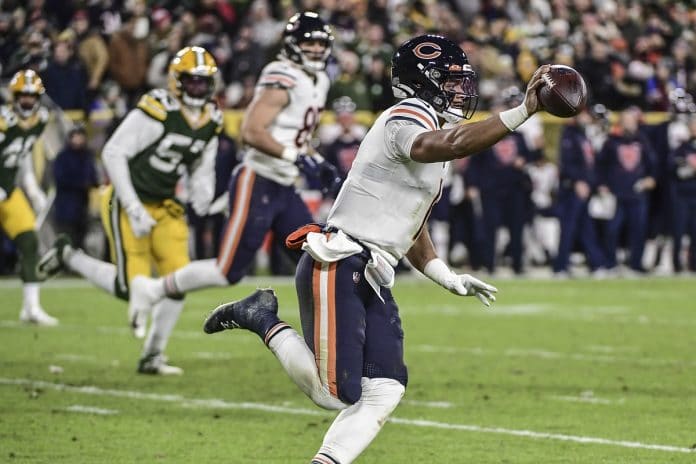
Dec 12, 2021; Green Bay, Wisconsin, USA; Chicago Bears quarterback Justin Fields (1) rushes for nine yards in the second quarter during the game against the Green Bay Packers at Lambeau Field. Mandatory Credit: Benny Sieu-USA TODAY Sports

This past Sunday, the Los Angeles Rams defeated the Cincinnati Bengals in Super Bowl 56, bringing an end to the 2021 NFL season. The Bengals shocked the league, making it to the Super Bowl after having the worst record two years ago with a 2-14 record. The quick turnaround inspires hope for the Chicago Bears, who have experienced several quick turnarounds of their own in the last 21 seasons.

Several Of Chicago’s Playoff Seasons Have Come Unexpectedly

Following the 2000 season, the Chicago Bears have made the NFL Playoffs six times in the last 21 seasons. Four of those playoff seasons followed seasons in which Chicago finished under .500. Those Bears’ teams made the playoffs in 2001, 2005, 2010, and 2018. In three of those four seasons that came before the playoff season, Chicago finished with five wins.

The most surprising playoff team in Bears’ history was the 2001 team that won 13 games and the NFC Central Division. Under Dick Jauron, Chicago would make an eight-game improvement from the year before as they featured the best scoring defense that season. The 2001 Bears were so good that anytime they scored 13 points or more, they were victorious. What led Chicago’s turnaround in 2001 wasn’t just their strong defense led by linebacker Brian Urlacher and Mike Brown, as the offense featured Offensive Rookie of the Year running back Anthony Thomas, who rushed for 1,183 yards.

Four seasons later, in 2005, Chicago would make the playoffs and win the NFC North Division with 11 wins. Despite having the worst offense in the NFL the year prior and only winning five games, the 2005 Bears’ offense ranked eighth in rushing, which complimented the second-best defense in the league. Urlacher was named Defensive Player of the Year in 2005, as cornerback Nathan Vasher recorded eight interceptions.

In 2009, the Bears acquired Pro Bowl quarterback Jay Cutler in trade with the Denver Broncos. The acquisition of Cutler led many to believe that Chicago would be a playoff team in 2009. The 2009 Bears would finish below .500 with a 7-9 record, but their turnaround came the following year after the free-agent signing of All-Pro defensive end Julius Peppers. In 2010, Chicago would win 11 games and the NFC North Division due to a top-ten defense. The team would make it to the NFC Championship game before losing to the eventual Super Bowl Champion Green Bay Packers.

Following a five-win 2017 season, there wasn’t much excitement heading into the 2018 season for Matt Nagy’s first season with the Bears. That would change a week before the start of the season after general manager Ryan Pace made a blockbuster trade to acquire All-Pro linebacker, Khalil Mack. With Mack, the 2018 Bears’ defense was the best defensive unit in the NFL as they led the league in turnovers and sacks. Chicago won 12 games for the first time since 2001 and won the NFC North Division, leading Nagy to be named NFL Coach of the Year.

The 2022 Chicago Bears Could Make An Unexpected Turnaround As Well

The 2022 season will mark Matt Eberflus’ first season as the Bears head coach, and there is potential for the team to be competitive. Chicago won only six games this past season which led to the firing of both Nagy and Pace. Although the Bears won six games, they were extremely competitive and could have finished above .500. Three of Chicago’s 11 losses were by eight points or less, with two of those losses coming at the very end of regulation. In back-to-back games against the Pittsburgh Steelers and Baltimore Ravens, the Bears’ defense allowed a game-winning touchdown or field goal in the final 30-second of both games.

With several key players likely to be a part of the 2022 campaign for the Bears, Eberflus has a good chance of having a successful first season as a head coach. If he can add three wins, the Bears will finish above .500 for the first time since 2018. Furthermore, it will allow Eberflus to win over Chicago fans and prove that he was the correct hire by new general manager Ryan Poles. This will also provide the Bears’ new head coach more time to completely change the defense from a 3-4 to a cover-2 defensive scheme that he is more accustomed to deploying.

Although expectations will be low for the Bears in 2022, there should be optimism given what took place with the Bengals and quarterback Joe Burrow. Burrow made a significant jump in performance following a rookie season cut short by a career-threatening knee injury. Second-year quarterback Justin Fields can make a similar jump as his rookie season was hampered by several injuries.

When it comes to fan expectations, the Bears appear to perform the opposite of what is expected of them. Heading into the 2001, 2005, 2010, and 2018 NFL seasons, there were no big expectations for Chicago to make the playoffs or win a division title. Likewise, When the Bears were expected to make a Super Bowl run in 2007, 2011, and 2019, the team finished without a winning record. Uncertain expectations may be the best thing for Chicago heading into the 2022 season.


Zach LaVine Injury Timeline Shows His Determination

chicago bulls, zach lavine
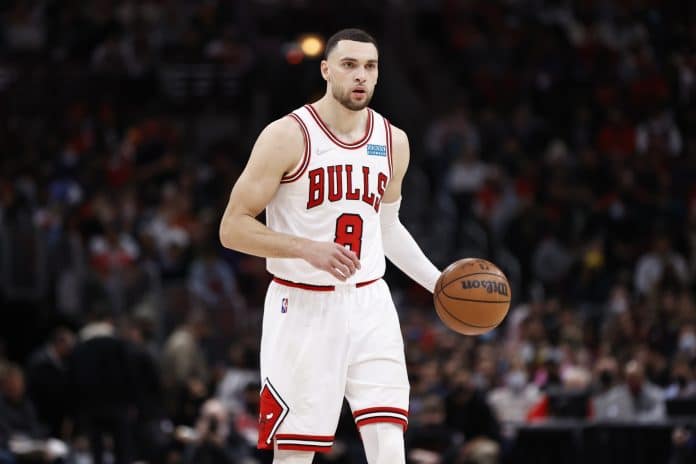
Feb 7, 2022; Chicago, Illinois, USA; Chicago Bulls guard Zach LaVine (8) brings the ball up court against the Phoenix Suns during the second half at United Center. Mandatory Credit: Kamil Krzaczynski-USA TODAY Sports

Zach LaVine is a tough player.

Any Chicago Bulls fan knows LaVine desperately wants to be on the floor at all times. If there’s a will there’s a way, and LaVine’s willingness to play through the pain is admirable.

The star shooting guard recently had fluid taken from his knee and an injection to help prevent soreness and swelling. Through the process of visiting a doctor in Los Angeles and missing the last three games up until the All-star break, he’s endured plenty more pain.

LaVine has played in 47 of the 59 games the Bulls executed this season. But, the 12 games he missed were for a multitude of injuries. I designed a table below with the injuries and dates for the time he dealt with them.

[table id=2 /]

LaVine played through a lot this season. Most impressively, the torn ligaments on his thumb hardly affected his shot, even though they were torn in his shooting hand.

In the 14 games with his thumb injury, LaVine averaged 26.1 points, 3.4 assists, and shot 48.1 percent from the field, 37.5 percent from downtown and 85.7 percent from the free-throw line, according to NBCSports Chicago.

LaVine’s knee soreness certainly gave Bulls fans a scare. Considering his pain developed from the knee that he tore his ACL back in 2017, it looked like another Derrick Rose situation in Chicago.

LaVine missed an initial six games in the middle of January with that injury. Including the game, he left against the Warriors three minutes into the contest with that injury. The Bulls went 1-5 during that stretch without him.

He returned for six games before sitting out the following two with back spasms. During the stretch he returned to the lineup, the Bulls went 4-2 against their opponents.

Now, he has been without his team for the past three games leading up to the All-star break due to his recurring knee injury. Luckily, his specialist in Los Angeles found no serious damage to his knee.

Bulls fans can take a sigh of relief now that their star could participate in All-star weekend as well as the Bulls’ next game against the Atlanta Hawks on Feb. 24.

The Bulls stepped up

It’s crucial to point out two things from LaVine’s up-and-down season, peppered with injuries and nearly a cautionary tale.

First, LaVine is the heart and soul of the Bulls. His adamant behavior towards playing while injured should not go unnoticed. There have been plenty of injuries around the league that players could play through but don’t.

LaVine should be praised for his nobility on the floor, risking injury in multiple places as he continues his fast-paced, aggressive style of play.

Second, for this reasoning, this is why the Bulls’ stacked the box with veterans and All-star caliber players, like DeRozan. DeRozan has scored over 35 points in each of his last seven contests, breaking the abstract, is that-really-a-record NBA record of seven straight games with 35+ points with 50 percent shooting from the field.

It’s also a kudos to Nikola Vucevic, who has averaged 24.4 points and 13.6 rebounds per game in his last 10 games while shooting 63.9 percent from the floor. In a time without LaVine to carry the offensive momentum, Vucevic has stepped up, right alongside DeRozan.

LaVine should return after the All-star weekend, marking the return of the Bulls’ true leader.


Chicago Bears Bring Back Remnant Of 2006 To Solve Injury Crisis

chicago bears

In 2004, the Chicago Bears suffered an uncanny array of injuries that torpedoed their season. Several started missed multiple games, and some were lost for the season. Brian Urlacher missed seven games. Mike Brown missed 14. The list was long. So in 2005, the team hired a new strength and conditioning coach, bringing Rusty Jones over from Buffalo. The injury woes evaporated almost instantly, and the Bears won the division.

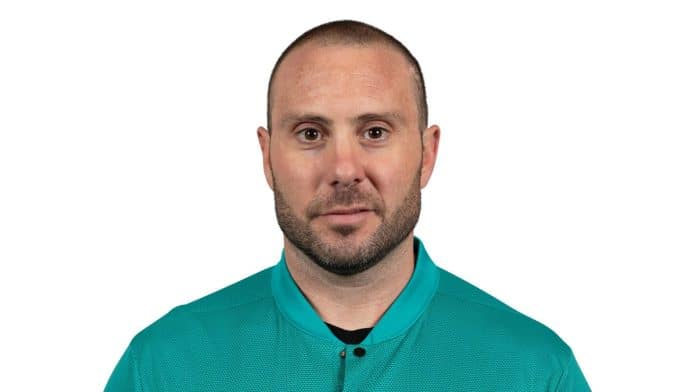
Next to the great Clyde Emrich himself, Jones is widely regarded as the best strength coach the organization ever had. Now it seems the team aims to put his protege in that same job 17 years later. The Bears announced on Friday that Jim Arthur would take over the strength and conditioning department for the departed Joe Loscalzo. Arthur was the right-hand man of Jones from 2006 to 2013. He stayed two more years through 2015 before leaving for the Miami Dolphins in 2016.

This opportunity was a long time coming for Arthur.

He’s been an assistant strength coach for well over a decade. At 43-years old, he is well-prepared for this opportunity. It is somewhat fitting that the Bears are the team to give it to him. Their new GM Ryan Poles worked with him briefly during 2008. Poles was an undrafted free agent offensive lineman out of Boston College at the time. It seems the young coach made a favorable impression on the future executive.

This also feels like another step by the organization to further modernize. Poles came in with a reputation for embracing old school scouting and the latest analytics trend. He brought that same mentality to the strength and conditioning department too. Brent Salazar arrived to take over as director of high performance. His job will be helping to open up the sports science possibilities at Halas Hall. Something Arthur figures to champion as well.

Arthur can help solve Chicago Bears’ injury issues

Football is a physical sport. Injuries are inevitable. That is just the way the league works. However, the difference between good and bad teams is often those that can avoid unnecessary ailments. Soft tissue injuries like hamstrings, groins, calves, and the like. The Bears saw seven players miss at least one game in 2021 due to a soft tissue injury. Among them were Allen Robinson, Akiem Hicks, and Eddie Jackson.

By contrast, the Dolphins where Arthur just came from had three such cases. This was a trademark of the Jones years. The Chicago Bears avoided lesser injuries, allowing their best players to stay on the field more often. When that happens, the team tends to win. Arthur was present for four winning seasons in Chicago, including two NFC championship appearances and a Super Bowl berth.

He has learned from some of the best.

While he still has plenty to prove given this is his first promotion in over a decade, the experience is there. If he brings the same ideas to Chicago as Jones did with some modern flavors mixed in, this team should be a lot healthier moving forward. It might be a small addition, but it’s an important one.

Hall Of Fame Exec Urges Bears To Keep James Daniels In Chicago

james daniels

When a new GM takes over, the only thing that becomes predictable about a team is its unpredictability. Nobody knows what Ryan Poles has planned for the Chicago Bears. Only that he intends to get them turned in the right direction after a disappointing 2021 season. The first step in that mission is determining if any of the team’s 25 unrestricted free agents should be retained before starting the new league year. Chief among them are Allen Robinson, Bilal Nichols, and James Daniels.

Robinson is an easy guess at this point. His season was a disaster in many respects, and the wide receiver blames Matt Nagy and the former coaching staff for it. Everything points to him seeking a fresh start elsewhere. Nichols was drafted to play in a different defense, so it’s not certain whether Matt Eberflus and his staff see the 26-year old as a fit for their new 4-3 system. As for Daniels, he might be the most challenging case of the three.

On the one hand, the Bears can’t afford to let go of solid offensive linemen.

On the other, early projections are the young guard will likely earn a payday above $10 million per year. That is a lot for somebody that struggled with inconsistency throughout last season. One person encouraging the team to work something out is Gil Brandt. The Hall of Fame former executive compiled a list of one free agent every team should work to keep. For Chicago, that player was Daniels. His reasoning was…interesting.

“The former second-rounder missed most of 2020 with a torn pectoral, but he bounced back with a strong season in the final year of his rookie deal, earning the best offensive and pass-blocking Pro Football Focus grades of his career thus far while starting in all 17 contests. Re-signing Daniels will make life easier for Justin Fields.”

Now, this statement would have plenty of weight behind it under normal circumstances. Unfortunately, it seems Brandt might be working with faulty data. He says that Daniels finished with the best pass-blocking grade of his career in 2021. This is not true. According to Pro Football Focus, he had a 68.3 grade for the year. His marks in 2018 and 2019 were higher at 71.2 and 72.6, respectively. Daniels surrendered a total of 40 pressures, which tied him for ninth-worst among guards.

James Daniels didn’t earn the money he’ll be looking for

The critical issue is determining how much of that was his fault. Most of his time in the NFL was spent at left guard. That is where he has consistently played his best. However, Matt Nagy and the previous coaches chose to move him to right guard last season because of how well Cody Whitehair played at left when Sam Mustipher took over at center. It seemed logical at the time. Sadly, it seems Daniels didn’t take to the right side too well.

If the Bears were to bring him back, it would likely be at either left guard or center. Much of that hinges on what new offensive line coach Chris Morgan envisions for him. The problem is Poles doesn’t have a lot of money to work with. When listing positions he views as most important in building a successful team, guard was not even mentioned.

That may not bode well for James Daniels sticking around.

Nobody can say the 25-year old isn’t talented. He’s played some good football over the past four years. It is a matter of him never quite ascending to the mainstay status many envisioned him capable of. He never became a tone-setter. Merely a solid player content with being one of the boys. His lack of an alpha mentality along with a bloated price tag may see him gone despite Brandt’s caution.

George McCaskey Had Two Rules In Bears Head Coach/GM Search

george mccaskey
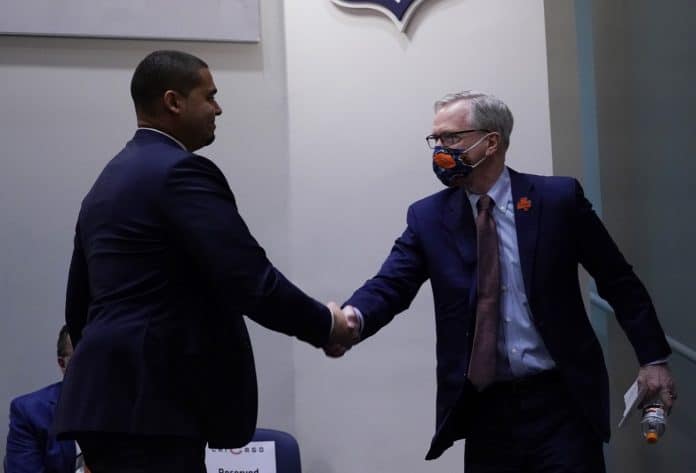
Jan 31, 2022; Lake Forest, IL, USA; Chicago Bears Chairman George McCaskey (right) shakes hands with Bears new General Manager Ryan Poles (left) at a Press Conference to introduce new Chicago Bears-Head Coach Matt Eberflus Mandatory Credit: David Banks-USA TODAY Sports

George McCaskey didn’t exactly get his latest attempt to overhaul the Chicago Bears power structure off on the right foot. His end-of-season press conference was ugly in all respects, sending multiple wrong messages while failing to offer any cohesive plan. His only assurance that things would go well this time is he’d brought aboard Hall of Fame executive Bill Polian to help lead the search process. People weren’t convinced.

McCaskey was the owner. He is supposedly the chairman of the board for a reason. People felt he should be the one out in front of this. Well, it seems he actually was. At least in terms of establishing parameters for the coach and GM search. Polian explained to Adam Jahns of The Athletic that it came down to two guiding principles. A desire to explore all candidates regardless of race and get the best possible leader. Expertise on either side of the ball did not matter.

No. 1: “We were going to institute the deepest and widest search in order to not only fulfill the new mandates of the Rooney Rule, but we’d go beyond them.”

No. 2: “We wanted to get the best man. Don’t get caught up in whether it’s an offensive guy or a defensive guy or whatever theories are out there. Let’s get the best head coach we can, and let’s get the best general manager we can.”

His wish was indeed granted.

The Bears interviewed 23 people between the two jobs, 13 for GM and 10 for head coach. Of the general manager candidates, more than half were minorities. That included their eventual selection, Kansas City Chiefs director of player personnel Ryan Poles. As for the coaches, five of them came from defensive backgrounds and five from offensive backgrounds. A dead even split.

In the end, Poles was given full latitude to pick his guy, and he opted for Indianapolis Colts defensive coordinator Matt Eberflus. Time will tell if that was the right decision, but at least one thing is clear. George McCaskey handled this search process far better than he did seven years ago in 2015. It felt like he was a passenger back then as Ernie Accorsi and Ted Phillips reached out to some buddies for recommendations.

This time, he made his voice heard. The Bears were methodical and thorough. They were also fair. People can’t ask much more from a process than that.

Chicago Bears 2022 Draft Sleepers: Wide Receiver Edition

chicago bears
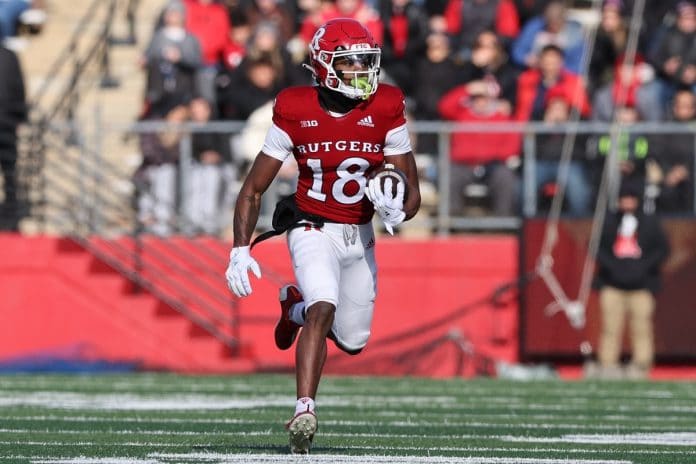
Nov 27, 2021; Piscataway, New Jersey, USA; Rutgers Scarlet Knights wide receiver Bo Melton (18) gains yards after the catch against the Maryland Terrapins during the first half at SHI Stadium. Mandatory Credit: Vincent Carchietta-USA TODAY Sports

New GM Ryan Poles has said from the beginning that the offensive line will be his primary focus for the Chicago Bears. This isn’t a bad thing. Giving Justin Fields more protection absolutely should be a top priority. That said, a quarterback is only as good as his arsenal of weapons. The Bears are lacking just as much in that department as their blocking—an ongoing trend for this organization.

Darnell Mooney had over 1,000 yards in 2021. This was the lone highlight of the group. Allen Robinson finished with a career-low 410 yards and is a free agent. The same goes for Marquise Goodwin and Damiere Byrd. That means three of the top four receivers on the roster could be gone by the end of March. This would make drafting one all but inevitable for Poles.

The problem is if he wants to stay focused on the line, he’ll have to wait until the later rounds to address the issue. This means he’ll need a bit of luck finding one. Not a challenge he would fear. During his time with the Kansas City Chiefs, Poles helped uncover overlooked talented like Chris Conley and Tyreek Hills. Here are a few sleeper prospects that should fit the new GM’s likes.

Chicago Bears can find lots of value at wide receiver

Romeo Doubs (Nevada)

With the emphasis on speed moving forward, the Bears are likely to be drawn to Doubs. Nevada made sure to stockpile fast weapons for their strong-armed QB, Carson Strong. He was the best of the bunch. Across 20 games during the past two seasons, Doubs collected 2,111 yards, receiving 20 touchdowns.

At 6’2, he presents good size for the position and couples that with great speed and acceleration. Not only can he beat defenders down the field, but he’s equally dangerous after the catch hence why he is also a capable punt returner. The lingering questions are a limited route tree and inconsistent hands that plagued him before 2021.

Charleston Rambo (Miami)

A young man who scratched and clawed for opportunities in Oklahoma but never really got them. So he bet on himself by transferring to Miami in 2021 and set a program record with 79 catches for 1,172 yards and seven touchdowns. This helped to showcase how competitive Rambo is. Something that often shows up in his effort as a blocker too. The Chicago Bears have said they want more toughness.

He’s got solid speed mixed with sharp route-running ability. There are no struggles at finding open spaces and tracking the football. The big concerns are the drop issues he suffered at Oklahoma and his slender 185 lbs frame. Some worry that he lacks the necessary strength to handle more physical defensive backs in the NFL.

Kaylon Geiger (Texas Tech)

One of those receivers that can’t be summed up in his production. Geiger’s numbers are modest compared to others in the draft, with just 2,175 yards and nine touchdowns across three seasons. Yet upon closer examination, it becomes apparent he wasn’t the problem. More often, it was highly questionable quarterback situations that held him down.

In truth, Geiger is a baller. His quickness and route-running skills make him an absolute menace out of the slot. He finds different ways to get open and is an equal nuisance after the catch, rarely going down on the first tackle attempt. If teams can look past his modest 5’10 size, they’ll end up with somebody destined to be a much better pro. Something the Chicago Bears already saw happen with Mooney.

Reggie Roberson Jr. (SMU)

He wasn’t used in many different ways in college but what SMU did use him for Roberson did extremely well. The Mustangs’ 6’0 receiver was a consistent vertical threat across all four seasons with 2,704 yards and 23 touchdowns. If opponents game him any room to run, they would soon regret it as Roberson gobbled up soft coverages with ease.

Getting the ball in his hands was never a bad thing, as he found ways to make things happen after the catch. As with many overlooked receivers though, he has questions about his limited prowess as a route-runner (which isn’t really his fault). Not to mention questions about his overall lack of an alpha mentality. Something he’ll have to answer going into the draft.

Bo Melton (Rutgers)

Rutgers has never been a program known for producing high-end offensive talent in the NFL, but that shouldn’t overshadow Melton. While his production never wowed (failed to top 700 yards in any of his four seasons), the tape tells a different story. His stop-start suddenness mixed with good quickness and speed can make for a lethal combination.

Even better, he is perhaps at his most dangerous after the catch. Despite only being 5’10, he runs with considerable strength and balance in his lower half. This looks and feels like a player held down not by his own limitations but by the lack of creativity in the offense he played in. A more imaginative coach in the NFL will recognize his potential.