Jun 28, 2024; Las Vegas, Nevada, USA; Sacha Boisvert is selected by the Chicago Blackhawks with the 18th overall pick in the first round of the 2024 NHL Draft at The Sphere. Mandatory Credit: Stephen R. Sylvanie-USA TODAY Sports
With his team in a win-or-go-home playoff game against Vermont last weekend, Chicago Blackhawks prospect Sacha Boisvert was scratched, making headlines around the Blackhawks’ social media community. The Boston University staff was notably vague, allowing rumors to run rampant, including reports of locker room problems for the 19-year-old. Later, Mike McMahon of College Hockey News reported that Boisvert was late to a team workout earlier in the week, which was not his first infraction.
On Monday, Boisvert was again in the news. This time, it was because he signed his entry-level contract, as expected, after his Terriers lost in the Hockey East tournament. He’ll draw into the Blackhawks’ lineup as soon as his visa issues are resolved—he won’t play Tuesday night, but could travel with the team to Minnesota Thursday or make his home debut on Friday.
Boisvert was drafted 18th overall in the 2024 NHL Draft as an exciting combination of skill and size—he’s 6-foot-3, 185 pounds. After he was drafted, Boisvert played at the University of North Dakota and was the NCHC Rookie of the Year. Amid a UND coaching change, he transferred to BU, where his play left a bit to be desired. He scored three times in 26 games and dealt with some injuries. The good news for the 2026 Blackhawks is that he was also suspended for fighting this season, so Chicago will be getting a bit more enforcement.
Boisvert has become a bit of a controversial prospect this year, with his healthy scratch putting the cherry on top of the debate. He was brimming with potential at UND, but has some work to do to become a top-six forward. One would imagine the Blackhawks will burn the first year of his ELC to get him as many as 15 games of NHL action, so they should get a look at him before the summer break.
Head coach Jeff Blashill said that they’ll “slowly” ease Boisvert in, but that he’ll have to “earn it.” Boisvert will wear number 12, and his locker will be right next to Connor Bedard’s.
Indiana Hoosiers wide receiver Omar Cooper Jr. (3) makes a catch for a touchdown Friday, Jan. 9, 2026, during the Peach Bowl and semifinal game of the College Football Playoff against the Oregon Ducks at Mercedes-Benz Stadium in Atlanta.
So remember when I warned that the Chicago Bears’ draft priorities might not align with what fans and media think they are? SM was told that wide receiver was a position head coach Ben Johnson had higher on his board than people realize. He and others in Halas Hall felt the 2026 class was among the strongest of any group this year. It almost feels foolish not to take advantage while they can. However, it isn’t simple greed driving such thinking. Adam Hoge of CHGO pointed out another issue that has the Bears wary.
While they remain confident in their starting lineup ahead of next season, the team’s depth has taken a considerable hit over the past week.
The draft is loaded with wide receivers and this seems like a position Johnson might look to add every year in the draft. They also have a need at receiver as Rome Odunze, Luther Burden, Jahdae Walker and Raymond are the only receivers who seem destined for the 53-man roster right now.
D.J. Moore was traded to Buffalo. Devin Duvernay signed with the Arizona Cardinals. Olamide Zaccheaus returned to the Atlanta Falcons. Most of the players who made up the bottom half of their depth chart are gone, while Moore was moved for salary cap purposes. Considering how much Rome Odunze struggled with health problems last year, it feels foolish not to address wide receiver in this draft.
The Chicago Bears already seem to be focused on specific names.
One they seem to like a lot is Germie Bernard from Alabama. That isn’t a surprise. He’s one of the draft’s best route-runners and also capable after the catch. Both are key for Johnson, since those traits work best in the slot. See Amon-Ra St. Brown. Another name gaining lots of traction is Omar Cooper. He had a breakout year for Oregon in 2025, going for 937 yards and 13 touchdowns, earning a reputation for being a violent runner after the catch. On the other side is Chris Brazzell, who is also a sharp route runner but known more for his dangerous vertical speed. That, too, is something the Bears want more of.
With four picks in the first three rounds, it isn’t a question of whether they grab a wide receiver. It is about when. We can rule out the 1st round. Poles and Johnson aren’t ignorant of the team’s more pressing needs on the defensive line and secondary. However, things get interesting in the 2nd and 3rd rounds. It isn’t crazy to think one of those players will be available in that range, or somebody else they like. For all the talk about protection, it’s also vital to keep Caleb armed with weapons in the passing game.
The Bills are trading a 2026 second-round pick to the Bears in exchange for DJ Moore and a 2026 fifth-round pick, per source. https://t.co/GFtJRfS5if
The Bears already know the value of striking on a deep class.
Recent history proves it. The last class widely considered really deep ahead of the draft was 2020. That was the year of Justin Jefferson, CeeDee Lamb, Tee Higgins, Jerry Jeudy, and Brandon Aiyuk. It was also the year the Chicago Bears snagged Darnell Mooney in the 5th round. There is a clear incentive to dabble in a strong position group even if said position might not be high on the priority list. We saw that last year when the Bears took Colston Loveland in the 1st round, capitalizing on a strong tight end group.
It appears they are ready and willing to do so again at wide receiver. What isn’t yet clear is what their options will be. Unlike last year, they aren’t picking near the top of the 2nd round. They hold picks #57 and #60. That makes things more challenging. Still, those spots have proven fruitful in the past.
Devin Hester (57th)
Golden Tate (60th)
Torrey Smith (58th)
Mark Carrier (57th)
Ricky Proehl (58th)
Evaluation and scheme fit will be paramount, and Johnson has demonstrated an ability to identify both. Much will depend on how the board falls. We saw what happened with the running backs last year. Maybe things will be more generous to the Bears this time.
Oct 11, 2025; College Station, Texas, USA; Florida Gators offensive lineman Jake Slaughter (66) sets the ball during the first half against the Texas A&M Aggies at Kyle Field. Mandatory Credit: Maria Lysaker-Imagn Images
For all the talk about defense leading up to the NFL draft next month, people should not ignore the offensive line. It took two rough body blows in less than six months. First, Ozzy Trapilo, their promising young left tackle, tore his patellar tendon and will likely miss the 2026 season. Then Drew Dalman, their Pro Bowl center, abruptly retired at age 27. Head coach Ben Johnson went from having a stable offensive line to one with uncertainty at its two most critical positions.
The Bears were able to staunch the bleeding somewhat by trading for veteran center Garrett Bradbury, re-signing Braxton Jones, and bringing in former 1st round pick Jedrick Wills. Now the team at least has some experience to work with at both positions. Still, everybody expects the team to add help in the upcoming draft. It is only a question of who they target. To answer that, we must go back to last year. Johnson delivered a quote that felt important then and could prove crucial now.
“The intelligence factor is a major portion of it because they got to be able to handle different fronts for all these variety of schemes that we would like to employ,” Johnson said after the team introduced Thuney and Jackson. “End of the day, we’ll push this thing as far as we feel the collective group can handle up front. And that’s where the intelligence is so, so important to expand on that variety.”
Ben Johnson should have plenty of options this year.
People talk about strength and athleticism all the time when evaluating offensive linemen. Yes, both can be important to success in the NFL. However, you often find that the players with the longest careers are those who understand the game at its fundamental level. Just look at Joe Thuney. He was a 4th round pick because of concerns about his size and power. It didn’t matter. His technical mastery makes him an almost impossible puzzle to solve. That will be the archetype in this draft. Here are five players who fit it.
Sam Hecht (C, Kansas State)
“Academic All-American caliber intellect translates directly to the field; this is a player who will pick up a new playbook in days, not weeks, and communicate protection calls at an NFL level from day one.”
It probably isn’t a coincidence that the Bears had a large contingent presence at the Kansas State pro day. They clearly have an interest in Hecht, and for good reason. If there were a player who is the spitting image of Dalman in this class, it would probably be him. While not the biggest and lacking a strong anchor, he is technically sharp, with great athleticism, and a savant at blocking in space.
Logan Jones (C, Iowa)
“He’s a highly intelligent player with a strong understanding of protections. He seems like a monster out of a book with eight eyes, due to how good his peripheral vision is.”
Anybody who has followed the draft for long enough understands there are few certainties in life. One of them is that Iowa offensive linemen transition to the pro game better than most. Jones is an older prospect who will be considered undersized by teams. However, he’s also a good athlete who has made it his personal mission to master the art of blocking. Add a do-or-die mentality on every snap, and it’s easy to like him.
Jake Slaughter (C, Florida)
“A multi-year starter and team captain with elite football IQ, refined technique and natural pass protection skills.”
Florida has gone through some turbulent times in recent years. One of their few sources of security was Slaughter, who started four seasons for the team. His efforts helped Anthony Richardson become a 1st round pick and aided the ascent of running back Jadan Baugh. Slaughter has good size for a center and the anchor to go with it. Add the leadership and intelligence, and the appeal becomes pretty obvious.
Caleb Tiernan (6’7 329) Northwestern
+ Technician in pass protection + Experienced four-year starter + Blocking at the second level + 84.3 pass blocking grade in 2025 + Has played both left and right tackle + Effective strike timing + Anchor strength
“The 6’6”, 325-pound left tackle boasts a rare combination of Ivy League-level football IQ and NFL-level athleticism.”
Northwestern isn’t a true hotbed of NFL talent, but the program has been surprisingly good at developing offensive linemen in recent years. Tiernan is one of their latest projects. He is one of those greater-than-the-sum-of-his-parts players. What he lacks in elite traits, he makes up for in savvy and grit. There aren’t many holes in his game. Such players tend to overachieve.
Blake Miller (OT, Clemson)
“His hands are not only up and active but also exhibit patience, a sign of high football intelligence.”
He hasn’t gotten as much pre-draft hype as guys like Monroe Freeling and Max Iheanachor. That’s a shame, because Miller is a tremendous athlete with some of the most polished fundamentals in the class. There is a reason he started 54 games in college. Coaches love him, and he’s an outstanding teammate. Put him in the hands of someone like Ben Johnson and he probably starts for a decade.
Bears GM Ryan Poles speaks to quarterback Caleb Williams after selecting him 1st overall in the 2024 draft
People are racking their brains trying to decipher what the Chicago Bears have planned for their 25th overall pick in the upcoming 2026 NFL draft. It isn’t an easy task. Due to the lack of quarterbacks in this class, it is more difficult to pinpoint which direction the teams picking ahead of them will go. That means there are more scenarios that could play out than normal. Bears general manager Ryan Poles is conducting the NFL equivalent of wargames, running countless mock drafts to build a database of probabilities on how it might go.
However, there is another side to this. That is the man in charge. Up until now, Poles have only conducted draft picks inside the top 10 during the 1st round. This will be the first year he has sat in the bottom half, far away from the biggest action. That blind spot makes it difficult to assess what the GM might be thinking. In situations like this, the best thing to do is look into his history before coming to Chicago. That means going back to Poles’ tenure as a scout and personnel executive with the Kansas City Chiefs.
There are one of two likely outcomes with Ryan Poles in charge.
The first is that he plans to draft a pass rusher. Across his tenure in Kansas City, the Chiefs held a pick in the bottom third of the 1st round seven times. Of the three players drafted in that range, two were offensive weapons. Wide receiver Jon Baldwin came in 2011, and running back Clyde Edwards-Helaire arrived in 2020. Baldwin was an outright bust, while Edwards-Helaire was a serviceable but disappointing starter. The other player was edge rusher Dee Ford, who collected 30.5 sacks in five seasons and made the Pro Bowl in 2018. He was eventually traded to San Francisco for a 2nd-round pick.
As for the other four outcomes? One was a trade down to accumulate more picks in 2016. The other three were traded for players at premium positions. Kansas City traded up in 2017 for Patrick Mahomes, flipped their 1st-round pick in 2019 to Seattle for defensive end Frank Clark, and did the same in 2021 for left tackle Orlando Brown Jr. Based on the success experienced during his time there, Poles will do one of two things. He will either take a pass rusher with the 25th pick or trade it.
Year
Pick
Player / Asset
Outcome / Note
2011
No. 26
Jon Baldwin (WR)
Selected after a trade down with Cleveland
2014
No. 23
Dee Ford (LB)
Pro Bowler; recorded 30.5 sacks before being traded to SF.
2016
No. 28
Traded Away
Traded to the 49ers to move out of the first round.
2018
No. 22
Traded Away
Traded in the 2017 deal to move up for Patrick Mahomes.
2019
No. 29
Traded Away
Traded to the Seahawks to acquire DE Frank Clark.
2020
No. 32
Clyde Edwards-Helaire (RB)
Key part of the 2020/2022 Super Bowl rosters.
2021
No. 31
Traded Away
Traded to the Ravens to acquire OT Orlando Brown
The first wave of free agency is over, and the Chicago Bears have created more questions than answers – especially on defense – with the roster.
Examining the plan at left tackle, where the Bears find a Day 1 starter at defensive end and how they'll fill the holes in the…
After all, the Chiefs kept using it after Ryan Poles left. In 2022, they took pass rusher George Karlaftis with the 30th pick. They did the same again with Felix Anudike-Uzomah in 2023. Then, after taking speedy receiver Xavier Worthy in 2024, who’s been somewhat underwhelming, they added left tackle Josh Simmons last year. The strategy works. Clark was crucial to their Super Bowl wins in 2019 and 2022. Brown was the starter on that ’22 team. Karlaftis had 10.5 sacks in that 2023 repeat championship season.
All of the evidence points Poles in two directions. Unless there is an obvious option at left tackle like Simmons on the board, he will take a pass rusher at #25. Either that, or he’ll flip the pick to another team for one. We’ve already heard about Maxx Crosby. Other names who are about to need huge extensions include Tuli Tuipulotu and Travon Walker. Maybe offering up the 25th pick might convince one of those teams to make a deal if they don’t think they can afford such contracts.
Poles has the formula. It’s just a matter of which part he decides to follow.
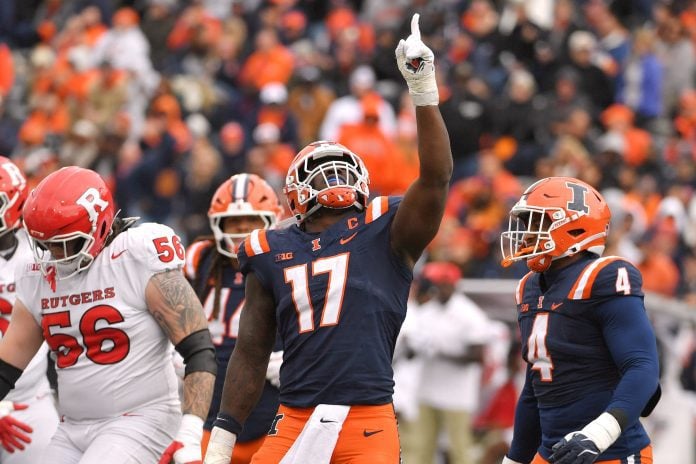
Nov 1, 2025; Champaign, Illinois, USA; Illinois Fighting Illini linebacker Gabe Jacas (17) celebrates his sack on Rutgers Scarlet Knights quarterback Athan Kaliakmanis (16) during the first half at Memorial Stadium. Mandatory Credit: Ron Johnson-Imagn Images
The Chicago Bears have been connected to several names with their 25th overall pick going into the NFL draft month. Probably the most popular is Clemson defensive tackle Peter Woods, who represents the elusive interior pass rusher they’ve needed for ages. Other prominent names include Missouri defensive end Zion Young, Toledo safety Emmanuel McNeil-Warren, Ohio State defensive tackle Kayden McDonald, and Miami pass rusher Akheem Mesidor. All have plenty of good points to make the case for going at that spot. However, one name isn’t getting nearly enough attention. That is Gabe Jacas.
He is a defensive end from Illinois, fresh off an excellent season with 11 sacks and 13.5 tackles for a loss. Jacas brings good size at 6’3″, 270 lbs, boasts a wrestling background, good power, and plenty of violence in his approach. Add the fact that he’s a standout leader and highly intelligent, and you have a prospect who seems to check all the boxes. Draft insider Todd McShay recently gave the reason why Jacas is the name people should be watching for the Bears at #25.
One of my favorite NFL comps in this year‘s draft is Gabe Jacas (Illinois) and Trey Hendrickson. Like Hendrickson (pk 39, RD3), Jacas won’t be a RD1 pk because he lacks the athletic profile. But both are excellent with their hands, have strong wrestling backgrounds and play with…
For one, being compared to one of the NFL’s best pass rushers is never a bad thing. Hendrickson had 35 sacks between 2023 and 2024 for the Cincinnati Bengals. There is a reason Baltimore felt comfortable handing him $112 million this offseason, despite his being 32 years old. Yet the specific mention of Hendrickson also holds important context for the Bears. After all, defensive coordinator Dennis Allen was with the New Orleans Saints when they drafted him in the 3rd round in 2017.
If anybody sees the similarities between the two, it’ll be the guy who coached Hendrickson through the first four years of his career. That is why Bears fans shouldn’t be dismissing Jacas as an option at #25. Despite being a bit average in height, he has the desired weight and length Allen prefers in his defensive ends. Power isn’t a problem, either. That will help with the run defense. Character concerns? Not even a little. Throw in the fact that Jacas came up in the team’s backyard, and it’s an easy sell.
This draft has little separation in talent outside the top 10.
Experts often say there comes a point at which someone picked in the 20s doesn’t have much more talent than someone picked in the 40s or 50s. It is all about preference. The Bears will likely be in that spot at #25. Plenty of people have tried saying Gabe Jacas won’t go until the 2nd round. Yet when you read up on him, it is far from crazy to think he goes in the 1st. Way stranger things have happened in the draft. Jacas has everything you could want short of truly elite attributes.
He has sack production.
His body fits the Bears’ system.
He is a high-character player.
Obviously, he fills a major need.
Everything lines up. If Allen signs off, this feels like an easy pick for the Bears come April. As always, it depends on how the board falls. There could be an unexpected name that slips through the cracks. Maybe the Bears decide to be aggressive and trade up. Yet based on their current needs, the strength of this class, and the preferences of the coaching staff, Jacas is a major sleeper.
Ohio State Buckeyes defensive back Caleb Downs (2) celebrates during the NCAA football game against the Michigan Wolverines at Michigan Stadium in Ann Arbor, Mich. on Nov. 29, 2025. Ohio State won 27-9.
The Chicago Bears face a problem. They’re picking 25th overall in the 1st round. Yet according to most draft experts, this class is light on legitimate blue-chip talent. ESPN circled only 11 of them this year, which is one of the lowest numbers in a long time. Chicago had remarkably good fortune in 2025 as two of those talents, Colston Loveland and Luther Burden, fell to them in the 1st and 2nd rounds. It seems unrealistic to expect lightning to strike again this time. However, if it does, there is only one semi-realistic name that could fall that far: Caleb Downs.
Going into the pre-draft process, many labeled the Ohio State safety as one of the best prospects at his position in years. Some even mentioned the forbidden Ed Reed comparisons. There is no denying the talent. Downs was a vital component of the Buckeyes’ national championship in 2024. He has size, range, instincts, and the ability to thrive in coverage or along the line of scrimmage. Many see him as an agent of chaos, making life much more difficult for opposing quarterbacks.
So why would he fall?
Chicago Bearsreason #1 – Downs plays a “non-premium” position.
These days, NFL teams talk a lot about positional value going into a draft. They prefer to focus their most important resources on positions they feel have the greatest impact on the game. At the top are quarterbacks, left tackles, pass rushers, and cornerbacks. Safeties aren’t in that same tier, which is why many teams are reluctant to spend 1st round picks on them. Only one went in the top 32 last year when Malaki Starks went 27th overall to Baltimore. The year before that, none went until Tyler Nubin at 47th overall in the 2nd round.
Even safeties considered elite don’t go as high these days as many have projected. Derwin James, one of the best in the league, was expected not to fall out of the top 10 in 2018. He ended up going 17th. Jamal Adams was the only one to break the mold by going 6th overall in 2017, and that could be seen as a mistake given how his New York Jets tenure went. The trends speak for themselves. As hyped a prospect as he’s been, Downs doesn’t play a position most teams consider vital.
I feel comfortable saying Caleb Downs is the best football player in the 2026 draft class. He won't be the first pick—you have to consider upside, positional value, all that, and there are guys with more of all that stuff. But no one in the class is a better football player. https://t.co/cLmAWzpNy3
For all the Ed Reed talk, experts who have watched Downs use more measured comparisons for him. NFL.com saw Jalen Pitre as his likeliest one. A scout inside the league itself compared him to Budda Baker. Pitre and Baker both went in the 2nd round. Much of this could be due to Downs’ good-not-great athletic profile. He didn’t perform at the scouting combine, so nobody is sure what his measurables are. That uncertainty isn’t helping his draft stock.
Meanwhile, Dillon Thieneman of Oregon crushed his combine performance, establishing himself as a top-caliber player at his position from a talent standpoint. Anybody who has followed the draft long enough knows that teams tend to lean towards elite athletes in the 1st round. Downs is a good athlete. Nobody disputes that. Elite though? Not really. All of these factors could push him down the board. All the way to the Chicago Bears? Crazier things have happened.
Nov 22, 2025; Columbus, Ohio, USA; Rutgers Scarlet Knights quarterback Athan Kaliakmanis (16) throws a pass against the Ohio State Buckeyes during the first quarter at Ohio Stadium. Mandatory Credit: Joseph Maiorana-Imagn Images
The Chicago Bears have been quietly combing through the quarterback ranks of the 2026 NFL draft class. While it is never a bad idea to stay plugged into that position every year, the timing is hard to ignore. Trade buzz has hovered around Tyson Bagent since the offseason began. Some feel it’s only a matter of time before the backup gets traded. That is partly why the Bears opted to re-sign Case Keenum to a significant pay raise. They’re prepared for the possibility. However, they would need more depth and appear on the hunt for it. By the sound of things, running back Kyle Monangai may have given them a tip.
Multiple draft insiders reported the Bears plan to host Athan Kaliakmanis at their local pro day ahead of the draft. The Antioch native started at Minnesota before transferring to Rutgers in 2024. He and Monangai were teammates that season and had a good season. The team went 7-6, beat Washington, and made a bowl game. Kaliakmanis had his best all-around season in 2025, throwing for 3,124 yards, 20 touchdowns, and seven interceptions with four rushing touchdowns. Teams appear taken by his mixture of size, pocket poise, and strong timing as a passer.
The #Bears will host Rutgers QB Athan Kaliakmanis as one of their local prospect visits, per source.
8,604 passing yards and 65 total TDs in college between stints at Minnesota and Rutgers. Antioch native. pic.twitter.com/9AN1EbuA5N
Kyle Monangai knows the crucial details about Kaliakmanis
The tape shows most of the physical attributes. While he doesn’t have the strongest arm and streaky accuracy, he understands how to play in a true pro-style offense. These are attributes head coach Ben Johnson can work with. What the Bears want to know is how he is as a leader. What’s his work ethic like? Does he understand the game at a fundamental level? These are questions Kyle Monangai can answer better than most, having spent a year in the locker room with him.
Considering the Bears are paying close attention to him, it seems the running back told them what they wanted to hear. Current projections have Kaliakmanis as a likely undrafted free agent. However, the growing interest in him from multiple NFL teams suggests he could be drafted late, perhaps in the 7th round. The Bears have two picks in that range. They could reserve one to bring him aboard if he has a productive workout and interview. He seems like the sort of project who could yield interesting results down the line.
Year
Player
College
Overall Pick
1998
Moses Moreno
Colorado State
232nd
1991
Paul Justin
Arizona State
190th
1989
Brent Snyder
Utah State
192nd
1972
Jim Fassel
Long Beach State
167th
The Bears are finally embracing a proven strategy.
Plenty of teams have said they aim to draft a quarterback every year. In reality, few of them have actually followed through on such a strategy. One team that sort of pioneered it in the Super Bowl era was the Green Bay Packers. Between 1992 and 2002, the organization drafted eight quarterbacks. Among them were future NFL stars like Mark Brunell, Matt Hasselbeck, and Aaron Brooks. All three were eventually traded to other teams, fetching the Packers seven additional 1st-round draft picks, three 3rd-round picks, and a 5th-round pick.
New England deployed a similar strategy. During Tom Brady’s long tenure as the starter from 2001 to 2019, the Patriots drafted ten quarterbacks. Two of them, Matt Cassel and Jimmy Garoppolo, fetched 2nd round picks when traded a few years later. There is a method to the madness for the Bears. Adding a steady stream of young quarterbacks will both keep their depth strong and also give them some potential trade currency down the line. Kaliakmanis could fit into that category.
Nov 29, 2020; Jacksonville, Florida, USA; Cleveland Browns offensive tackle Jedrick Wills (71) blocks Jacksonville Jaguars defensive end Dawuane Smoot (94) during the second half at TIAA Bank Field. Mandatory Credit: Reinhold Matay-USA TODAY Sports
The Chicago Bears went into the NFL offseason knowing they had a big problem at left tackle. Ozzy Trapilo, their planned solution for the position, tore his patellar tendon in the playoffs. His recovery process will be a long one, most likely eating up the entire 2026 season. That means Bears general manager Ryan Poles and head coach Ben Johnson would need to find a solution. Initial expectations were that they might just decide to bring back Braxton Jones. He was finally healthy after his issue last year and could serve as a decent bridge for a year. Sure enough, the team re-signed him before free agency began. However, an unexpected twist soon followed. The team also brought aboard Jedrick Wills.
The former Cleveland Browns starter had been the 10th overall pick in the 2020 NFL draft. Many saw him as the second coming of Jason Peters after a stellar run with Alabama in college. However, after an uneven first couple of seasons, Wills’ career was derailed by a severe knee injury that forced him to miss most of 2024 and all of 2025. Some wonder why the Bears would take a chance on him. An NFL executive told Brad Biggs of the Chicago Tribune that it stemmed from how well he fits this offense.
One pro personnel director, reviewing his evaluation of Wills in 2024, noted he moved in space well, which makes him a potential fit for Ben Johnson’s offense, but said he struggled at times in pass pro and could be overpowered.
Maybe it’s a long shot Wills will work his way back into the player with traits that made him the second tackle selected in 2020, three spots ahead of the Tampa Bay Buccaneers’ Tristan Wirfs. But putting Wills with offensive line coach Dan Roushar and assistant Kyle DeVan is worth a shot for the Bears.
“He’s a guy that we want Dan and Kyle to lean into,” Poles said. “We have phenomenal offensive line coaches, two really good ones that do a fantastic job developing players. They’re going to lean into Jedrick, spend time with him. We think there is a connection there between our coaches and him.
“He’s willing to put in the work. We have an unbelievable performance staff that’s going to help him get his body right so he can compete at high level.”
Jedrick Wills may finally be in a position to succeed.
Part of the problem with his time in Cleveland was that he ended up in a situation that may never have suited him. In the first two years with the Browns, they ran an offense similar to what you see in San Francisco and Los Angeles, with an outside-zone rushing attack. His mix of power and mobility was tailor-made for that. However, everything changed in 2022 when Cleveland traded for quarterback Deshaun Watson. Head coach Kevin Stefanski was forced to switch from a run-heavy scheme to a spread offense with frequent shotgun formations. That put a ton of pressure on Wills in pass protection, resulting in the worst season of his career.
There will be no such issues in Chicago. The Bears under Ben Johnson ran the ball the 5th-most times in the league last season. Their primary mode of attack was outside-zone, utilizing their athletic offensive line to create space for their running backs. It would be a return to what Jedrick Wills played during his first two seasons, easily his two best. Besides, Johnson is no stranger to working with blockers with perceived anchor issues. Drew Dalman suffered the same problems at center. He made the Pro Bowl anyway.
Asked Bears OT Jedrick Wills Jr. about what the Bears communicated to him about the left tackle position and the situation he will be entering.
“Opportunity, they wanted me to have here, have me here on the roster, and they gave me another chance to play, basically just…
During his stint as Detroit Lions offensive coordinator, the team brought aboard Graham Glasgow in 2023. He’d been a 3rd round pick for the team in 2016 but hadn’t achieved his potential. After leaving for a stint in Denver, he returned at age 31, hoping for another chance. He ended up playing two of the best seasons of his career, helping the Lions reach the NFC Championship that first year and go 15-2 the next. Glasgow always had limitations. With Wills, it could be a different story.
He is an elite athlete for his position. The issue was never talent. Experts always felt the only obstacle between him and success was his fundamentals. If he could clean up his mental mistakes and sharpen his technique, he could block anybody. If any coach is equipped to get him there, it’s Johnson. Wills sounds prepared to compete. If he didn’t love football as some have said, he would’ve just retired after that knee injury a few years ago. His decision to join the Bears for the minimum salary says he has something to prove.
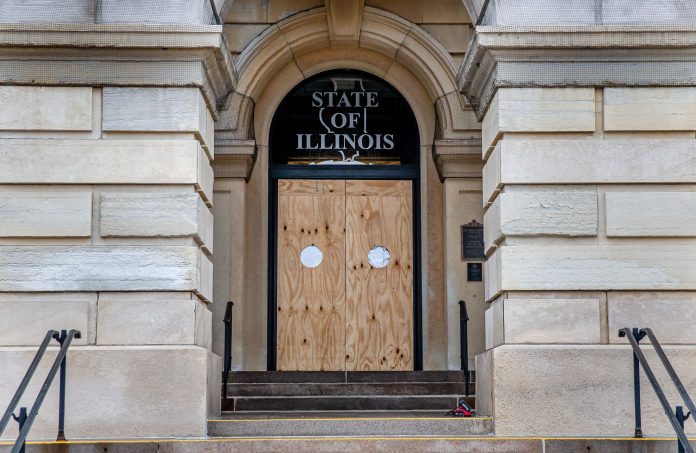
An entrance to the Illinois State Capitol is boarded up with plywood that has holes cut out to see through in preparations for possible protests at the Illinois State Capitol, Saturday, January 16, 2021, in Springfield, Ill. Illinois Gov. JB Pritzker announced that he has activated 250 members of the Illinois National Guard amid threats of armed protests in capital cities across the country in the days leading up to President-elect Joe Biden's inauguration. [Justin L. Fowler/The State Journal-Register]
The Chicago Bears stadium saga has been one long headache for fans everywhere. It all started in 2021 when the team placed a bid on the Arlington Park property that had gone up for sale in Arlington Heights. That was the first indication the team planned to pursue a new stadium. What followed was a long, bumbling process that saw team president Kevin Warren abandon that project to try getting something done in Chicago, realizing it was pointless, pivoting back to Arlington Heights and meeting resistance from the Illinois government in Springfield.
For a long time, people thought the primary reason Governor J.B. Pritzker and his legislature weren’t cooperating was that they didn’t want to give the team any tax breaks. It turns out that wasn’t the whole truth. Arlington Heights mayor Jim Tinaglia shared some new information on that with the Daily Herald.
Chicago legislators’ initial resistance to the Bears-friendly bill was out of hopes to keep the team in the city, Tinaglia said.
This explains a lot. Once the Bears made it clear they would fund the primary construction of the stadium and only needed some infrastructure help, many felt the deal should’ve been easy from there. Yet Illinois kept resisting, kept stalling the process. Eventually, the Bears reached a breaking point and began flirting with the idea of going to Indiana instead, which has made it clear it’s ready to roll out the red carpet. Tinaglia believes Arlington Heights is still the preferred option, but they are prepared to go if the government delays it again.
“I spend a lot of time talking to those guys,” Tinaglia said, “and I can tell you that I know they want to come here. They can’t come here unless they get some help from Springfield on this.”
Indiana’s governor signed the Bears’ stadium bill shortly after it was voted through, while Illinois’ house made progress on key legislation, this as the team lauded work on both sides. Reporting from the capitol in Indianapolis: https://t.co/puxaM2sifw
The state had its chance to intervene on Chicago Bears stadium issue.
All of this could’ve been avoided if Pritzker had stepped in from the beginning and tried to mediate the situation between the Bears and the Chicago government. It was clear the franchise was tired of being stonewalled by the Chicago Park District in its efforts to improve Soldier Field. Then, when former Mayor Lori Lightfoot basically told the Bears that their complaints didn’t matter and that they were stuck, that was the breaking point. By the time everybody realized the McCaskeys were serious about leaving, they tried to put forward solutions to upgrading Soldier Field.
By then, it was too late. Pritzker, for his part, only fanned the flames by making it clear the state would give no public money to the organization in any stadium endeavor. That hard stance eventually led to the Indiana situation. Now you have people in the government still holding out a fleeting hope that the Chicago situation can be salvaged. They are clearly delusional. That ship sailed three years ago. Their decision to delay voting on the new stadium bill is only making things worse.
The upcoming House session will determine the Bears’ future.
What Tinaglia said is correct. All signs point to ownership being tired of the drawn-out process. They want to start the process for this new Chicago Bears stadium this year. If the government tries to waffle on it again, the McCaskeys have made it known they’re leaving for Indiana. The neighboring state already pushed the necessary legislation through. They merely have to settle on a site. Early indications are that Hammond, near the state border, is the preferred location.
It comes down to whether Illinois thinks they’re bluffing. Tinaglia doesn’t think so, and he’s been close in the negotiations for a long time. He believes the Bears are serious, and they should be. Everybody has a breaking point. The McCaskeys have given the state lots of second chances because the team has called it home for generations. It’s amazing to think Illinois has squandered that in such a short space of time. Yet here we are.
Bears GM Ryan Poles and team president Kevin Warren discuss team business ahead of the 2025 draft
Adam Schefter created a bit of a firestorm on ESPN this week when asked about whether the Chicago Bears could make a big move for more help on their roster. The insider stated clearly not to expect anything because “they’re broke.” Many took this specific wording to be deliberate. While the Bears were up against the salary cap, they had plenty of ways to create more if needed. Some local media believe the comments referred to the McCaskeys being low on cash, meaning they’re not equipped to hand out more big contracts. The theory centers on the looming construction of their new stadium and the expected extensions for Darnell Wright and Caleb Williams.
It would explain why the team has been unusually quiet in free agency despite having several needs. David Kaplan of ESPN 1000 decided to dig into the issue. He came away with details that went against those assumptions.
So there is an uproar after Adam Schefter said the Bears are broke. Relax. After making calls here’s the scoop. That was in reference to salary cap situation. They have whatever they need financially if Poles wants to make a move. We will discuss on @ESPN1000 Monday at 6 a.m.
So it appears the McCaskeys have not informed general manager Ryan Poles and the front office that they have a cap on the budget they can spend. If they want to be aggressive, they have the green light. While that is great news, it leads to another controversy. That means the Bears’ passive approach to free agency has been a deliberate choice by the team’s braintrust rather than a result of being strapped for cash.
Poles warned this would be his Chicago Bears philosophy.
Many teams around the league use restructures regularly to create cap space, allowing them to stay aggressive in pursuing upgrades or keeping a strong core together. Poles has only done it once in his career as Bears general manager. That was Jaylon Johnson’s contract last year, creating an additional $8 million. He can do the same with guys like Montez Sweat, Grady Jarrett, and Joe Thuney if he wishes. Yet he warned before the offseason even began that this wasn’t a road he wanted to go down.
“There’s philosophical things that we believe in, in terms of not getting to this place where we’re kicking the can down the road on a bunch of guys, and then at some point you got to pay that bill,” he said. “And you don’t want that to be the reason why you’re not flexible and able to do unique things or take advantage of opportunities with your roster.”
A lot of people will be upset by this. The Bears just made the playoffs. They were an overtime away from the NFC Championship. This is the time to strike. Instead, Poles has allowed a huge chunk of the starting secondary to leave in free agency, traded D.J. Moore, and released Tremaine Edmunds. Yes, they brought in Coby Bryant and Devin Bush, but that isn’t enough to mitigate the losses in the minds of many. However, Poles doesn’t believe the path to a championship lies in aggressive free agent spending. He’s made that clear for years.
The Bears want to keep their options open.
One thing Poles learned during his time with the Kansas City Chiefs is that all-in moves were never necessary. If you were smart with your cap, there would always be opportunities to upgrade your roster without completely breaking the bank. While the Chiefs did have aggressive trades, you’ll notice most of them stopped before the red line of two 1st round picks. They also never handed out huge contracts to outside free agents. The strategy was clear. Most teams would only unload actual good players via trade. Free agents were what they felt were disposable.
Save your money for players that teams are reluctant to part with. Poles showed this philosophy with the Montez Sweat and Joe Thuney trades. Both have pretty much earned their respective contract extensions. That is why the Chicago Bears are hoarding their money. It is less about greed and more about a calculated tactic to keep it aside in case some really good players go on the trade market. That way, when they manage to get somebody, they’ll have the money ready to ensure that person sticks around.
You may not agree with it, but that is how this regime wants to operate.