
Wednesday, November 18, 2026
EDGE is live. Chicago fans can now access and explore the beta.
Home Blog Page 2673

One Way Chuck Pagano Will Handle Khalil Mack Differently

khalil mack

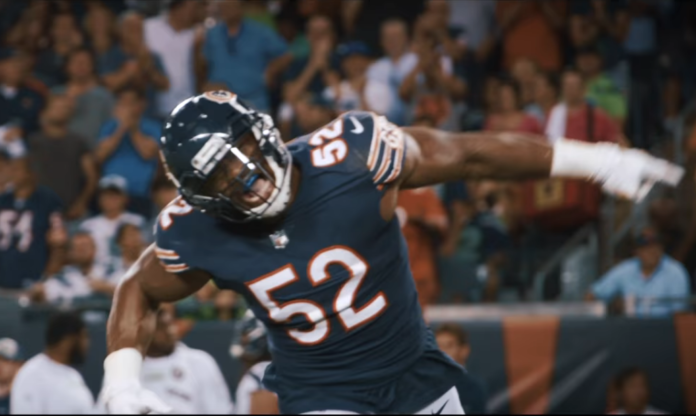
Vic Fangio got 12.5 sacks out of Khalil Mack in 14 games. That should be considered a success in every way. It’s the highest sack total a Chicago Bears defender has had since 1993 when Richard Dent had that same amount. With that said, Fangio did come under some minor criticism last year. Hard to believe given he had the #1 defense in the NFL.

It centered around the ways in which he used Mack at times. Specifically in regards to dropping the superstar into coverage in certain key passing situations. A key example was the loss to the New England Patriots. Despite facing off with Tom Brady, Mack dropped into coverage 18 times. He only rushed the passer 16 times.

Brady was only sacked once and threw three touchdowns in the game. It was a puzzling decision by Fangio that never got a direct answer as to why he did it. Was he protecting Mack’s injured ankle? Was he trying to to keep Brady guess? Whatever it was it didn’t work, and it frustrated a lot of people. Pass rushers are supposed to…you know…rush the passer.

So will things be any different under Chuck Pagano? Data says it should be.

Chuck Pagano likely will dial down times Khalil Mack goes backward

Keep in mind this is still a 3-4 defense. Having the outside linebackers drop in coverage from time to time has its advantages. Still, Mack is who he is. He’s one of the best pass rushers in the NFL. Period. It makes far more sense to have him doing that. Below is a small chart that notes how often Mack rushed the quarterback on passing downs vs. dropping in coverage. Then it shows the notable pass rushers Pagano has coached and how they were used.

  • Khalil Mack in 2018: Dropped in coverage 12.02% of the time
  • Terrell Suggs in 2011: Dropped in coverage 10.32% of the time
  • Robert Mathis in 2013: Dropped in coverage 7.26% of the time

Fangio had Mack rush the quarterback 505 out of 574 chances last year. The other 69 he dropped into coverage. Now a drop of 1.7% might not sound like a lot, but it would equal out to an extra 9-10 snaps that Mack would’ve rushed the passer. Remember that Mack had at least a pressure on the quarterback every 6.91 times he rushed. So the odds favored him getting at least one hurry, hit, or even sack on the quarterback.

Conversely he had one interception and four passes defended in the 69 times he dropped into coverage. That’s an impact play once every 13.8 snaps. It’s clear that Mack is far more effective when he’s allowed to hunt the quarterback. So expect Pagano to let him do that.
The Chicago Bears Have Done Special Things In Wartimes

chicago bears

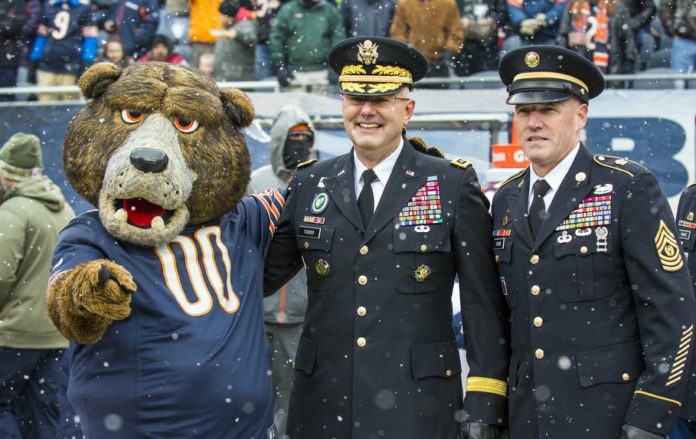
The Chicago Bears have a stadium called Soldier Field. So connections to the U.S. military and it’s long history should not be a surprise. George Halas served in the Navy during World War I. Sid Luckman was in the Merchant Marines during World War II. Other Bears have also spent time in various military branches as well.

Few teams are more deeply connected to the armed forces than this one. Perhaps this is why the Bears always seem to pull off something special when the country is involved in some sort of significant conflict. Seriously. If one were to look back at their long history, they’d find something big happening with them at the same time the country was at war.

Here are some notable examples:

1941: Chicago Bears win the NFL championship

December 7th, 1941 was a special day for the Bears. It was the last day of the regular season. The team was 9-1 and anxious to move on towards a possible NFL championship birth. They only had to get past the crosstown rival Chicago Cardinals to do so. Led by a dominant rushing performance that collected 204 yards and 4 TDs, they cruised to a 34-24 victory.

It was only afterward that news struck that a Japanese naval fleet had launched a surprise attack on Pearl Harbor in Hawaii. The U.S. Pacific Fleet had been decimated and suddenly America had been dragged into World War II. While the country began gearing itself to strike back, the Bears forged ahead. They crushed the Packers and Giants in the playoffs by a combined scored of 70-23 to win their second-straight title.

1950: Bears make playoffs for the first time in four years

The Korean War is technically still active to this day. Most people don’t know that. North and South Korea never made peace. They only signed an armistice to cease hostilities, creating the Demilitarized Zone that separates the countries even now. That conflict began back in 1950, the first one that America fought since the end of World War II and ultimately claimed over 33,600 lives.

The Bears also seemed to be a beast that awakened for the first time in years. They hadn’t made a postseason appearance the previous three years. Finally, they broke through in ’50, winning the division and meeting the Los Angeles Rams in the opening round. Sadly they lost 24-14, committing three costly turnovers despite rushing for over 200 yards in the contest.

1975: Walter Payton drafted by the Bears

The beginnings of wars weren’t the only times that the Bears did significant things. They also accomplished goals at the end of them too. In 1975, President Richard Nixon finally completed his longstanding promise and pulled U.S. forces out, ending the Vietnam War after over a decade of major conflict. One that cost the country 50,000 lives.

Just three months prior almost to the day, the Bears were involved in a critical NFL draft. The team had experienced some of the worst luck in its history over the past several years. They badly needed somebody who could carry them out of the darkness. With the 4th pick, GM Jim Finks took a risk on a young man out of Jackson State named Walter Payton.

An all-time rushing record and a Super Bowl later, it’s safe to say that worked out.

1990: Mike Ditka wins his final division title

People were starting to wonder if the Bears had finally run their course in 1989. The team went 6-10 and missed the playoffs for the first time in five years. Several of their best players were getting older. Payton was retired. Jim McMahon was gone. It was fair to wonder if the time was approaching for a changing of the guard, including at head coach with Mike Ditka.

To make matters worse, an Iraqi invasion of Kuwait led to the U.S. joining the U.N. in the Persian Gulf War on August 2nd, 1990. The first conflict the country had been part of since Vietnam. As American forces battled Saddam Hussein in the Arabian desert, Ditka rallied his own troops to an 11-5 record, winning the division. His last as Bears head coach.

2001: Bears achieve greatest turnaround in franchise history

The start of the 2001 season seemed like another in a long line of disappointments for the Bears, losing to the defending champion Baltimore Ravens. Two days later, Islamic terrorist flew passenger jets into the World Trade Center in New York City and the Pentagon in Washington D.C. Over 3,000 people were killed. President George W. Bush declared war on terror to a shocked and angry nation.

Twelve days later, the Bears beat the Minnesota Vikings. Their first of six-straight victories in what would end up being the greatest single-season turnaround in team history. Chicago went 5-11 in 2000. By the end of this year, they were 13-3 and NFC Central champions. A remarkable run that nobody saw coming. Their rallying cry of “Soldiers” was a fitting tribute to a nation that went to war in Afghanistan.

The Greatest QB in Bears History Was Also Part of the “Longest Day”

sid luckman
Landscape

When people think about the name Sid Luckman, they immediately declare the greatest quarterback in Chicago Bears history. It’s well-deserved. The man played a critical role in changing his position in the eyes of the NFL. The forward pass was still something new back in the 1940s and Luckman’s ability to throw it and throw it well was a big reason it became more and more popular.

The man also won four NFL championships and still holds the league record with seven touchdown passes in a single game. He was and remains the only Bears quarterback in the Pro Football Hall of Fame. There is little the man didn’t accomplish in his career. It’s a big reason he was ranked #4 all-time on the Top 100 Bears list.

However, what’s even more incredible about Luckman was how real life got in the way during his prime years. He was 25-years old when the United States was dragged into World War II by the Japanese attack on Pearl Harbor. For the first year in 1942, he remained with the team. By 1943 though, the military demands for manpower had grown.

Ready to do his duty, Luckman enlisted with the U.S. Merchant Marines and was sent across the Atlantic Ocean to Great Britain by 1944.

Sid Luckman was present when the Allies invaded Normandy

People don’t understand how crazy things were for Luckman at that time. On December 26th, 1943 he had the best game of his life. Against the Washington Redskins in the NFL championship, he threw five touchdown passes. Then for good measure, he intercepted fellow Hall of Famer Sammy Baugh twice. It was a feat no quarterback has achieved since.

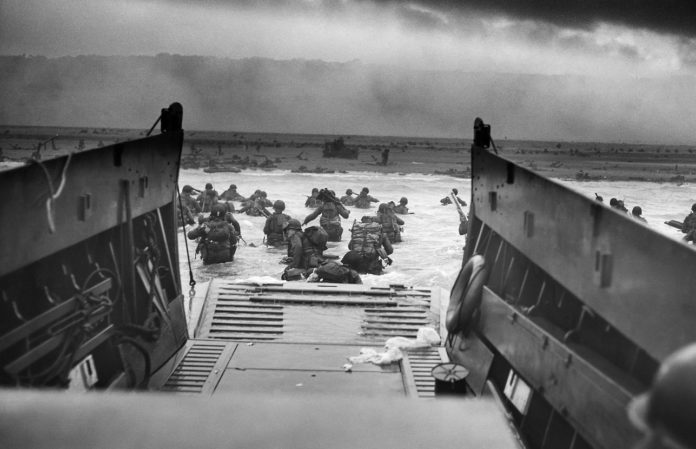
Just six months later, Luckman was on U.S. Navy vessel departing from the southern coast of England. It was the early morning of June 6th. Over 5,000 ships were in the midst of crossing the English Channel. They carried with them tens of thousands of soldiers and sailors from an assortment of different countries including America, Britain, France, Canada, Australia, New Zealand, and Poland among others.

It was raining, cold, and the seas were windswept and high. Then through the morning mist, the French coast came into view. The Nazi garrisons on the Normandy coast had no idea they were coming. Allied warships soon began a fierce bombardment, hitting every defensive installation they could find with high explosives.

Even so, the German guns soon began to respond, sending up massive spouts of water and scoring a few hits of their own. Luckman, just like on the field, was undaunted. He boarded a smaller craft that quickly loaded up with American soldiers. Then when the signal was given, it set off for the beaches. All the while under a hail of artillery and machine gun fire.

When close enough, the craft disgorged the troops onto the beach and they quickly stormed their way towards the defenses. Then Luckman turned the craft around and went back for more. He would continue to do this for the rest of the day. What many still call the “longest day” in modern history.

Celebrate Former Bear Mark Anderson’s Birthday With His Best Play

mark anderson

Mark Anderson is a name that Chicago Bears fans have mixed feelings about. While he had the greatest rookie season a pass rusher has ever had in the modern football era, he’s also viewed as a disappointment. Why? He was never able to come even close to what he accomplished that season again. A true one-year wonder if ever it existed in Bears history.

Still, it was a great year nonetheless. What made it special was where Anderson came from. He was a 5th round pick out of Alabama. Keep in mind this was back when the Crimson Tide was in one of their rare down cycles. Two years before the arrival of Nick Saban. So expectations were understandably curtailed in regards to what he could do.

Anderson didn’t take long to adjust them. In his first five games, the defensive end had 5.5 sacks. People were starting to take notice but he hadn’t yet had a true signature play. That would come on Monday Night in week 6 during one of the greatest Bears games in history.

Mark Anderson made the play that ignited the comeback

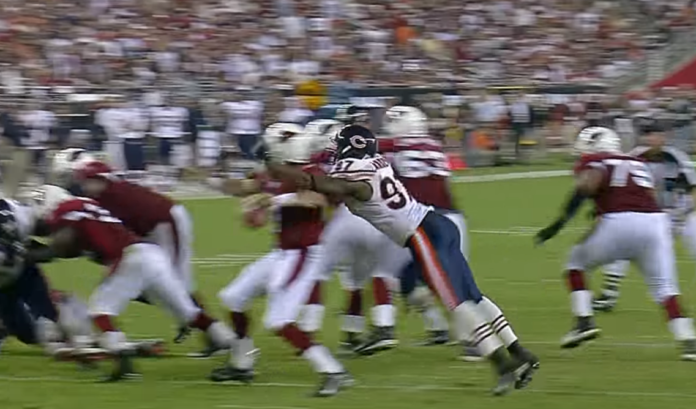
When thinking about that epic comeback in Arizona in 2006, the two leading names that get all the credit are Brian Urlacher and Devin Hester. Urlacher for his absurd 25 tackles and forced fumble that led to a touchdown by Charles Tillman. Then Hester for the punt return TD that gave the Bears the lead 24-23 after being down 23-3.

Not enough people give credit to Anderson, who made the pivotal play of that game. The Cardinals had the ball again up by 20. Matt Leinart had cut them apart most of the game. It was then the offensive line suffered a blocking miscue, leaving the rookie unaccounted for. Anderson, to his credit, didn’t hesitate and went right for Leinart.

He could’ve easily just gone for the sack, but Anderson remembered his coaching and made sure to swipe at the quarterback’s arm as he arrived. The ball was knocked free, allowing safety Mike Brown to return the fumble for a touchdown. After that play, the momentum stayed with Chicago. They won the game and went on to finish 13-3.

The Greatness of the UFC Lightweight Division

Tony fights Conor. Conor fights Khabib. Khabib fights Tony. Tony fights Cowboy. Cowboy fights Conor… What is going on right now in the UFC Lightweight Division?!

The Three Kingpins
The UFC lightweight division is arguably the most talented division in the UFC. The division hosts THREE top 15 fighters in MMA. That’s right, three. Khabib Nurmagomedov is the champion of the weight class, sporting an undefeated 27-0 record. He is by far the best grappler in the UFC, while having a ground and pound arsenal similar to that of Jon Jones. He is the best pressure fighter in MMA.

Tony Ferguson is the number one contender of that weight class. He is the only fighter in Khabib’s weight range that can match his volume and pressure. Not to mention Tony’s Jiu-Jitsu is about as elite as possible, which serves as a defense against Khabib’s wrestling. Tony is the only fighter in that weight class that has anything for Khabib’s pressure.


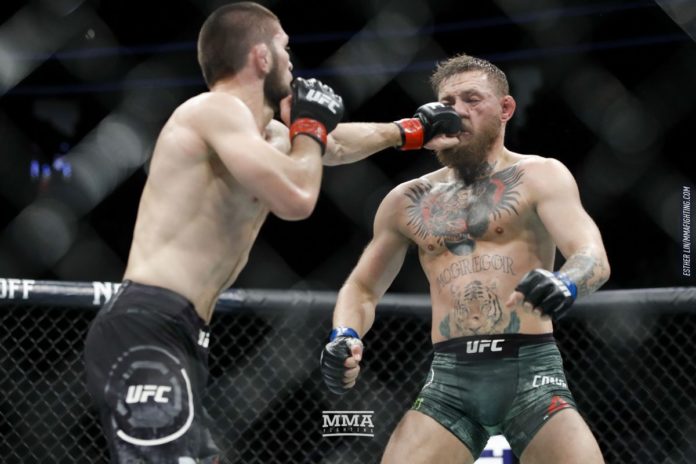
Conor McGregor is the final pound-for-pound namesake in the UFC lightweight division. He is the sport’s biggest star even after his peak and is looking to get a rematch against Khabib. He does not have the tools to match the pressure of Khabib, however he has the boxing to stun the world and hand the Dagestani kingpin his first loss. He is the game’s biggest name.


Now we have Dustin Poirer’s name thrown into the mix, as he is now the UFC interim champion after beating Max Holloway at UFC 236 for Khabib’s interim belt. This means that a matchup between Dustin Poirer and Khabib Nurmagomedov is inevitable in the near future to unify the titles.

Khabib Nurmagomedov on his upcoming fight with Dustin Poirer


Poirer has come a long way from his loss to Conor. He has put together a string of wins over big names including a historical fighter like Max Holloway. Wins over Justin Gaethje and Anthony Pettis validate this title shot for “The Diamond.” However, his willingness to bite down on his mouthpiece and trade blows is what separates him susceptible in fights.

His jaw has taken some damage throughout his career. He’s been knocked out a couple times and he’s been dropped in some of his wins as well. To his credit, Poirer is a very well rounded fighter who’s looking more technically sound each fight. He has a puncher’s chance against any of the three perennial superstars in that division.


Now… we have Cowboy’s name thrown into the mix. And by Cowboy, I mean Donald Cerrone. And by Donald Cerrone, I mean the fighter with the most fights inside the UFC octagon. Cerrone has never won the title, but he has gone on run after run throughout the course of his career, coming up short every time.

Cerrone is a Muay Thai specialist who is a black belt in Brazilian jiu-jitsu. His kicks are lethal as he has created a highlight reel inside the cage from just head kick knockouts. His wrestling can be exposed against an elite level wrestler however. That right there is probably what as kept him outside that tier 1 category of fighters throughout his career. But he is still a dangerous matchup for Tony Ferguson at UFC 238.


That division holds a handful of other elite fighters as well. Justin Gaethje, Al Iaquinta, Edson Barboza, and Nate Diaz being some of them.


Khabib Nurmagomedov is lighting the UFC on fire right now. He is dominating opponent after opponent, looking to cement himself as one of the greatest fighters of all time when he retires.

There are two superstars on his trail, who believe they have the tools to beat him. Both of these superstars have the potential to be top 30 all time.As if that wasn’t enough, Dana White and company loaded the front of that division with beasts hungry to earn their respect. Every fight in that top 10 is pure violence. Sean Shelby might have the easiest job in the world with that division. How can he NOT put together a good fight?

History is around the corner for one of these gentlemen. It’s just a matter of who.

Watch This Seahawks Insider Tear Aaron Rodgers to Pieces

aaron rodgers

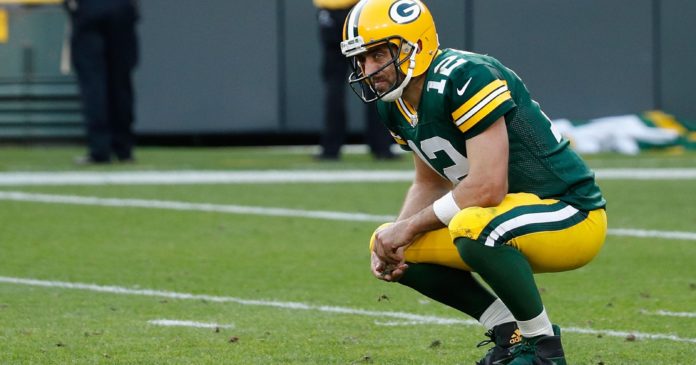
Chicago Bears fans love it when anything negative happens to Aaron Rodgers. Poetic justice for all the years he tortured them. This particular offseason has been a rough one for him. The Green Bay Packers quarterback had his first losing season as a starter since 2008. His offensive coaching staff was blown up and a new head coach hired that he had no say in.

If that weren’t enough, his Milwaukee Bucks blew a 2-0 series lead in the Easter Conference Finals against Toronto. All while he was exposed as a terrible chugger of beer. So things haven’t exactly gone his way. Yet the status quo remains largely unchanged. Rodgers is still viewed by the majority of the wider NFL as an elite quarterback. Maybe the best in the league.

That didn’t seem to sit well with Seattle Seahawks insider Ben Baldwin. The Athletic reporter decided to shine a light on this myth that Rodgers is anything like the players he was five years ago. He has regressed instead to a really good quarterback hiding behind his past greatness.

Aaron Rodgers doesn’t scare teams like he used to

An initial look at his stats from 2018, one would say Rodgers had another great year. Was it though? Most will focus in on the fact he only threw two interceptions in 16 games. Something that is beyond difficult to accomplish. However, there is a big reason for that. Rodgers threw a lot of passes away last season. A total of 59.

Most will say that was just him protecting the ball. Others argue that he wasn’t willing to take more chances. Remember the Packers finished 9th in passing. That may sound good, but they were 3rd in passing attempts. This leads one to think they weren’t as efficient through the air as you’d think. In the final 10 games of the season, Rodgers topped 300 yards passing just twice.

The offense scored 17 points or fewer in five of those games, including the one that knocked them out of the playoff hunt against the Bears in Chicago. A game where Rodgers threw one of his two interceptions at the absolute worst possible time. This is why simple numbers never tell the entire story.

Bart Starr Was a Legend, an Icon, and Hated Passing Against the Chicago Bears

bart starr
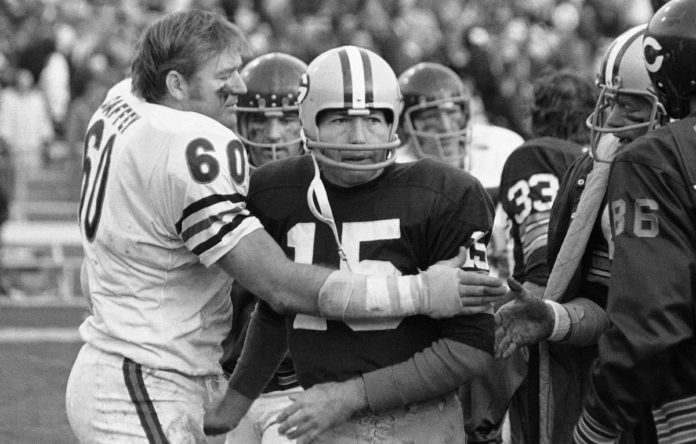
FILE - In this Nov. 16, 1970, file photo, Chicago Bears' Lee Roy Caffey (60) congratulates Green Bay Packers quarterback Bart Starr after Starr scored the winning touchdown at a football game in Green Bay, Wisc. Starr, the Green Bay Packers quarterback and catalyst of Vince Lombardi's powerhouse teams of the 1960s, has died. He was 85. The Packers announced Sunday, May 26, 2019, that Starr had died, citing his family. He had been in failing health since suffering a serious stroke in 2014. (AP Photo/PJS)

The NFL lost one of its all-time greats today. Bart Starr, former Green Bay Packers quarterback who led the franchise to five NFL championships and two Super Bowl titles passed away at 85-years-old. His health had been dealt a serious blow back in 2014 when he suffered a massive stroke. It appears he caught an illness recently and it ended up taking what he had left.

There is nobody who can deny Starr was a legend. Not only a tremendous player and leader, but one of the nicest human beings on the planet. Someone who carried himself with grace, humility, and respect. However, when it came to the rivalry with the Chicago Bears? Starr has certain memories he’d probably prefer to leave buried.

Like many Packer quarterbacks, Starr had his good days against the Bears. However, there weren’t many of them. Chicago tortured him quite often. In fact, two of the worst games of his career took place against his arch rival. Games that people never would’ve thought the game-managing Hall of Famer was capable of.

Bart Starr had the better teams but it rarely on his stat sheet

Starr only threw four or more interceptions in a game five times in his career. For somebody who played in the 1950s and 1960s, that’s pretty impressive. Two of those games though came against the Bears. The first was in 1960. It was opening day at Lambeau Field. Expectations were high for the Packers. Then Starr got things off to a rocky start. He completed just 8-of-22 passes for 36 yards, two interceptions, and a 7.4 passer rating.

Starr was also knocked out of the game with injury and didn’t return for a month.

Three years later, the Packers opened at home against the Bears again. They were defending NFL champions and had beaten Chicago a combined 87-7 the previous year. Starr ended up paying the price for that humiliation. Not only was he hit and sacked frequently, he threw a then-career high four interceptions. The Bears held Green Bay to just three points, their lowest mark of the Vince Lombardi era.

If Eddie Jackson is Ed Reed to Chuck Pagano, This is Ha Ha Clinton-Dix

ha ha clinton-dix

Even before the arrival of Chuck Pagano, there were people who compared Eddie Jackson to Hall of Famer Ed Reed. It was such an easy thing. They both had similar body types, speed, athleticism, range, and elite ballskills. Still, Pagano was the man who helped transform Reed into a star at Miami and then oversaw the second half of his career in Baltimore.

If anybody could offer a valid opinion on whether Jackson is like Reed, it’s him. Surprisingly, Pagano embraced the idea. He didn’t try to downplay anything. From a pure talent perspective, the two are much alike. There is still plenty of ways for Jackson to improve, but that is natural for a young player. At his current trajectory, there is no telling how good he’ll get.

“From a talent standpoint? Very, very similar. Great instincts. Great range. Great ball skills. He’s only three years into it. Ed has a lot more time on task, obviously. He’s got a lot of the same traits. He loves football. He’s a football junkie. And again, the sky’s the limit for a guy like that.

When you know the defense and you know what you’re doing and then you can spend all your time figuring out the offense and being one step ahead, that’s where he’s got an edge on everybody. He’s very similar to Reed.”

A more interesting question though isn’t if Jackson is like Reed. It’s who is Ha Ha Clinton-Dix supposed to be?

Chuck Pagano likely sees familiar traits in Ha Ha Clinton-Dix

Remember that Pagano had a strong voice in the acquisition of Clinton-Dix during free agency. Granted, it was Ryan Pace, Jackson, and Mitch Trubisky who made the big sales pitch but it will be Pagano’s system he plays in. So what type of player did the veteran coach see in the safety? Looking back over his long career in the NFL, there is one name that fits.

Most NFL fans might not remember the name Bernard Pollard. Strangely, he had a somewhat similar career to Clinton-Dix. He was a former high draft choice (2nd round) in Kansas City. After some initial success he was let go to join another team in Houston. After a brief stint with them, he found his way to Pagano and the Baltimore Ravens in 2011.

Pagano’s first year as a defensive coordinator.

Pollard went on to have one of the best all-around seasons of his career. Somebody who showcased a mix of coverage prowess and a physical presence around the line of scrimmage. He finished with 75 tackles, 2 sacks, 3 forced fumbles, an interception, and 13 passes defended. A year later, he helped the Ravens win the Super Bowl.

Pollard and Clinton-Dix have similar build. Both are 6’1 with longer limbs and good athleticism. Pollard was a bit heavier at 225 lbs but Clinton-Dix is faster. Either way, it’s clear Pagano has seen this type of football player before. When he was paired with Reed in Baltimore, magic happened.

Leonard Floyd Wouldn’t Be the First Late-Blooming Pass Rusher

leonard floyd

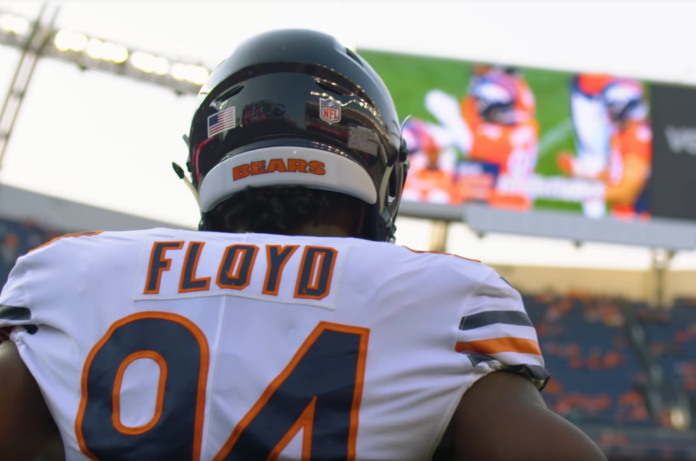
A lot of people out there, this writer included aren’t the biggest believers in Leonard Floyd. It’s not hard to understand why. The young man was drafted 9th overall in 2016. He was selected in the belief he’d become the next franchise pass rusher for the Chicago Bears. After two years, the waiting continued. Problems surface. Setbacks kept happening.

GM Ryan Pace couldn’t afford to wait on him any longer. The Bears traded for Khalil Mack in the late summer of 2018. While the star rusher issue had been solved, the waiting on Floyd continued. He’d broken his hand in the preseason, adding to the list of his health issues. As a result, he failed to register a sack through the first half of the season.

He would finish with just four, his worst total to date. All told Floyd has 15.5 sacks across three years. Not exactly inspiring numbers. It’s hard not to wonder if Floyd will ever turn the corner in his career. Thankfully there’s evidence out there to believe this should happen, and happen soon.

Leonard Floyd isn’t first pass rusher who’d get a late start to his career

Typically, most pass rushers turn the switch on in their careers around Year 3. Some get started sooner of course but that is the general trend when looking at the list of top sack artists in NFL history. However, scattered amidst those greats are other players. Those who took a bit longer than normal to get it going, whether it be due to injuries or position switches or simple lack of progress.

Leonard Little
  • First 3 seasons – 5.5 sacks
  • Next 3 seasons – 39 sacks
Robert Porcher
  • First 4 seasons – 17.5 sacks
  • Next 4 seasons – 49 sacks
Jacob Green
  • First 3 seasons – 3 sacks
  • Next 3 seasons – 42.5 sacks
Simon Fletcher
  • First 3 seasons – 10.5 sacks
  • Next 3 seasons – 32 sacks
Clyde Simmons
  • First 3 seasons – 16 sacks
  • Next 3 seasons – 36 sacks

All of those men finished with 87.5 sacks or more in their NFL careers. It should be proof that slow starts don’t automatically mean having a productive career as a pass rusher is out of the question. Far from it. Floyd has always flashed the ability to do it. The issue is a mix of staying healthy and learning how to use all of the tools available to him with consistency. There is no reason to think that can’t happen in 2019.

Why The Matt Nagy Offense Should Take a Big Step Forward

rich eisen

The Matt Nagy offense didn’t disappoint in 2018. Despite loads of new moving parts, it showcased plenty of instances of how good it could be. The complex formations. The creative playcalling. A mix of old school and new wave. The Chicago Bears head coach demonstrated a taste of things to come. People are left wondering what he might have in store for Year 2.

There’s plenty of optimism around Halas Hall. The belief is the added experience of a full season combined with a deeper and more versatile depth chart means big things for this offense in 2019. Remember this is a group that finished 21st in total yards and 9th in scoring. There is plenty of room for improvement. Will it happen though?

There are no such things as guarantees in the NFL, but history can often paint a clear picture on subjects like this. So it was time to dig into the research to see if there’s any correlation with the situation Nagy faces and those who’ve been through it before.

Matt Nagy offense has history on its side going into 2019

I decided to look back over history at previous offensive head coaches. The idea was to find those who fit two criteria. They had to call their own plays and they had to have consistency at the quarterback position. Then it was a matter of determining whether there was any significant spike in offensive production, be it in total yards or scoring. The results were fairly consistent.

  • Sean McVay in 2017: #10 (yards)
  • Sean McVay in 2018: #2 (yards)
  • Doug Pederson in 2016: #22 (yards)
  • Doug Pederson in 2017: #7 (yards)
  • Jay Gruden in 2014: #26 (scoring)
  • Jay Gruden in 2015: #10 (scoring)
  • Mike McCarthy in 2006: #22 (scoring)
  • Mike McCarthy in 2007: #4 (scoring)
  • Jon Gruden in 2002: #18 (yards)
  • Jon Gruden in 2003: #10 (yards)
  • Mike Shanahan in 1995: #9 (scoring)
  • Mike Shanahan in 1996: #4 (scoring)

There were some exceptions, mind you. Sean Payton went from #1 to #4 in scoring from 2006 to 2007. Andy Reid went from #6 to #16 in scoring from 2013 to 2014 in Kansas City. However, it’s worth noting he went from #25 to #12 in Philadelphia back in 1999 and 2000. So he offers some confirmation to the theory as well.

This is strong evidence that Nagy should be able to improve substantially on what he accomplished last season. The key of course will be good health at quarterback. Other offensive head coaches who didn’t make the list saw their second seasons ruined by injuries at that position. Something to keep in mind.