Mitchell, a 21-year-old right-handed defenseman, signed his entry-level contract with the Blackhawks while the 2019-20 regular season was “paused” due to the COVID-19 outbreak.
The Chicago Blackhawks may be getting a huge boost to their defense for their best-of-five play-in series against the Edmonton Oilers. Not only is shutdown defenseman Calvin de Haan expected to be healthy for the series, but top prospect Ian Mitchell could also be deemed eligible to join the team for the postseason.
TSN’s Darren Dreger announced on Thursday that the NHL is expected to push back the June 1 entry-level signing deadline another month so the NHL and NHLPA can negotiate the possibility of entry-level players signed during the COVID-19 pause joining their teams for the 24-team postseason.
Expect the NHL and NHLPA to push back the June 1 signing deadline one month. The league and PA need more time to negotiate possibility of entry level players like Alex Romanov being allowed to play when/if 2019/20 season resumes.
Mitchell, the Blackhawks second-round pick (57th overall) in 2017, has spent the last three seasons playing college hockey with the University of Denver Pioneers. In 2019-20, he served as captain of the Pioneers en route to career-highs in goals (10) and points (32) through 36 games. Denver was also ranked sixth in the national rankings when the season was shut down in March.
All in all, Mitchell was quite impressive during his college hockey career. The St. Albert, Alberta native finished with 89 points (18G, 71A) in 116 games as a Pioneer and won a national championship as a freshman in 2017-18. If Mitchell does get ruled eligible for the 24-team postseason, it’s likely that the Blackhawks insert him into the lineup for Game 1 against the Oilers.
For more Blackhawks news and updates, follow the author (@JackBushman2) on Twitter. Make sure to check out the author’s podcast, Talkin’ Hawkey, which can be found on Apple Podcasts, Spotify, and Twitter (@TalkinHawkey).
Almost immediately after Arturas Karnisovas took over as Executive VP of the Chicago Bulls, his first major decision was firing Gar Forman as GM. The only thing he said about it was the two just didn’t share like-minded philosophies. People will think that this is the extent of Karnisovas’ involvement in the demise of Forman from former Executive of the Year to one of the most reviled front office men in Bulls history.
That actually isn’t quite true.
The true starting point took place back in 2014. Keep in mind, this was a time when Forman still had a firm grip on his job. He’d built a perennial playoff contender and seemed untouchable. However, the Bulls still weren’t quite good enough to make a deep run. So he decided to make a bold move in that year’s draft. A move Greg Swartz of Bleacher Report called the worst mistake the franchise has made in the past 20 years.
“Doug McDermott was one of the best players in men’s college basketball, and Chicago didn’t feel the Creighton product would be available at their draft spot.
In order to move up, the Bulls traded both of their 2014 first-round picks and a 2015 second-rounder to the Denver Nuggets for the rights to McDermott at No. 11.
The Nuggets used the two firsts to take Jusuf Nurkic and Gary Harris, while players like Nikola Jokic, Clint Capela, Spencer Dinwiddie, Joe Harris and Jordan Clarkson were still on the board.
While Nurkic and Harris have become valuable starters for the Portland Trail Blazers and Nuggets, respectively, McDermott averaged just 8.2 points per game in two-and-half seasons in Chicago.”
Arturas Karnisovas helped break Forman’s grip with McDermott trade
One great thing about sports is it’s impossible to predict the crazy connections that develop over time. Denver completely fleeced the Bulls in that trade. The assistant GM who helped make that happen? Yep, Karnisovas. It can’t be understated how disastrous that move was in hindsight. Missing out on a clear stud in Nurkic was bad enough because they could’ve just stayed put. Yet they even drafted the wrong small forward. T.J. Warren went to Phoenix just three picks later. He’s averaged 15.2 points per game for his career.
Almost double McDermott’s 8.2.
That move only continued to haunt Forman not long afterward. In February of 2017, he sent McDermott, Taj Gibson, and a 2nd round pick to Oklahoma City for Cameron Payne, Anthony Morrow, and Joffrey Lauvergne. None of them did anything in Chicago and only helped speed up the team’s decline.
Meanwhile, Denver used that trade to help build the foundation for their recent resurgence as Western Conference contenders. That success led to his eventual union with the Bulls and in a bitter twist of irony Forman’s final demise. Sports can be so cool.
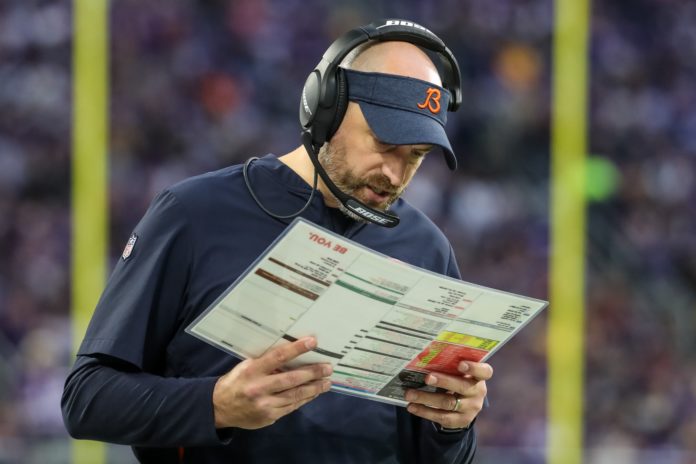
CHICAGO, ILLINOIS - DECEMBER 22: Head coach Matt Nagy of the Chicago Bears stands during the National Anthem with Mitchell Trubisky #10, and Kyle Fuller #23 before a game against the Kansas City Chiefs at Soldier Field on December 22, 2019 in Chicago, Illinois. The Chiefs defeated the Bears 26-3. (Photo by Jonathan Daniel/Getty Images)
Dhruv Koul (Twitter: @DhruvKoul) answers your questions in his weekly Bears Mailbag.
Thanks to everyone who submitted questions! Always appreciate the participation. Let’s dive in.
Mailbag
He was not brought here to develop Mitch. He was brought here to be the head coach of the Chicago Bears, and he's gone 20-12 in his first two season with an NFC North title to his name. That's why he isn't (at least publicly) on the hot seat.
Here’s a question — why are some so quick to dismiss Matt Nagy’s 12-4 record in 2018 just because it was largely defense-driven? Who makes a similar distinction of success when it comes to coaches like Bill Belichick (defensive coach, record-breaking offenses), John Harbaugh (offensive coach, suffocating defenses), and the like?
The head coach is the HEAD coach — responsible for the whole team.
Fuller is a proven beast at CB and Johnson is a rookie. Despite Johnson's physical press ability vs. Fuller's desire to play off, I'd expect #1 receivers to line up across Johnson to start off.
I've been similarly confused and have talked about this in my last couple of Mailbags. There seems to be some sort of desire to write shock-value items, as many in the media have shown. This roster can be sleeping on game day and still win six games.
Plenty of reasons. COVID-19 has changed free agency quite a bit. Player demands are another factor. Teams' ability (or inability) to verify medical status is another. Some of these players may not sign until later in the summer with OTAs not being a thing.
Some of it is luck (Cutler, McMahon). Most of it is scouting.
Keep in mind — there are VERY few QBs that are truly transcendent talents (Brady, Mahomes, Ryan, Stafford). Many are serviceable/productive in the right scheme, but it doesn't make them "good".
The Chicago Bears were faced with a tough decision when the 2020 offseason began. They had limited salary cap space and a number of roster issues that needed fixing. They also had two quality inside linebackers who were becoming free agents. One was an older veteran but team leader Danny Trevathan. The other was rising youngster Nick Kwiatkoski. Both had played really well in 2019. Both undoubtedly expected to be starters this year. So the Bears had to pick one to keep with full knowledge the other was going to walk.
In the end, they went with Trevathan, handing him a three-year extension. While Kwiatkoski had the advantage of youth, the Bears seemed to feel Trevathan offered more in terms of leadership and athleticism. Kwiatkoski quietly exited in free agency and signed a nice three-year deal to join the Las Vegas Raiders as a starter. It was a great outcome for him.
The full story though is a bit deeper. During an interview with Tashan Reed of The Athletic, the linebacker talked about how he rose from 4th round pick to backup and now a starter. When the subject of free agency came up, he indicated the Trevathan extension news didn’t reach him until it went public.
Kwiatkoski didn’t know what was going to happen after the season. He knew he’d played well but he was aware the Bears didn’t intend to hold onto both him and Trevathan. When they signed Trevathan to a three-year extension on March 12, the writing was on the wall.
“It was a unique situation in Chicago and, honestly, I had no idea,” Kwiatkoski said. “As it came closer to free agency, it kind of played itself out and I knew I was going to have to go somewhere else.”
Nick Kwiatkoski still loves the Bears but his exit could’ve been handled better
This is another reminder that the NFL is a cold business. Kwiatkoski did everything he could to show the Bears he could be their long-term starter. Unfortunately, Trevathan’s status on the team was just too strong. Yet one would think GM Ryan Pace, the guy who traded up to draft him in 2016 might’ve at least placed a courtesy phone call to warn him that the extension was in the works.
It’s doubtful that was done out of any sort of malice. More likely the Bears just wanted to get the deal done quickly before free agency began. Warning Kwiatkoski wasn’t a priority. Harsh, but true. In the end, the guy can’t complain too much. He ended up getting a nice deal from the Raiders and will play in a brand new stadium in a much warmer climate down in Vegas.
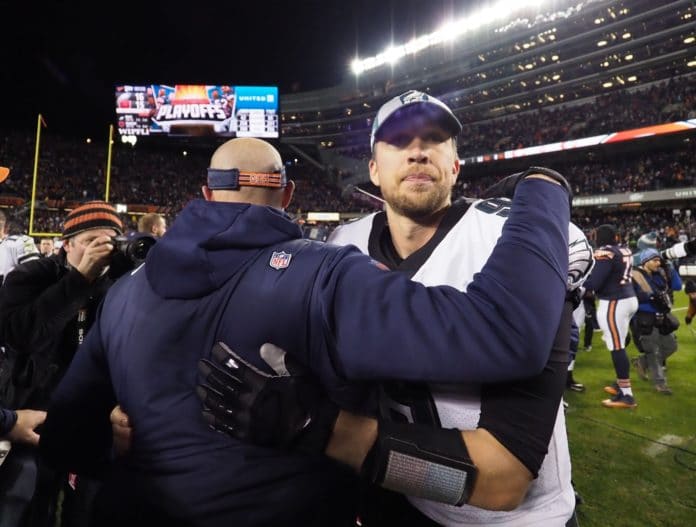
Let’s not get things twisted here. When the Chicago Bears traded for Nick Foles back in March, it was not a move driven by GM Ryan Pace. This was a decision championed by head coach Matt Nagy. The reasoning is obvious. The two have a history dating back to 2012 in Philadelphia and they reconnected for a year in 2016 with Kansas City. Nagy knows what Foles brings to the table and undoubtedly feels the QB can run his offense at a high level.
While Mitch Trubisky has a fair shot at keeping his spot, pretty much everybody of any note in NFL circles believes it’s Foles’ job to lose. His connection to Nagy and others on the staff along with that ring on his finger is just too hard to ignore. However, if it does play out that way there is one part of the scenario that comes with a double-edged sword. Kristopher Knox of Bleacher Report pointed it out when detailing why the Foles move was the smartest of the Bears offseason.
“This brings us to the trade to acquire Nick Foles from the Jacksonville Jaguars, which was a sharp move for a couple of reasons. For one, Foles should either push Trubisky or take over the starting job himself—theoretically increasing the odds of a successful season in 2020.
Additionally, Foles can help give the Bears a better idea of whether Trubisky is holding back head coach Matt Nagy or if it’s the other way around. If Foles plays significant snaps and Nagy’s offense still regularly stalls, then the Bears might be prompted to give Trubisky a shot with someone else running the show.”
Nick Foles will either validate Nagy or destroy him as an offensive mind
This is a persistent argument many Trubisky supporters have made. That it wasn’t him who was the problem last season. They believe Nagy routinely made things more difficult than necessary with inconsistent play calling. This includes a lacking commitment to run the football, a love affair with “cute” play designs in short yardage, and a stubborn refusal to play more to Trubisky’s strengths.
This of course glosses over how many times Nagy got guys wide open that the QB missed. Or Trubisky’s average-at-best ability to read Run-Pass Option situations. So it’s a tug-of-war on who the real source of the problem was. By trading for Foles, it is clear Nagy wants to make his case that having the right QB can make his system run the way it was intended.
So what if it doesn’t work?
Well, that will all but seal the coach’s fate. He was hired to win football games to be sure, but primarily to solve the Bears’ longstanding issues at fielding capable offenses. In two years thus far, he’s failed to crack the top 20. If he can’t do that with his own handpicked guy? His time in Chicago is probably done.
Former Chicago Bears first-round wide receiver Kevin White has been in the news this week following an interview about his playing time while in Chicago. White spoke in-depth with NBC Sports Chicago’s JJ Stankevitz regarding the injuries that limited his career and his playing time with the Bears. Although Bears fans are quick to lump him with other Bears first-round picks that turned out to be busts including wide receiver David Terrell, the former West Virginia wide receiver doesn’t deserve to be associated with that group.
Former Chicago Bears first-round draft pick Kevin White told @JJStankevitz that he "loves Chicago" and that he is "sorry for all the unfortunate events."
White: "I just wish I could’ve gave the city of Chicago the talent that they drafted. They have great fans."
— Daniel Greenberg (@ChiSportUpdates) May 26, 2020
White and Terrell both had parallel careers with the Bears as they were both top-ten draft choices, were viewed as the best receiver in their draft class, and had their best seasons cut short by significant injuries. Heading into the 2015 NFL draft, Chicago needed to draft a wide receiver due to the departure of All-Pro wide receiver Brandon Marshall. White appeared to be that receiver as many draft analysts were comparing his potential to that of All-Pro Julio Jones.
Back in 2001, The Bears had many needs on both offense and defense. The team failed to live up to expectations in 2000, winning just five games. Although Chicago had a reliable receiving group in place already with Marcus Robinson, Marty Booker, and Dez White, the team decided to use the eighth overall selection in the 2001 NFL Draft on Terrell. The Michigan wide receiver was the best talent available as Chicago passed on several defensive players and wide receivers that would go on to have Pro-Bowl careers.
Terrell and White’s time with the Bears were intriguing, as both players were vastly different from one another. The 2001 first-round pick instantly rubbed fans the wrong way when he held out at the start of training camp in his rookie season. Furthermore, Terrell was very open when it came to celebrating every catch, as was the norm with a majority of wide receivers in the early 2000s. He would go on to have somewhat of a disappointing rookie season catching 34 passes for 415 yards and four touchdowns. When the team lost their top receiver in Robinson early in the season, it was Booker that stepped up, and not Terrell.
In 2002, Terrell looked like he was ready to become the big-play receiver that the Bears envisioned. He caught nine passes for 127 yards along with three touchdown catches in the first five games of the season. Oddly enough, his longest reception of the season would be his last as he broke his foot after hauling in a 52-yard reception against Green Bay in week 5. In his final two seasons with the Bears in 2003 and 2004, Terrell would average just one touchdown, 42 receptions, and 530 reception yards.
Chicago would move on from Terrell following the 2004 season. He would go down as one of the worst draft picks in Bears’ history. What makes his Bears career even more frustrating was that Terrell was given all the opportunities to prove himself as a top-tier receiver and failed to do so. In an interview with Pro Football Talk in 2013, the former Michigan receiver blamed his poor career with the Bears on the quarterbacks he played with at the time.
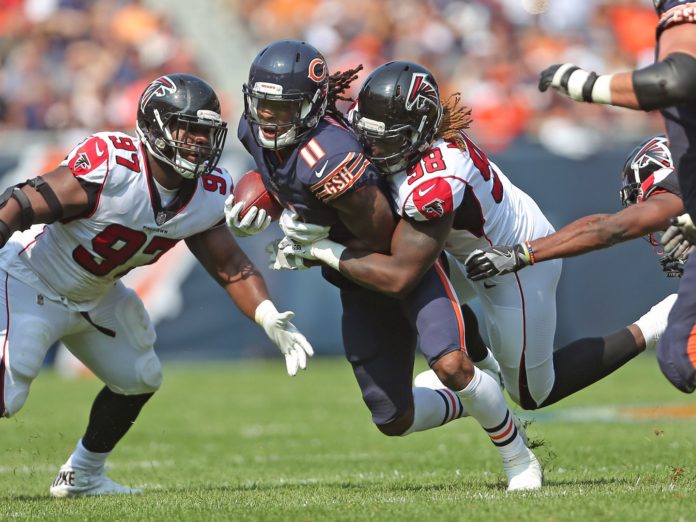
White, on the other hand, had the opportunities available to him, but could not take advantage due to bad misfortune. He missed his entire rookie season due to a stress fracture, missed 12 games of his second season with a broken ankle, and had his 2017 season end in the season opener against the Falcons following a broken shoulder blade. He played sparingly in 2018 under head coach Matt Nagy as it appeared that the new head coach had no role for the wide receiver. White’s best season came in 2016 when he caught 19 passes for 187 yards. In the two games leading up to his injury that season, he caught six passes in each of his last two games, appearing ready to take the next step.
It is disappointing that White’s career with the Bears did not work out, but unlike Terrell, it wasn’t due to a failure in talent or character. Chicago’s 2015 first-round selection suffered several freak injuries that robbed him of showing the team and the city what he was capable of when healthy. In the few catches White had in his last season with the Bears, fans were able to see glimpses of the talent he once possessed. Terrell demonstrated on several occasions that the team simply missed on their draft selection of him back in 2001.
How does Kevin White deal with being labeled a "bust"?
Bears’ football is filled with players who failed to live up to their draft potential, and it was shown the moment they got on the field. Although White couldn’t live up to the enormous draft expectations set for him, he doesn’t deserve to be associated in the same group that includes Cade McNown, Curtis Enis, and Terrell. Even after his time with the Bears, the former 2015 pick blames himself and felt the need to apologize for not being successful, something the 2001 draft selection failed to due.
The Chicago Bears offensive line took a beating from fans and the media last season. This shouldn’t be a surprise. When an offense finishes 29th in the NFL for a season, odds are the blocking is going to be a central focus of frustration. Pass protection was leaky but the run blocking was a true sight of horror. David Montgomery and Tarik Cohen almost always seemed to have defenders in their face before they even reached the line of scrimmage. Perhaps the two men who endured the most flak were tackles Charles Leno and Bobby Massie.
After both of them had strong showings in 2018, their regressions last year were impossible to miss. It led many to think that both were actually bad and they just happened to have a decent year. However, Pro Football Focus has come to the defense of Massie. Their writer Ben Linsey argues that while the big veteran isn’t always great, he does have one thing going in his favor.
When the Bears have needed him in crunch time, he always delivers.
“Massie missed several games last season with injury and put up a 63.2 grade in total, but he graded out better than any other qualifying right tackle in the fourth quarter and overtime of one-score games. Even then, his performance in pass protection was serviceable rather than stellar. Actually, it was the several nice blocks that moved defenders on double teams in the run game that boosted his overall grade to the top of the top right tackle position.
Next year is a big opportunity for Massie to show that he can be an above-average starter on that Chicago offensive line, capable of marrying the improved pass protection he showed in 2018 with the run-game ability he has flashed at times throughout his career.”
Bobby Massie can still play good football if healthy
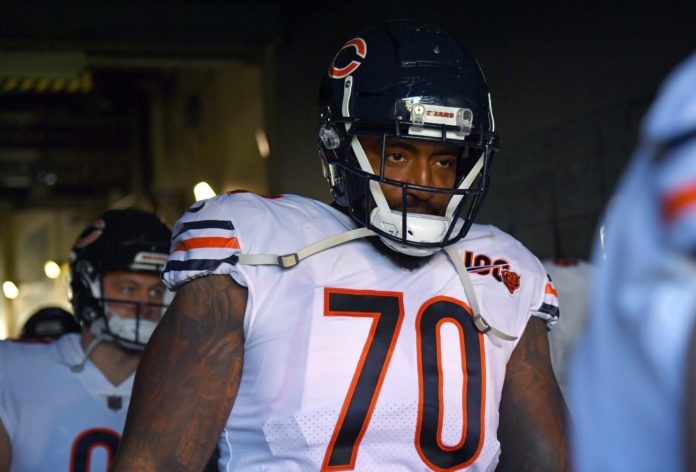
Nobody is saying Massie is a star, but then again he doesn’t have to be. The Bears just need good enough. He should be healthy again in 2020. His return coupled with the possible starting of Germain Ifedi at right guard does do one thing. It opens up the possibility of reinvigorating the run game. Massie is a punishing run blocker and Ifedi showed he could be as well in spurts during his time in Seattle. Both are big, strong, and nimble for their size.
If Matt Nagy does commit to the ground attack more this year, then those two will be key. If nothing else, it’s nice to know Massie always makes sure to deliver his best when the Bears need it. If they want to make a run this year, that is the type of play they will need. Not just from him but the rest of the offense in general.
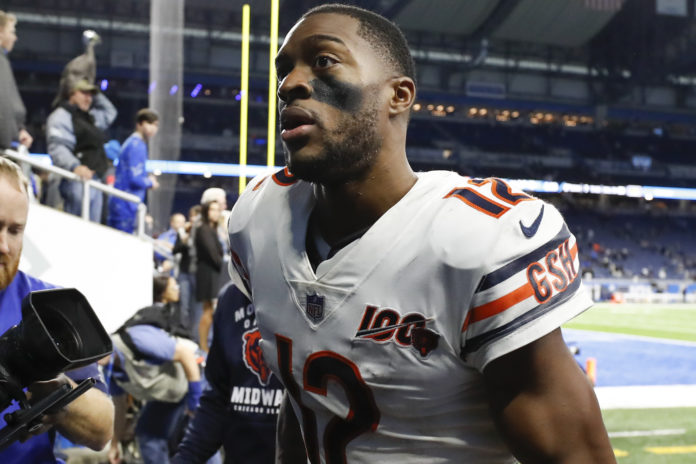
Nov 28, 2019; Detroit, MI, USA; Chicago Bears wide receiver Allen Robinson (12) walks off the field after the game against the Detroit Lions at Ford Field. Mandatory Credit: Raj Mehta-USA TODAY Sports
Just a few months ago, there was jubilation around the NFL world when a new Collective Bargaining Agreement was forged. One that planned to take full advantage of new television deals and the rise of legal sports gambling to bring in more revenue. This was expected to deliver a sharp increase in the overall salary cap starting in 2021. Something GM Ryan Pace and the Chicago Bears could’ve taken advantage of with contract extensions and pursuing outside free agents.
Now those plans are in jeopardy. Belief is that unless the league is somehow able to pack out stadiums with fans this season, teams stand to loses millions of dollars. Perhaps as much as $100 million per club. Given the current concerns with COVID-19, the idea of full stadiums in the fall don’t seem likely. This has led to fears of the short and long-term financial impacts.
Albert Breer of the MMQB explained that the salary cap could be a major victim.
“The cap is a percentage of total revenue, and losing $100 million per club (I don’t think the number winds up being near that high, but let’s work with it, since it’s a round number) would mean $48 million coming out of the 2021 cap equation. Let’s say then, otherwise, there’d have been a $10 million jump (due to structure of TV deals, etc.). Now, you’re at minus-$38 million. I don’t believe the league or union would go forward like that—it’d mean a bloodletting that would be good for no one.
So I think they’d borrow from future years to flatten it out. So let’s say you spread that out over 2022-24. You lose a little less than $13 million each year. Eventually, with new TV deals and gambling money, that’ll self-correct. But it creates economic uncertainty that’ll make teams more hesitant to do big long-term deals with their own free agents, and certainly more conservative in pursuing other teams’ guys. Which, again, is good for no one.”
Chicago Bears could be forced into some very difficult roster decisions
So think about that. Instead of the cap taking a sizable jump up as expected in 2021, it might instead go down instead. Something that hasn’t happened in the NFL this side of the millennium. Right now the Bears are projected to have somewhere around $24.9 million in cap space next season according to Spotrac. Imagine if $13 million of that had to be taken away? Suddenly what little flexibility they had is gone.
The timing couldn’t be worse too because the team is projected to have no fewer than 28 unrestricted free agents who could hit the market by next March. This includes some of their key players like Allen Robinson and Cordarrelle Patterson. This could force the team into some tough roster decisions regarding pricier contracts. Kyle Fuller, Akiem Hicks, Eddie Goldman, Charles Leno, Jimmy Graham, and Bobby Massie will all be names who could get the ax.
Something to keep in mind as this process plays out.
Matt Nagy was hired by the Chicago Bears for a specific reason. He has a sharp offensive mind. He was groomed by one of the best in NFL history in Andy Reid and showcased a lot of what he could do in Kansas City. One of the things that became clear about him almost right away? Nagy is not a fan of doing the same things too often. Even if those things might be working. This is a man who is striving for defenses to operate with one line in their heads.
Expect the unexpected.
This has led to him calling rather fancy plays in situations that typically demand a straightforward approach. The common term for such moments is getting “cute.” Too often in 2019 these plays ended up backfiring for the Bears and Nagy ended up taking a lot of heat for it. People felt his love for crazy play designs was overriding the need to streamline to offense and make it easier for his players to execute.
Colin Cowherd got the chance to ask him about that on his show The Herd. The head coach explained why he operates that way and where he gets his inspirations from.
Matt Nagy knows he needs to be better but won’t stop innovating
The truth is Nagy understands last season didn’t go well. He was the first to admit his play calling didn’t get the job done. He spent a healthy chunk of the past few months figuring out what went wrong. If that weren’t enough, he overhauled his coaching staff to bring in more veteran experience. Guys who have strong reputations for play design and coaching up offense like Bill Lazor and John DeFilippo. They should be a big help to him.
It’s easy to forget Nagy has only been calling plays for two and a half years. He’s still learning.
Keep in mind Andy Reid started calling plays for the first time when he became a head coach in Philadelphia. He didn’t produce a true top 10 offense until his fourth season. Nagy has a ways to go but he’s shown enough flashes to make one think he can get there. The fact that he understands the NFL is an adapt-or-die business is a good thing. The less a defense knows about what you’re going to do, the better.
Innovation is not a crime. It is imperative. Nagy just needs to learn when and where to use it better.
Chicago Bears players being overlooked is nothing new. The wider NFL media just seems to prefer that way. Or they just don’t take the team seriously since it rarely puts a winner on the field often enough to be relevant. Regardless, that is a bad excuse for ignoring some truly great talents. Obviously Khalil Mack gets his due as does Eddie Jackson. Yet where is the love for Akiem Hicks or Allen Robinson? Both are great and yet rarely get mentioned among the best at their respective positions. However, their snubs pale in comparison to what just happened with Roquan Smith.
Marc Sessler of NFL.com released his list of the 2020 All-Under-25 team. A group of players who come in under the age of 25 who are the best at their respective positions. When the subject of linebackers came up, one would think Smith gets attention being he’s only 23. This was not the case at all. The first choice was the Cowboys’ Leighton Vander Esch, which is fair given how good he’s been. However, it was the second that should instantly send Bears fans into a tirade.
Not only was it not Smith, it was somebody most people haven’t even heard of named Bobby Okereke.
“Many to pick from with Devin Bush, Devin White and Dre Greenlaw showing plenty as rookies. Okereke produced the most complete campaign of the bunch, though, finishing as PFF’s ninth-rated linebacker with an ability to line up all over the field. He’s dynamic in coverage, too, more of a need than ever in today’s NFL. Colts general manager Chris Ballard has an eye for stacking talent in the middle of his defense, pairing Okereke with alpha dog Darius Leonard to cause a special blend of havoc in Indy.”
It is a crime that Okereke beat out Roquan Smith for that spot
Not only was Okereke chosen over Smith, which is bad enough. It appears the Bears linebacker wasn’t even in the conversation. That is a travesty. Think about this. Okereke played 16 games. He finished with 65 tackles, a sack, and two forced fumbles. Smith, who is the same age remember, had 101 tackles, two sacks, and an interception in 12 games. So he produced more in four fewer games.
Not only that, but Okereke gets lauded for being so good in coverage. Quarterbacks posted a 98.3 passer rating when throwing in his direction last year. They managed just a 75.9 rating when going at Smith, who also didn’t allow a touchdown as Okereke did. What else is there to say? Sessler either intentionally snubbed Smith as part of some personal issue or didn’t do proper research for his piece.
Neither can really be excused. Smith is one of the best linebackers in football under the age of 25. That’s not up for debate. Not being chosen is bad enough. Being dismissed in favor of somebody like Okereke is a joke.