


Let’s not sugarcoat. For ten weeks, the Chicago Bears were bullying people. We were physically imposing our will on defenses, running the rock down their throats, and making Ben Johnson look like the smartest guy in the room. We had an identity. We were tough. We were the team nobody wanted to tackle in the fourth quarter.
And then? The wheels didn’t just fall off; the damn axle snapped, the engine exploded, and the car careened off a cliff into a ravine.
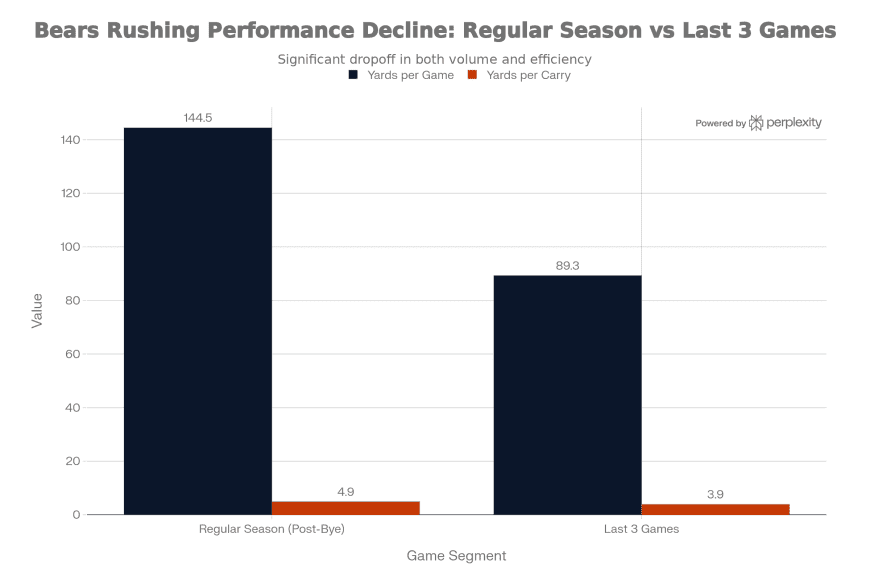
In the span of four weeks — including that heart-attack Wild Card game — the Bears’ rushing attack went from “elite powerhouse” to “anemic joke.” We’re talking about a unit that was churning out 144.5 yards per game suddenly struggling to crack 90. We went from averaging nearly 5 yards a pop to looking like we were running in quicksand at 3.9.
If you’re sitting there thinking, “Well, maybe defenses just adjusted,” stop making excuses. That’s lazy analysis. The reality is much uglier. Through some deep-dive film study and enough analytics to make your head spin, I’ve pinpointed exactly why our ground game died on the vine. It wasn’t one thing. It was a perfect storm of panic, regression, and straight-up failure to execute against teams we should have dominated.
🔥 Subscribe to the Untold Chicago YouTube channel to hear Chicago legends tell stories you’ve never seen in headlines — real moments, real experiences, straight from the athletes themselves.
Grab a drink. We need to have an uncomfortable conversation about what the hell just happened.
The Cliff Dive: By The Numbers
Before we get into the why, let’s look at the what. Because the numbers are frankly disgusting.
From Week 6 to Week 15, the Bears were a machine. We were 3rd in the NFL in rushing yards, 1st in yards before contact (meaning the O-line was parting the Red Sea), and 1st in rushing success rate. D’Andre Swift was eating. Kyle Monangai was the steal of the draft. Life was good.
Then came the final three regular-season games and the Wild Card round.
- Rushing Yards Per Game: Dropped from 144.5 to 89.3. That’s a 38% collapse.
- Yards Per Carry: Plummeted from 4.9 to 3.9.
- First Down Percentage: Went from top-5 elite to bottom-third trash.
We didn’t just regress to the mean; we fell below it. And it happened against the Packers (twice), the 49ers, and the Lions. Three of those four performances were offensive malpractice. So, what broke?
Factor #1: The Panic Button (Game Script Dominance)
Here is the single biggest reason the run game vanished: We stopped trusting it the second we got punched in the mouth.
Ben Johnson’s offense is beautiful when it’s balanced. It’s built on 12-personnel, under-center play-action, and the outside zone. But it requires patience. The moment the Bears fell behind by two scores — which happened in three of the last four games — the coaching staff panicked. They abandoned the identity that got them there.
Look at the splits. When trailing by double digits in the fourth quarter, the Bears went 3-0 this season. Great, right? We love a comeback. But that success is fool’s gold because it conditioned the staff to abandon the run immediately.
- Rushing Play % in last 3 games: Dropped to 35%.
- Passing Play %: Skyrocketed to 65%.
We stopped running to set up the pass and started passing to save our lives. When you become one-dimensional, defenses don’t have to respect the play-action. They pin their ears back. The outside zone runs — which rely on horizontal stretch — don’t work when defensive ends are sprinting upfield to sack Caleb.
In the Wild Card game against Green Bay, we trailed 21-3. We literally didn’t run a single offensive play with a lead until the final two minutes. You can’t establish a ground game when you’re playing catch-up for three hours.
Factor #2: The Interior Softness (Dalman & Jackson)
I love our O-line. They’ve been top-tier all year. But let’s be real: down the stretch, the interior of the line got soft.
Pro Football Focus had our boys ranked highly, but that was mostly for pass blocking. In the run game, specifically the last month, Drew Dalman and Jonah Jackson regressed hard. Ben Johnson’s outside zone scheme relies on the center and guards executing “combo blocks” — double-teaming a defensive tackle and then climbing to the linebacker.
If you watched the tape against the Packers, you saw the issue. Dalman and Jackson weren’t getting that vertical push. They were getting stoned at the line of scrimmage (at least in the first half).
Worse, there were reports of “problematic snap exchanges” between Dalman and Caleb. In an outside zone scheme, timing is everything. If the snap is a split-second late or off-target, the running back misses his landmarks, the linebackers flow over the top, and the play is dead.
We paid these guys to be maulers. In December and January, they played like they were on roller skates.
Factor #3: We Failed to Exploit the Weak
This is the one that pisses me off the most. We didn’t struggle against the ’85 Bears or the 2000 Ravens. We struggled against defensive fronts that were decimated by injuries.
- Packers (Wild Card): No Devonte Wyatt. No Kenny Clark (traded). They were playing practice squad guys on the interior. We averaged 3.3 yards per carry. That is embarrassing.
- 49ers (Week 17): No Nick Bosa. Their D-line was a hospital ward. We managed 110 yards, but on only 22 carries. We should have run it 40 times and broken their will. Instead, we got cute.
- Lions (Week 18): A defense that had regressed all year and allowed 4.5 yards per carry. We put up 3.6.
We had golden opportunities to bully depleted fronts, and we failed. Why? Because we didn’t adjust. Defenses played two-high safeties, daring us to run into light boxes. A competent run game destroys light boxes. We ran straight into brick walls.
That tells me our “schematic advantage” evaporated. Defenses figured out our count system. They started slanting away from our combo blocks, disrupting the plays before they began. And Ben Johnson didn’t have a counter-punch until it was too late.

The Internet on Swift & Monangai
I see the tweets. “Swift is washed.” “Monangai hit the rookie wall.”
Stop it.
This wasn’t on the backs. D’Andre Swift averaged 6.0 yards per carry against the 49ers and 4.5 against the Packers in Week 16. The talent is still there. The burst is still there. But you cannot run through a brick wall if there isn’t a hole.
The metric to look at is Yards Before Contact (YBC). We were #1 in the league for most of the year. In the last month, that number cratered. Swift didn’t suddenly forget how to read a defense. He was getting hit the second he took the handoff.
As for Monangai, yes, 2.3 yards per carry against the Lions is ugly. But again, watch the tape. He was fighting for his life just to get back to the line of scrimmage.
Final Verdict
Here’s the wild part: Despite the run game tripping over its own feet for a month, we’re still here. We survived the Packers. Ben Johnson and Caleb Williams pulled a rabbit out of the hat, and this team showed the kind of grit that defines Chicago football. They refused to die.
Now we’ve got the Rams on Sunday Night in the Divisional Round. This isn’t just another game; it’s a war for a spot in the NFC Championship. We know the Rams have a defensive line that can wreck game plans, so we can’t afford to play from behind again. If we want to dominate — not just survive — we have to rediscover that ground-and-pound identity right now. The Ferrari is still running, we just need to shift it back into gear. Let’s get it done.
Bear Down.


